









Tarfia Faizullah’s poem “Two Days in a Row in November I Died Twice” draws out the word ‘stranger’ three times: “Soft / as the sacred eyes of a stranger / who sees in another stranger a stranger / version of a story / many of us shoulder.”
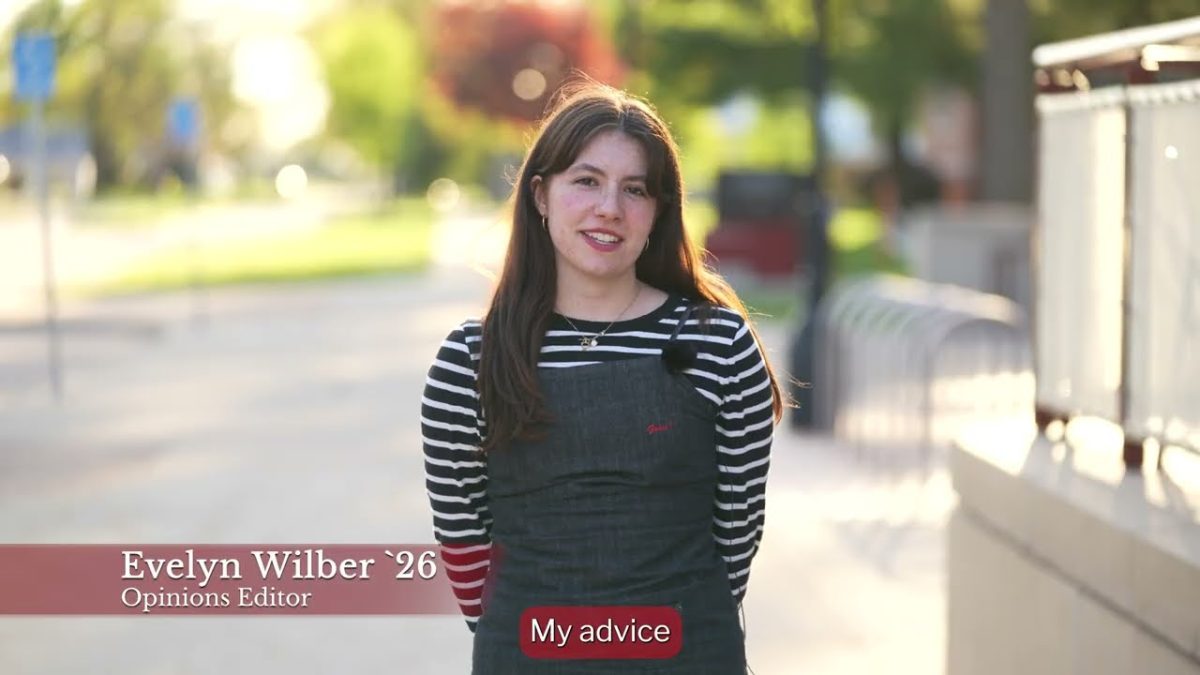
Likewise, some things were stranger about this Writers@Grinnell (W@G) event on Sept. 18 — the first of the fall 2025 lineup. The director of W@G, associate professor of English Hai-Dang Phan, did not introduce the evening reading with a biography of the writer.
Instead, for Faizullah, Phan performed a careful interpretation of her fourteen-line poem. Before the event started, Phan placed a postcard-sized sheet with this poem on the red-cushioned chairs in the Joe Rosenfield ’25 Center (JRC). On the other side of the sheet, there is a hazy photo of Faizullah standing in a sea of near-neon yellow flowers. She is looking at the camera and holding something feathery. In the background, the trees shoot up, scattered about.
The poem opens, “I plan to die for good in the state / of Texas.”
The title of the poem “Two Days in a Row in November I Died Twice” does not exaggerate. Faizullah had a deathly allergic reaction to the painkiller hydrocodone, the medicine for her shoulder surgery. She flatlined twice in two days.
“One way to die for good is to live for the stranger,” said Phan at the end of Faizullah’s introduction.
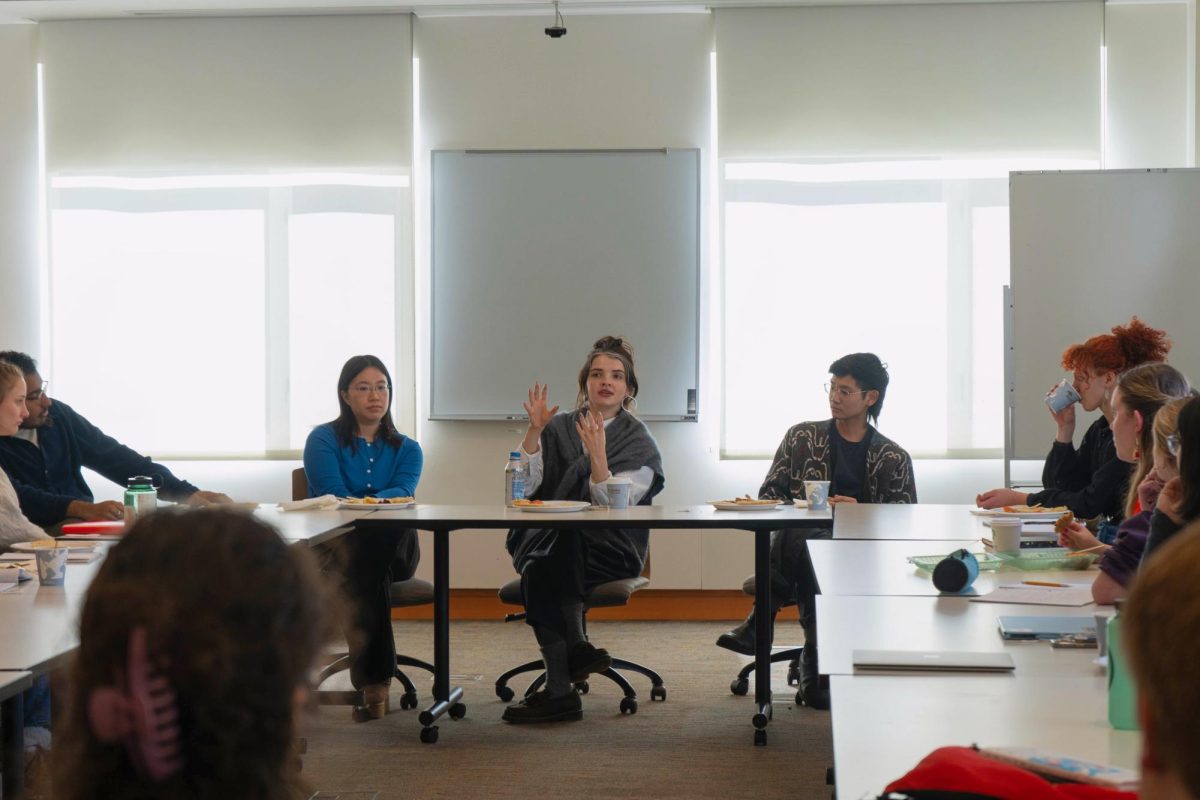
At 4:15 p.m., she was in conversation with Phan for a roundtable discussion at the Humanities and Social Studies Center (HSSC). Faizullah then returned to W@G that evening, nearly eight years after she and fellow poet Jamaal May first spoke at a W@G event, on the concept of metaphor in a place inevitably made stranger by time — Grinnell.
Faizullah was born in Brooklyn, New York. Nine days later, her family moved to Mansfield, Missouri. After three years, her family moved to Midland, Texas. Texas and its mythology — the oil country and the Bible Belt — continue to influence the contents of her poetry. Her family was one of two Bangladeshi families in the area, and she refers to herself as a Bangladeshi Texan.
When Faizullah was younger, she used to write short stories. But her sister’s death, which occurred when her sister was seven and Faizullah was 12, led her from writing “full, complete sentences to words that felt like nonsense.”
“I was feeling wordless for the first time,” she said.
Faizullah went on to receive her Master of Fine Arts in creative writing from Virginia Commonwealth University. During her Fulbright scholarship in 2010, Faizullah went to Bangladesh to speak to survivors of rape and torture endured during the 1971 Liberation War. This is the subject of her first poetry collection “Seam.” She is also author of another poetry collection “Registers of Illuminated Villages,” and currently teaches creative writing and poetry as assistant professor at the University of North Texas.
Faizullah said her third poetry collection, “Aliens of Extraordinary Ability,’” which is still in the works, is attempting new ways of thinking about alienness and ability.
During the reading, Faizullah mainly read aloud new work not yet integrated into a published collection. She read aloud many love poems — one an ode to a beloved’s farts, one to her mother from the perspective of her father, and one about Emily Dickinson and libraries, among others.
One of the poems Faizullah read aloud to her oldest friend, whom she said she still talks to everyday. Their friendship, which Faizullah described as uncanny, began in second grade. In school, they were separated for laughing too much, so, inspired by Madeleine L’Engle’s “A Wrinkle in Time,” they tried to learn telepathy. In the poem, the narrator replaces the word “fragile” with “flower,” producing phrases like “I’m so flower” and “It’s all flower.”
As Faizullah is writing her third poetry collection, she said that she is trying to write about joy, love, her friends and things that feel important to her but are not very edgy.
“I want to write about things being beautiful, even if sometimes the world isn’t,” she said.
Over the years, Faizullah’s personality as a poet has changed — “A moody, solitary writer purposefully feeding and enhancing my sadness, to still moody but public with people,” she said.
“I went from moody, forlorn scribbles to now actively trying to seek out workout buddies but for writing,” she said. “It destroys the romantic ideal of being inside all dressed in black.”
Faizullah said that she shares poetry regularly with Jennifer Chang, another poet who teaches at a university in Texas. One of the poems Faizullah read aloud was about keeping halal in Tennessee. The poem responds to a question Chang asked in her own poem to Faizullah — what are you eating?
She said she is also sharing poetry with her niece in high school, who is becoming interested in poetry.
As Faizullah’s ambitions for poetry have changed, she said her goal recently was to write a poem her mom likes. “I want to write a poem that is accessible to the people I love — for people who are not poetry nerds, not a poet whore like I am. I wanted to still write a poem that had that sort of depth that I crave,” she said.
Faizullah recently read some of her poems from the collection she was working on to her mom. “I hadn’t lost any of the depth,” she said.
W@G anticipates hosting 5 more writers this semester. On Thurs., Oct. 9, environmental essayist Maria Pinto, who writes about mushrooms, will do a roundtable HSSC S1325 and a reading at 8:00 p.m. in JRC room 101. Her visit is co-sponsored by the Environmental Studies Department and the Conard Environmental Research Area. Future W@G events include poet Ahmad Almallah on Oct. 30, novelist Ling Ma on Nov. 6, and a joint reading with poets and multimedia artists Diana Khoi Nguyen and Lindsay Webb on Nov. 20.