


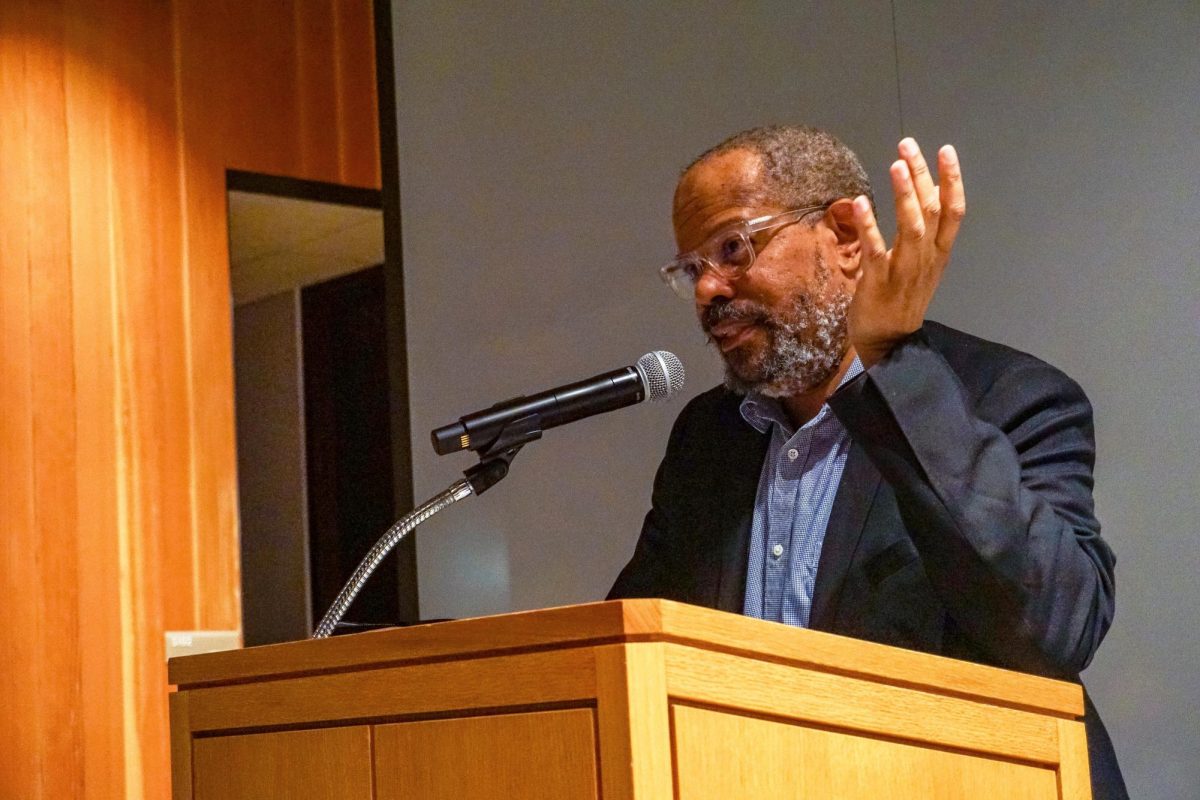








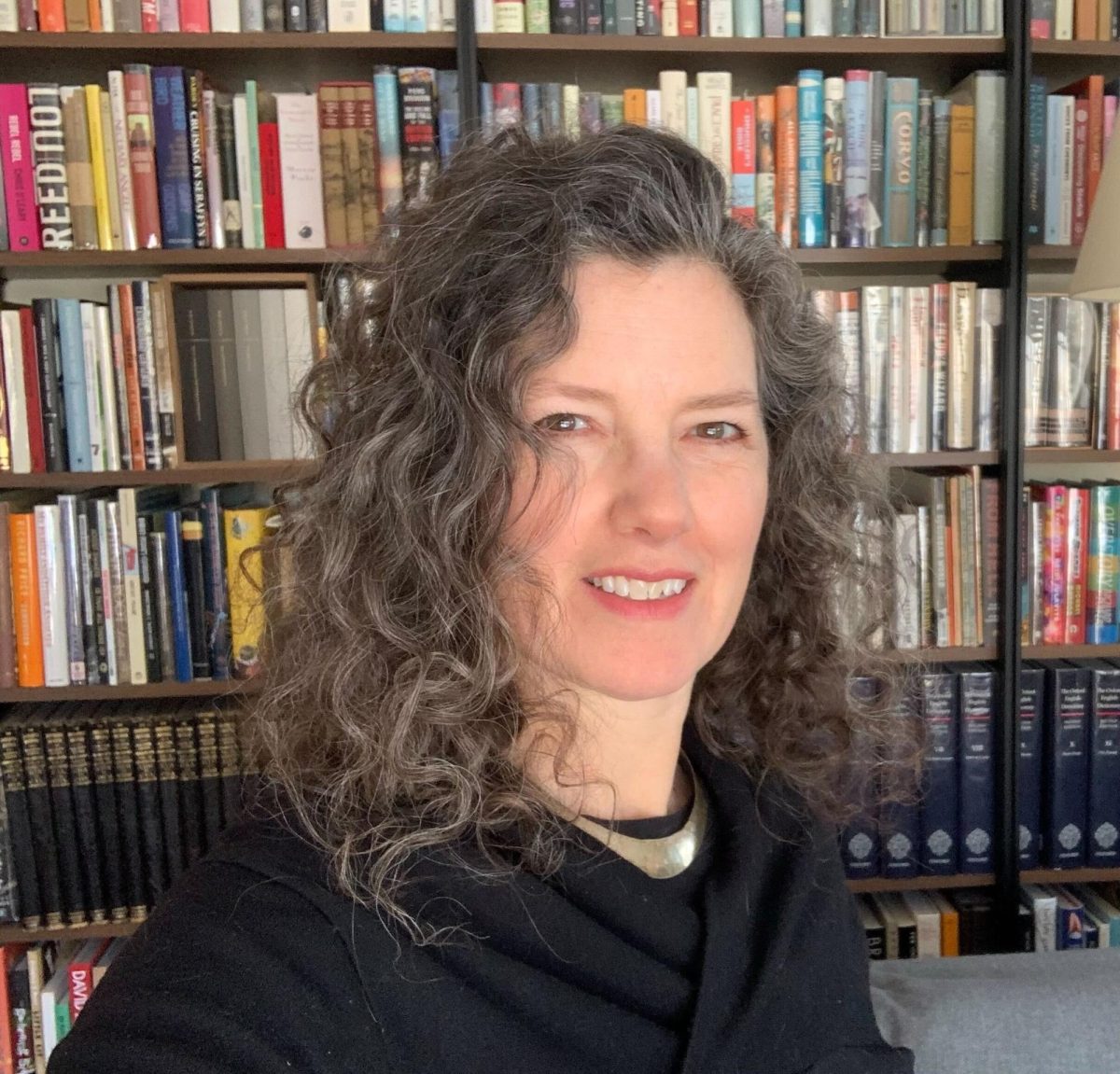





Laughter rippled through the Humanities and Social Studies Center (HSSC) Auditorium on Thursday as writer Shahnaz Habib read from the third chapter of “Airplane Mode,” the opening event in this semester’s Writers@Grinnell series. The book, a satirical anti-travel guide that won the 2024 New American Voices Award from the Institute for Immigration Research, blends humor with cultural critique.
Habib’s essays and fiction have appeared in The New Yorker, The Guardian and Creative Nonfiction. Born and raised in Kerala, India, Habib’s work combines the genres of memoirs, criticism and cultural history. Her English translation of the novel, “Jasmine Days,” won India’s prestigious JCB Prize for Literature. In addition to literary work, Habib teaches writing at Bay Path University and The New School, and works as a communications consultant for the United Nations.
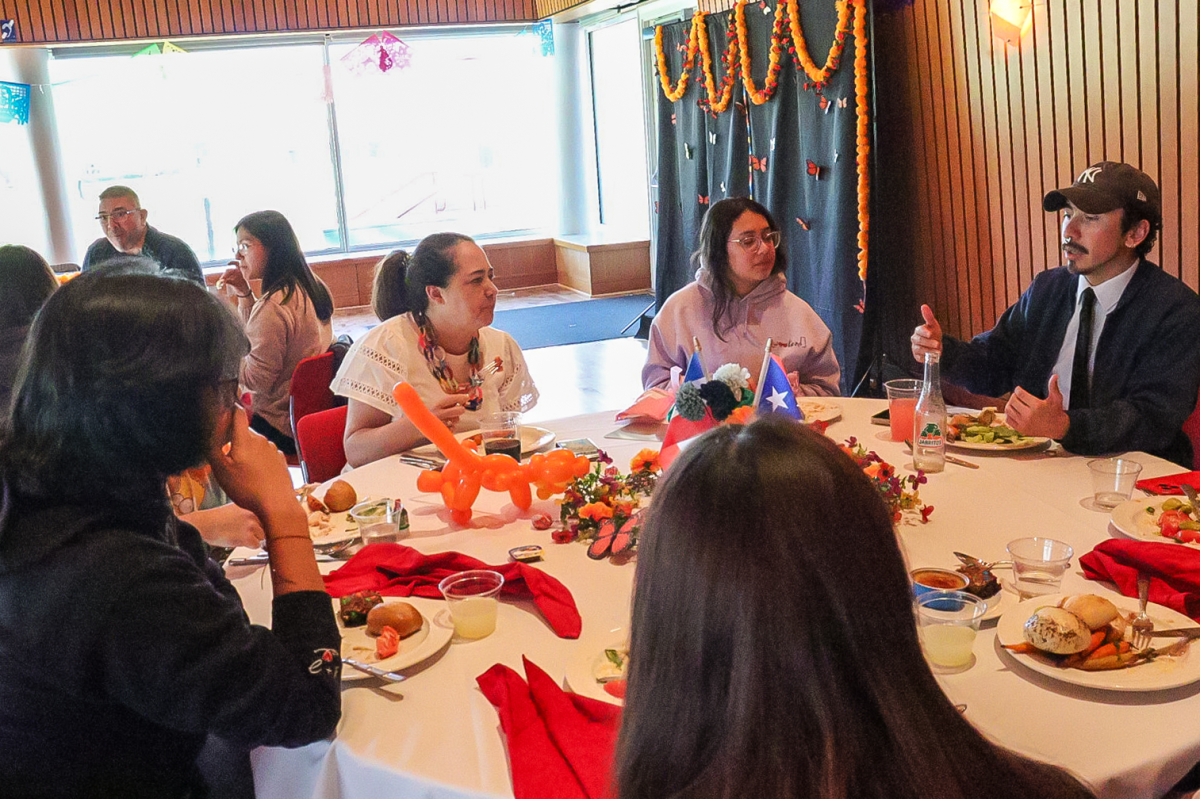
Earlier in the day, Habib met with students and faculty for an informal roundtable discussion. Speaking candidly about her writing process, she described “Airplane Mode” as an attempt to reshape the stories she wished existed when she was younger. “A lot of this book is about trying to find my way toward the books and literature I want to see in the world,” Habib said, noting that many travel narratives she encountered growing up centered on white, Western perspectives.
In an interview with The S&B, Habib emphasized that “Airplane Mode” directly addresses structural inequality within travel culture. “I have a whole chapter about passportism,” she said, referring to how the passport a person holds influences who gets to move freely and whose stories dominate travel writing. “The fact that some passports open so many doors really entrenches the existing power hierarchies.”
Felix Alexander `29, who attended the roundtable, wrote in an email to The S&B that Habib’s openness about her uncertainty during the writing process stood out. “She said she was ‘not the person you should ask’ about revision,” he wrote. “It was great to get a reminder that even published authors still struggle and get writer’s block.”
The roundtable also focused heavily on translation, a practice that shapes both Habib’s career and her writing philosophy. Reflecting on the difficulty of translating cultural nuance from Malayalam into English, she described loss not as failure but as intimacy. “The loss is also such a beautiful loss,” Habib said. “But in encountering that loss, your reading becomes so much richer. You’ve thought about that phrase so deeply that the intimacy you feel with the book, with the words you’re translating, is such a sweet experience.”
Alexander also noted that one of the most memorable moments came when Habib reframed translation as an intensely personal act. “Suddenly you have a deep, private understanding with a word that makes you appreciate and understand the word so much more, and only a translator could possibly achieve this relationship with a single phrase or word,” he wrote. “That was by far the most beautiful and poetic way of explaining translation and the loss it brings I have ever heard.”
Habib also challenged conventional assumptions about travel ethics. “I actually embrace the term tourist,” she said during the roundtable, noting that acknowledging one’s role in larger systems can be more honest than claiming moral distance. “Who gets to be called a traveler, and who is labeled a tourist?”
Themes from the afternoon conversation resurfaced during the evening reading. In an excerpt of “Airplane Mode,” Habib examined travel through stories about family, migration and the politics of movement, including a reflection on her father, a man who she wrote dislikes travel but remains deeply connected to the world through reading. “There are many, many ways to travel,” she wrote, suggesting that intellectual curiosity can be as transformative as physical movement. “But reading is not simply a fat-free, gluten-free version of travel. Reading the world is, for the provincial, an act of self-preservation.”
The audience’s reactions shifted throughout the reading, moving from laughter at wry observations about airports and tourism to quiet attention during passages exploring identity and belonging. Lines describing her father’s reluctance to sightsee, calling iconic attractions “eminently avoidable,” drew knowing chuckles from the audience.
Throughout both events, Habib returned to the idea that writing begins with curiosity rather than certainty, explaining that she often starts projects without knowing exactly where they will lead. “Writing is a way of figuring out what that something is,” she told students. “But a book should not be like a vegetable. It should be something delicious.”