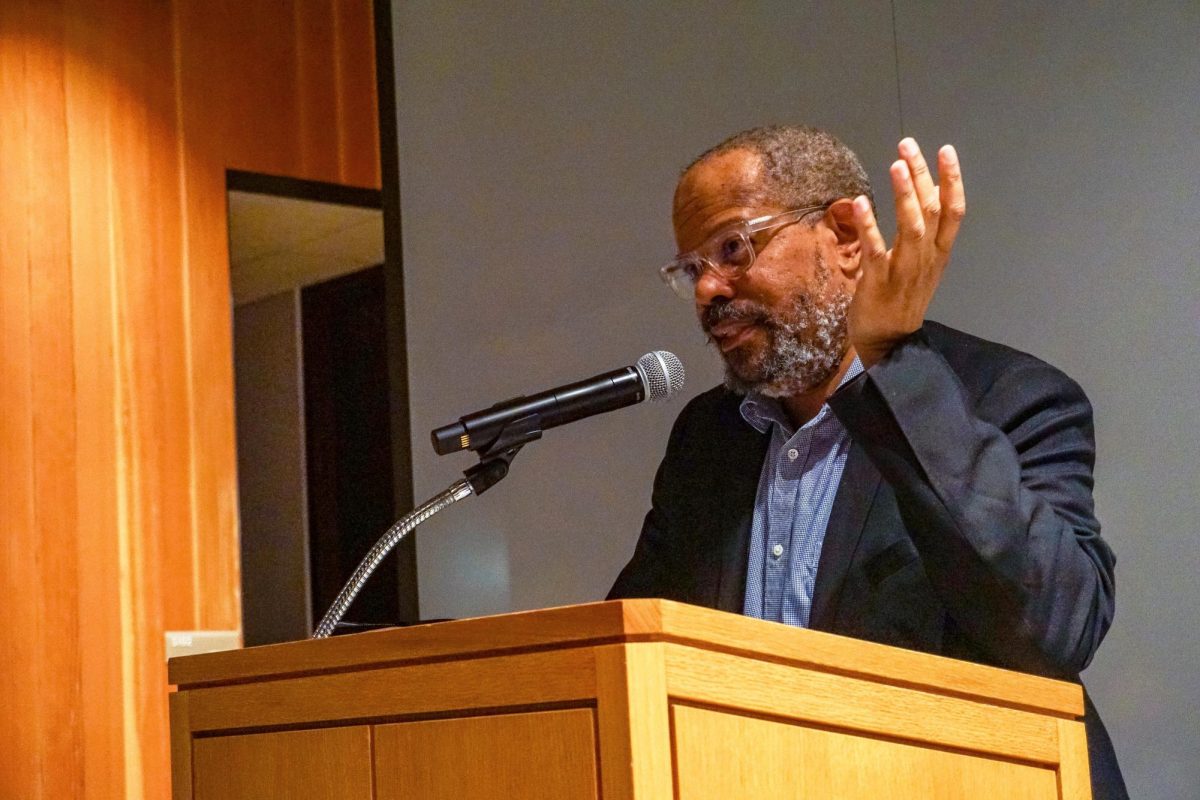
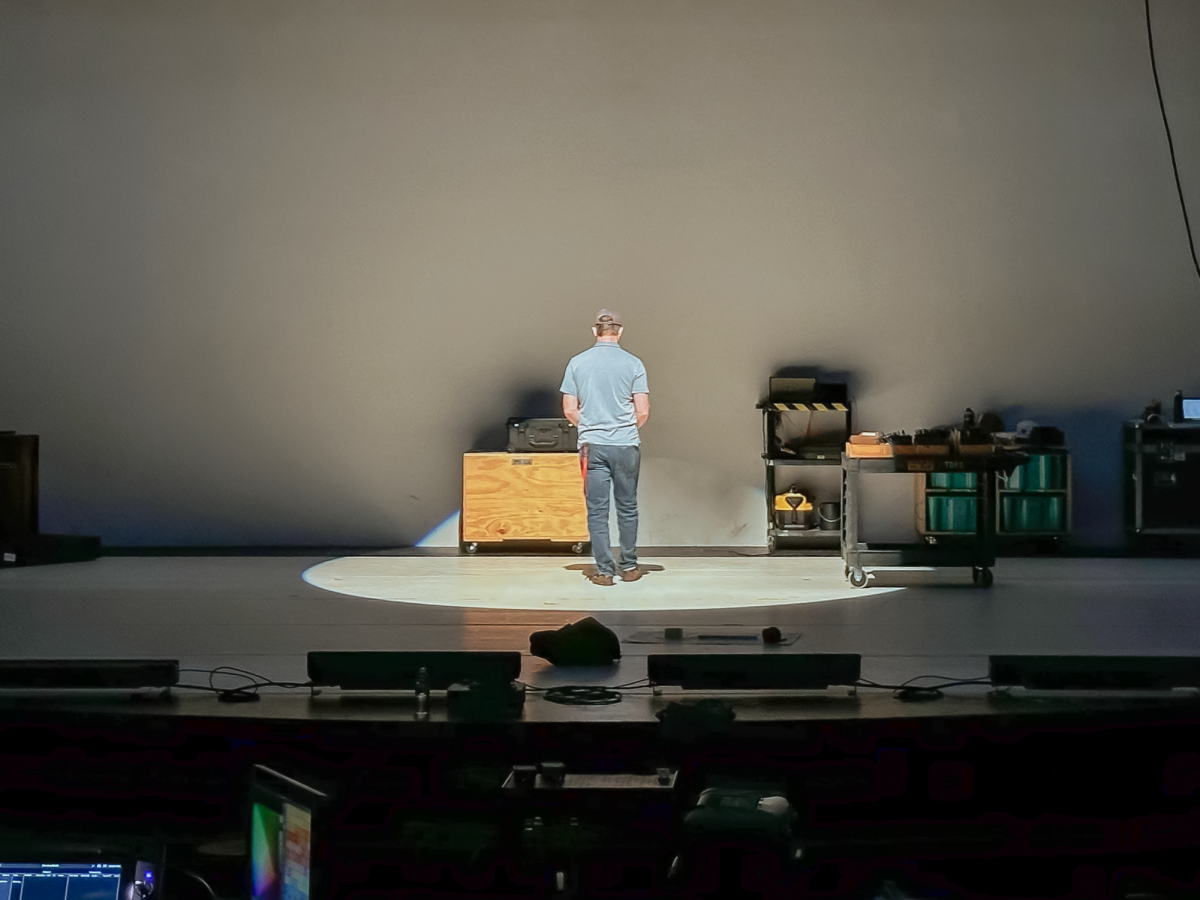
Ahmad Almallah — poet from Palestine and Pennsylvania and an artist-in-residence at the University of Pennsylvania’s creative writing program — said that one of his obsessions is the chair and the table, which he considers the perfect pair. During his visit to Grinnell on Thursday, Oct. 30, he came upon chairs and tables in pairs while participating in another classic pair — the Writers@Grinnell (W@G) afternoon roundtable conversation and evening reading.
“I wish all relationships were like this. But, you know, life sucks,” said Almallah about the perfect chair-table pair.
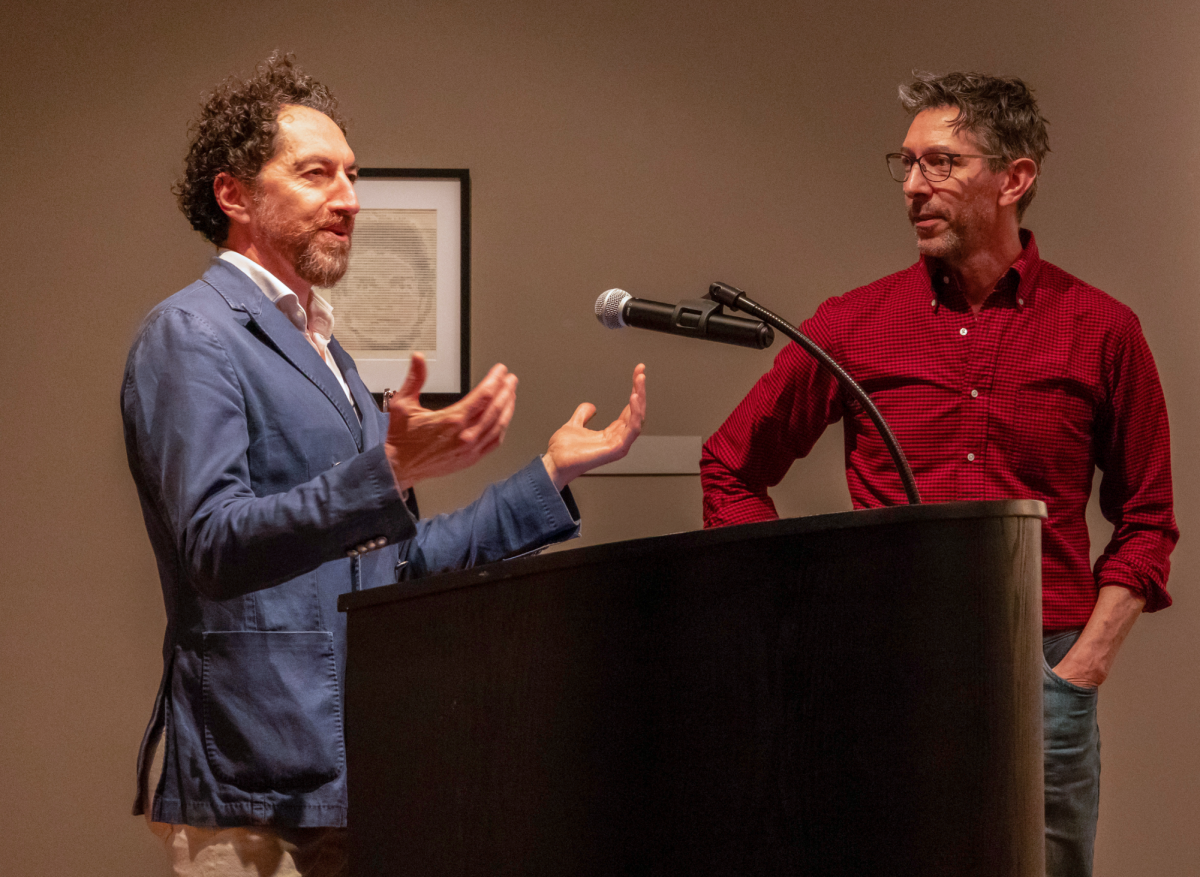
Almallah spoke with Hai-Dang Phan, director of W@G, associate professor of English and fellow poet, and Adey Almohsen, senior lecturer of history, for the roundtable at the Humanities and Social Sciences Center (HSSC), followed by the evening reading in the Joe Rosenfield `25 Center (JRC). He spoke about his relationship to Gaza and the genocide industry, mis-translating himself from Arabic to English, his deceased mother and writing poetry with his partner, among other topics.
His latest poetry collection “Wrong Winds” (Fonograf Editions, 2025) confronts and converses with European poetic tradition, engaging with the likes of Paul Celan, Federico García Lorca and T.S. Eliot. His earlier collections, “Border Wisdom” (Winter Editions, 2023) and “Bitter English” (University of Chicago Press, 2019), intertwines English and Arabic.
Following the afternoon roundtable, The S&B had an exclusive interview with Almallah about how he came to be a writer, what he is reading right now and elaborations on the chair and the table.
The first question was asked by Phan to begin the roundtable. This interview has been edited for concision and clarity.
How did you come to be a writer? Was there a reading, an account or a teacher, an experience that you remember as a kind of formative, memorable moment where you’re like, “Aha, this, what is this thing called poetry, and I might take it up.”
It’s a very, very easy question for me. It has to do with my background as a Palestinian child under Israeli occupation around the time when I went to school in 1987. Intifada started the popular uprising against the Israeli occupation, and a lot of the people involved in this popular uprising were students from schools, and they were facing the war machine of the Israeli army by throwing rocks and demonstrating in the streets. So the Israeli occupation decided to shut down the educational system and shut down the schools.
I remember maybe I spent a few weeks there, and then that was it. There was no school. As a way of providing me an alternative education — my parents were both Arabic teachers — they started gathering the family and started reading us poetry. Mostly, it was classical Arabic poetry, mostly pre-Islamic. I was the kid sitting in the background, and I was listening to all of this. By the time I was in the third or fourth grade, it was obvious I was illiterate. But throughout that time, I was listening to these poems, and I was absorbing them, and it became very, very easy for me to recite them. This was a pleasant surprise for my parents because my older siblings didn’t have any interest in reading these or memorizing. But, here I was, maybe five years old, I had the capacity to recite many verses that I just listened to. From that time on, this was an instant connection. I felt that I was really interested in this, and I wanted to memorize more, and I wanted to listen to more. And since that age, the idea of becoming a poet entered my head.
Classical Arabic poetry is metrical. So after a few years, I was trying to become a poet. This was around seven or so. In this metrical poetry, each line has two sections. What do you call them? (“The hemistitch,” replied Almoshen.) Anyhow, the line was made of two parts that remained on the same line. One of my first attempts to write this classical poem was just to imitate the visuals of what the poems I’ve seen should look like. When my father read them — my father was a harsh man — he said, “Well, this is not poetry. It’s not in meter.” On my own, I would read a certain poem, read it, reread it, listen to it, and then imitate the meter. And that’s how I learned how to write metrically.
How do you find your form? Or do you choose it? Whether that is in poetic writing, writing generally. In some ways, do you choose a form maybe rather than discover it?
My writing practice avoids form. I never go to the page wanting to write a poem. I usually try to journal, write prose. Sometimes, I empty my mind on the page in a very chaotic way. And then if I find something interesting in that, I will start using it towards writing a poem. And then the thing about free verse is that every poem is an experience, and every experience demands a certain form, and I go from there. That’s why a lot of people think the free verse is easier. On the contrary, when it comes to serious free verse, you have to invent a form for every poem. That’s the core of my poetics, this constant reinvention. If I write formally, I would do it sometimes as a prompt, if I’m blocked and I can’t write anything. “Okay, I’m going to write a sonnet,” or “I’m going to write a sestina or a villanelle.” But I never keep these intact. Out of writing these forms, certain poetic gold emerges. Not in the full form but in some lines, here and there. So I take that and I use it towards writing a free verse poem. Form for me is just a prompt that I use only to break.
I think you also talked a little bit about this at the beginning — the chairs and tables. Are there obsessions, things you find you keep coming back to, whether in writing or musing?
I have been obsessing about the relationship between the table and the chair. You find a lot of poems, a lot of fractions, in my work. There’s a poem on poetry called “Christos.” It’s about how Jesus was a carpenter and how he started with the creation of a table and chair. Then, I take it from there to something completely different.
I obsess also about writing on objects. So instead of going to the page, I choose objects to write on — an imitation of Emily Dickinson’s practice of writing on envelopes. I’ve written a lot of poems on envelopes. When I find myself in a bar, I write on a coaster. I have written on paper plates.
But the thing that I obsess about the most is the table and chair. They are, in my mind, the perfect pair. Why? Because they’re not identical. I feel like identical pairs are not possible. The table and the chair are so perfect as a pair because you can’t think of one without the other, but they’re completely different from each other. It preserves the real object as it is, but at the same time, we always pair these together.
What are you reading?
I’m reading a wonderful novel by Paul Aster called “In the Country of Last Things.” I’ve been very interested in the letter. There’s another by John Berger called “From A to X.” It’s also a collection of letters.
I’m curious if you do have an ideal aesthetic experience, what is it?
When you’re reading a collection of poetry, you encounter failed attempts. Those failed attempts lead you to this ideal aesthetic experience. And the same thing with reading poetry in general. So if you’re reading poem-a-day or poem.com or one of these sites that generate poems, they are coming from the current culture and the current culture of writing poetry. It’s the same thing as reading a collected work: you encounter good things, you encounter failed attempts, and, then, sometimes that process, being diligent about the process and being open to just poems of others that are being written right now, you encounter a wonderful poem that would say, “Oh, this is an ideal aesthetic experience.” This is opposed to saying, “Oh, well, every fucking poem right now is shit, and I’m not going to read anything.”
That openness is key. Even in the workshop, I do the same thing. I emphasize that we’re all trying, and we’re all sharing. It doesn’t have to be the ideal poem for you. The ideal aesthetic situation is to be in a circle where you can share freely and don’t feel like you need to produce your best work all the time. Yeah, that’s an ideal aesthetic situation.
W@G anticipates hosting three more writers this semester. This Thurs., Nov. 6, novelist Ling Ma will be in conversation with Bruna Dantas Lobato, writer, translator and assistant professor of English, during a roundtable discussion in HSSC S1325 at 4:15 p.m., followed by a reading at 8:00 p.m. in JRC room 101. On Nov. 20, there will be a joint roundtable and reading with poets Diana Khoi Nguyen and Lindsay Webb.