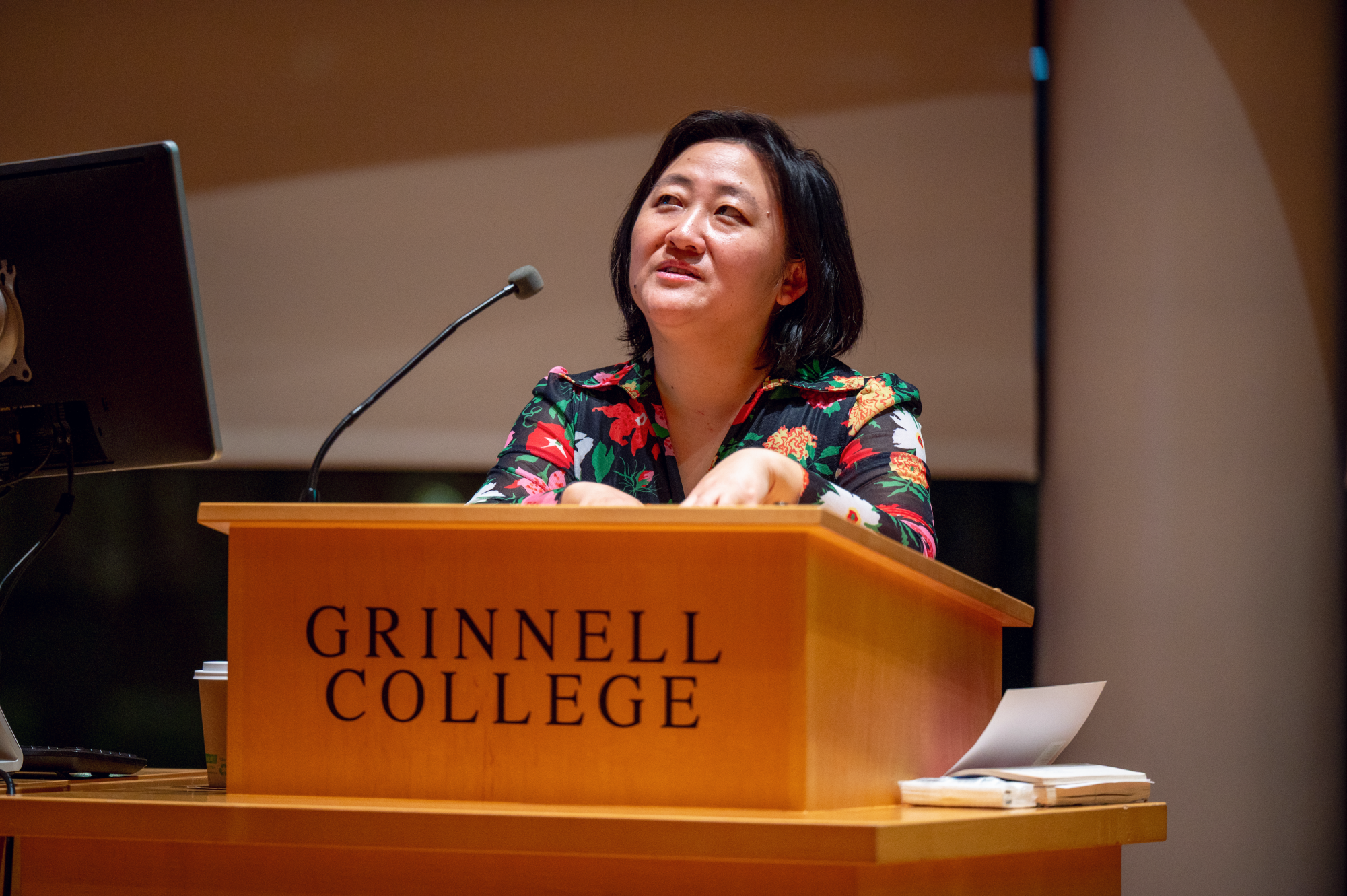
As fiction writer Ling Ma sat in the car taking her from Des Moines International Airport to Grinnell on Nov. 6, she said that she looked out the window and thought what her life would be like here in Iowa. When she was an undergraduate at the University of Chicago, where she is now an associate professor of English language and literature, her parents and sister lived in Des Moines.
“Whenever I’m back in this area, I just feel like I’m glimpsing a part of my family’s life that I was not a part of,” she said.
That Thursday, Ma had a glimpse of Grinnell through Writers@Grinnell programming. For an afternoon roundtable at the Humanities and Social Sciences Center (HSSC), she was in conversation with Bruna Dantas Lobato, assistant professor of English and fellow fiction writer. At the evening reading at the Joe Rosenfield `25 Center (JRC), Ma read five of the six parts of “Peking Duck,” a short story originally published in The New Yorker about a Chinese American writer’s attempt to write a story vaguely about her life.
Dantas Lobato introduced the writer at the evening reading. Leading up to Ma’s visit, Dantas Lobato said that she taught some of Ma’s short fiction — “Peking Duck,” “Returning,” “G” and “Tomorrow” — in her creative writing courses. These stories were collected in Ma’s short story collection “Bliss Montage,” published in 2022.
Dantas Lobato described Ma’s multilayered work as culminating in a new, more capacious genre. She described Ma’s 2018 best-selling novel “Severance” as a zombie novel, a road novel, an immigrant novel, a satire of contemporary life, late stage capitalism and the publishing industry, a social novel and a novel about love.
At the roundtable, students often described Ma’s work as speculative. In “Severance,” Ma aligns the sluggishness of mundane life with a zombie apocalypse. In “G,” two childhood friends take a drug that grants them invisibility.
“For many of the stories that have speculative premises, if the reader believes the voice, then they will believe anything that the voice touches,” she said.
Ma’s fiction writing takes this cue from other kinds of media that she loved growing up — early internet service provider AOL and personal zines made with a Xerox machine.
“It was sort of this strange time that lacked a lot of self consciousness,” she said. These forms, to her, represented early stages of the commercialization of the internet.
When Ma was an undergraduate studying in Chicago, she used to write movie reviews for a film magazine. She said that she watches television and movies more than she reads. “When I was in high school — I guess it was way back in the day — I often wanted some kind of literature that could be just as visceral as watching a film,” she said. “Bliss Montage” takes from film terminology, meaning a brief, ecstatic cinematic sequence.
Another key source of inspiration for Ma are dreams. Ma said most of their story ideas begin as dreams, and some of the problems in the writing process are solved by having a dream about the problem. One student at the roundtable said that after reading “Returning” and Ma’s interview “The Swampy Logic of Dreams,” they had a dream based on the short story, whose characters were switched out for their own family members.
“I feel very complimented whenever people tell me, ‘Oh, I read their work, and then I had a dream about it,’” Ma said in response. “I feel like that’s actually the highest compliment.”
W@G anticipates hosting two more writers this semester. On Thursday, Nov. 20, poets Diana Khoi Nguyen and Lindsay Webb will have a joint roundtable discussion in HSSC S1325 at 4:15 p.m., followed by a reading at 8:00 p.m. in JRC room 101.