










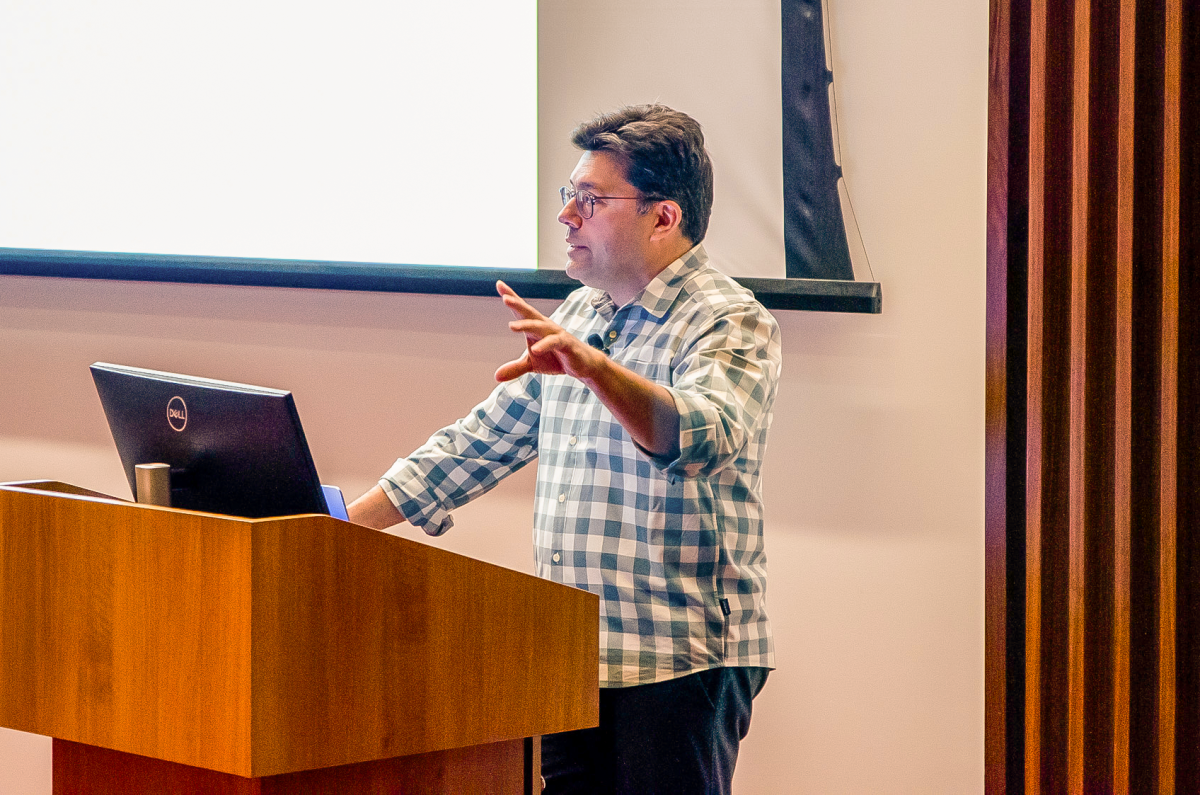
































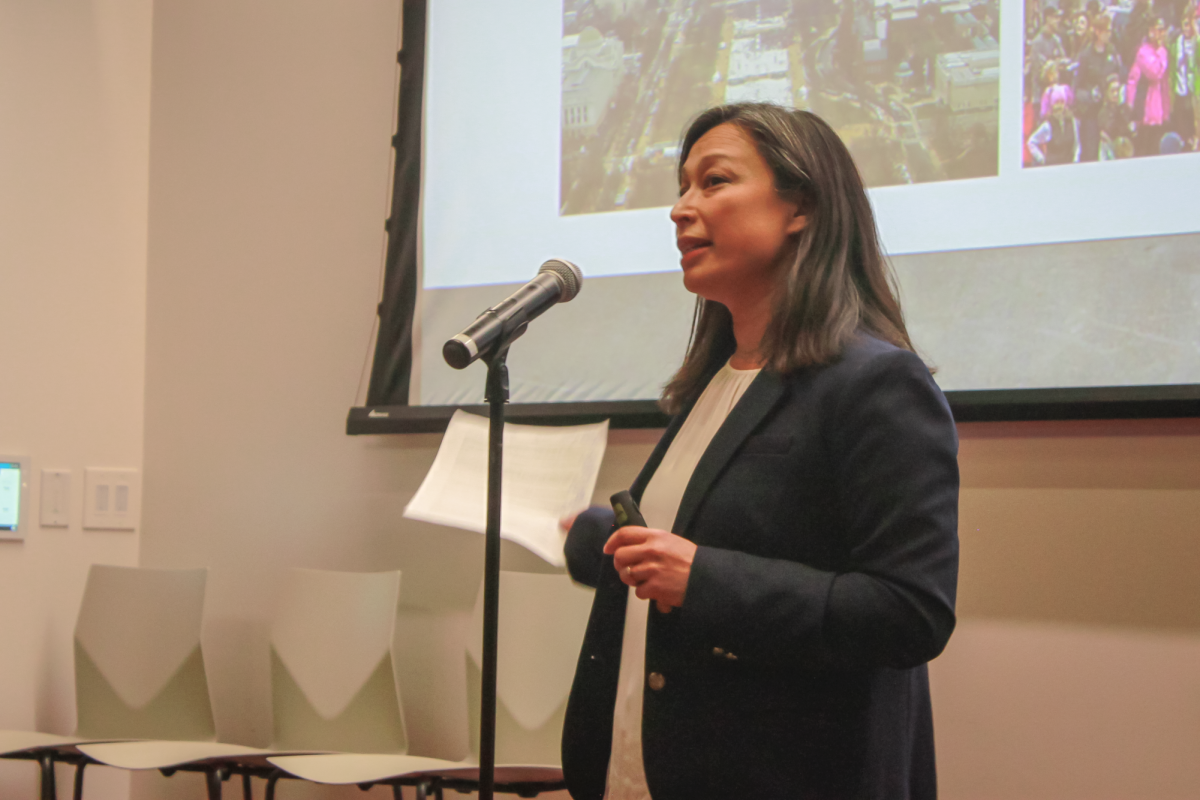
Award-winning sociologist Dr. Jaime Kucinskas explained her research, centered around the ethical dilemmas faced by federal employees during Trump’s first administration, during a talk at the Humanities and Social Studies Center (HSSC). While the norms and professional culture of the civil service typically help stabilize government, Kucinskas argued that they can leave bureaucrats unprepared under increasingly autocratic leadership.
Kucinskas began by saying that participation in her study, which included interviews with over 100 civil servants and informed her book “The Loyalty Trap: Conflicting Loyalties of Civil Servants Under Increasing Autocracy,” was shaped by the political climate. Despite presenting the project in neutral terms, she said, “The way I described this study was as neutral as possible… but even so, Republicans weren’t interested in participating.”
Kucinskas said that this absence is significant. “That’s really important to know about my results,” she said.
To illustrate the dynamics of ethical uncertainty, Kucinskas shared the story of a respondent referred to as Blackburn, a civil servant who entered government with strong credentials and institutional support.
As policies shifted during the Trump administration, Blackburn experienced increasing tension between her professional judgment and her role. “What I’m hired for is to follow directives of the president and the Secretary of State, and that was a real official directive, and we followed it,” Blackburn said.
However, decision-making processes became less transparent over time. Blackburn described uncertainty about the origins of directives. She said her boss would just say “Oh, the White House, the White House.” He would never say who within the White House nor what they were asking for specifically.
This lack of clarity made it difficult to determine whether certain changes reflected official policy or individual interpretation, particularly when they appeared to conflict with established legal or professional standards.
Kucinskas used such cases to define what she calls the “loyalty trap.” She said that these occur when civil servants are placed in positions where “they cannot fulfill the duties of their position and the new stringent expectations of personal loyalty to appointees or to the president’s agenda.”
Rather than facing clear ethical choices, respondents often described navigating competing obligations. “It’s not that people are in these situations where they’re deciding between right and wrong… they’re trying to figure out, ‘what do I do between a bad decision and another bad decision?’” Kucinskas said.
Kucinskas said that existing research had not fully accounted for the impact of these chaotic working conditions. Respondents described their environments as limited in communication with unclear leadership direction.
In some cases, civil servants reported working for extended periods without guidance. Kucinskas said that employees said they were “working in agencies for over a year, a year and a half, and sometimes two years where they didn’t get communication from the administrator.”
This uncertainty was compounded by fear of retaliation. One respondent said, “They found someone to punish, and that obviously had a very chilling effect on everyone.”
In response to these conditions, many civil servants adopted strategies aimed at minimizing risk. Kucinskas described these behaviors as “retrenching, ducking, hovering, putting their heads down,” adding that for some, “it just meant doing what’s necessary… because it’s safer.”
Rather than engaging in collective resistance, most responses were individualized. Kucinskas said that more visible forms of resistance occurred only under specific circumstances, such as when individuals felt supported or protected within their roles.
The conditions described by respondents had wider organizational effects.
Kucinskas reported declines in morale and collaboration, with some employees becoming increasingly isolated. She also said that uncertainty reduced innovation and contributed to inefficiencies within agencies.
Kucinskas positioned her work as both sociological research and a record of a particular historical moment.
“I wrote this book because this is a really important historical moment in American government, and I want to share my data,” she said.