





































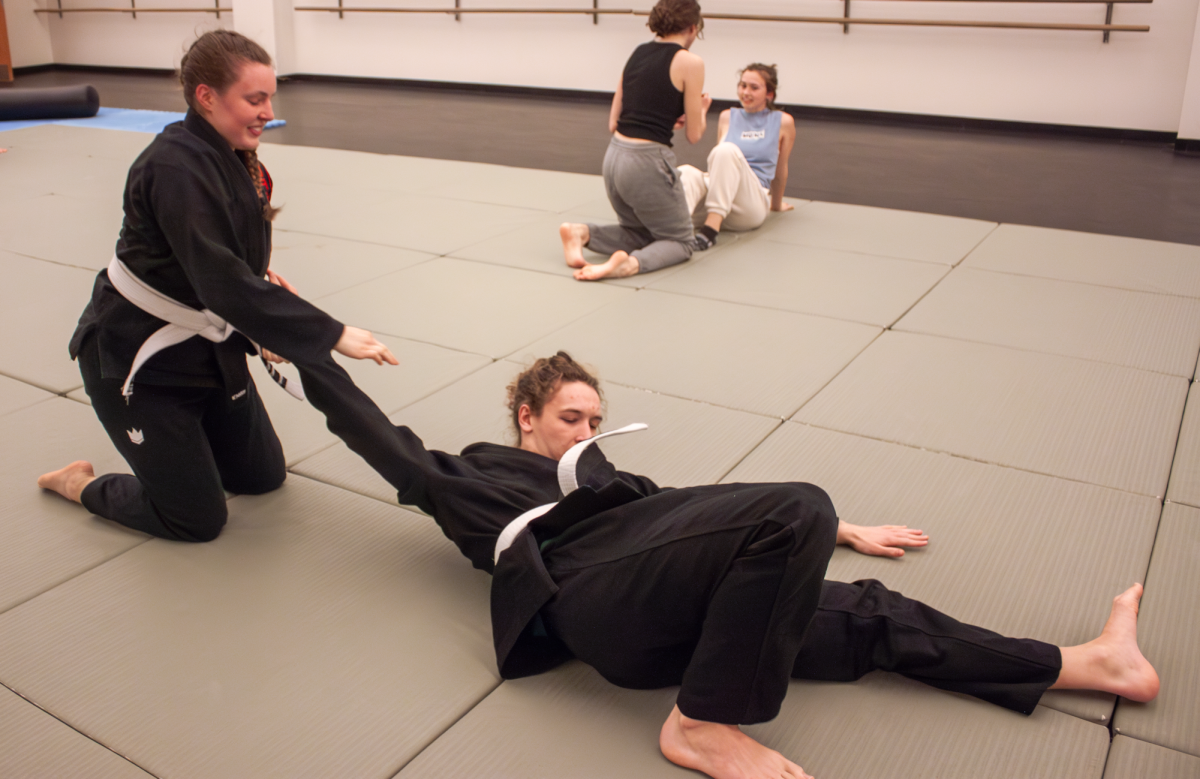
The thud of bodies hitting the mat mixed with quiet laughter and instruction could be heard in the Charles Benson Bear `39 Recreation and Athletic Center as students practiced during a women and gender minorities centered Brazilian Jiu Jitsu (BJJ) session. Designed to make the sport more accessible, the weekly training takes place every Monday from 6 p.m. to 6:30 p.m. in the Bear Multipurpose Dance Room.
Brazilian Jiu Jitsu is a grappling-based martial art focused on leverage, control and technique rather than striking. Grace Dukesherer `26, the current student leader of the BJJ’s Women and Minorities sessions, described it as “basically wrestling with extra steps, with the goal of putting the other person into a submission, which can be a joint lock or a choke.”
Dukesherer said while BJJ has grown in popularity, the sport remains traditionally male dominated, which can act as a barrier for women and gender minorities interested in joining. Dukesherer said the sessions for women and gender minorities — founded by Jada Fife `24 two years ago — provide an important entry point for those who may feel intimidated attending regular practices.
“Sometimes Jiu Jitsu is scary to get into, especially if you walk into a room and there’s just like a bunch of guys wrestling each other. So it’s nice to have a space where women and gender minorities can come and kind of get a little bit of an introduction and a little bit more confidence about the sport and about the whole class, before going to the normal class,” Dukesherer said.
Dukesherer began attending BJJ sessions during her first year at Grinnell. “Frequently when I was a first and second year, it was just me and all the guys,” she said. “My goal is to encourage other women and gender minorities to join the sport and help them feel supported doing so.”

The BJJ group, founded in 2011 by Assistant Professor of Physics Leo Rodriguez, has long emphasized both technical training and community. Rodriguez, who has been practicing Jiu Jitsu for 24 years, created the group after noticing Grinnell lacked Jiu Jitsu offerings when he moved from Iowa City. He said his goal was to “build a community and provide a valuable lesson plan for the community and the College.”
Both Dukesherer and Rodriguez emphasize that BJJ offers a wide range of physical and practical benefits. Rodriguez said the sport is a cardiovascular-intensive activity that builds strength, endurance and flexibility.
“I think it’s great exercise, especially because I’m bad at exercising without someone to tell me what to do, so I come here, and then you get to both learn things and exercise. And I’ve made a lot of friends here,” Dukesherer said.
Dukesherer and Rodriguez pointed to BJJ as effective for learning self-defense. Rodriguez noted that Jiu Jitsu combative, a form of the sport, is often taught in sexual assault prevention classes because of its focus on close-contact situations.
“I have gotten much more confident that I could defend myself because of this,” Dukesherer said. “When you know how to throw a grown man to the ground, it makes you feel a little bit safer.”
Beyond the physical, the sport also challenges participants mentally. “You face hardship on the mat when you’re fighting,” Rodriguez said. He explained that BJJ can help practitioners learn to manage and conquer feelings of claustrophobia or panic through controlled, supportive exposure.
“I also like the community,” Dukesherer said. “Everyone who goes here is super great. The blackbelts are so nice and encouraging.”
Rodriguez echoed this sentiment, saying “It’s a great community, everyone has become friends. There’s people that are outgoing, there’s people that are introverted, and that all feeds into itself.”
The women- and gender minorities-centered sessions are funded through the Bear as a wellness class and are free and open to anyone with a pass. While the sessions are designed as an accessible introduction, Dukesherer hopes more people will come, and that participants will continue training in whatever way feels most comfortable to them.
“My goal is for people to come, enjoy it and either keep coming to this class or feel confident enough to join the larger group,” she said.
“It’s not just a team,” Rodriguez said. “It becomes a family.”