

































Following reports of Immigration and Customs Enforcement (ICE) activity in Minneapolis and Iowa, the College has established policies explaining the role of the Department of Campus Safety in the event that ICE comes to Grinnell. While a recent campus-wide email outlined general safety protocols and resources, administrators have put additional measures into place to prepare the Grinnell community for the potential visit of ICE or other federal agencies.
In an email to The S&B, Director of Campus Safety James Shropshire wrote that the College maintains a proactive and consistent security presence across campus buildings and grounds. This includes regular patrols, active community engagement and established security procedures and infrastructure. According to Shropshire, this model positions the College to respond effectively if agents attempt to conceal their identity or intent.
Shropshire added that ICE agents may operate their duties without uniforms, as the agency has a non-uniformed division and a history of conducting official work in plain clothing.
Shropshire wrote that while the legal authority of the Department of Campus Safety does not extend beyond campus property, off-campus students are encouraged to follow the same safety guidance provided to the campus community. Although off-campus housing does not benefit from active patrols or campus security, Shropshire wrote that students can reduce risk by staying informed, prepared, and by reaching out to the appropriate campus offices with any questions or concerns.
According to JC Lopez, vice president for student affairs, Grinnell College administration created these protocols in consultation with legal counsel while taking into account both federal and state law and the institution’s mission and values.
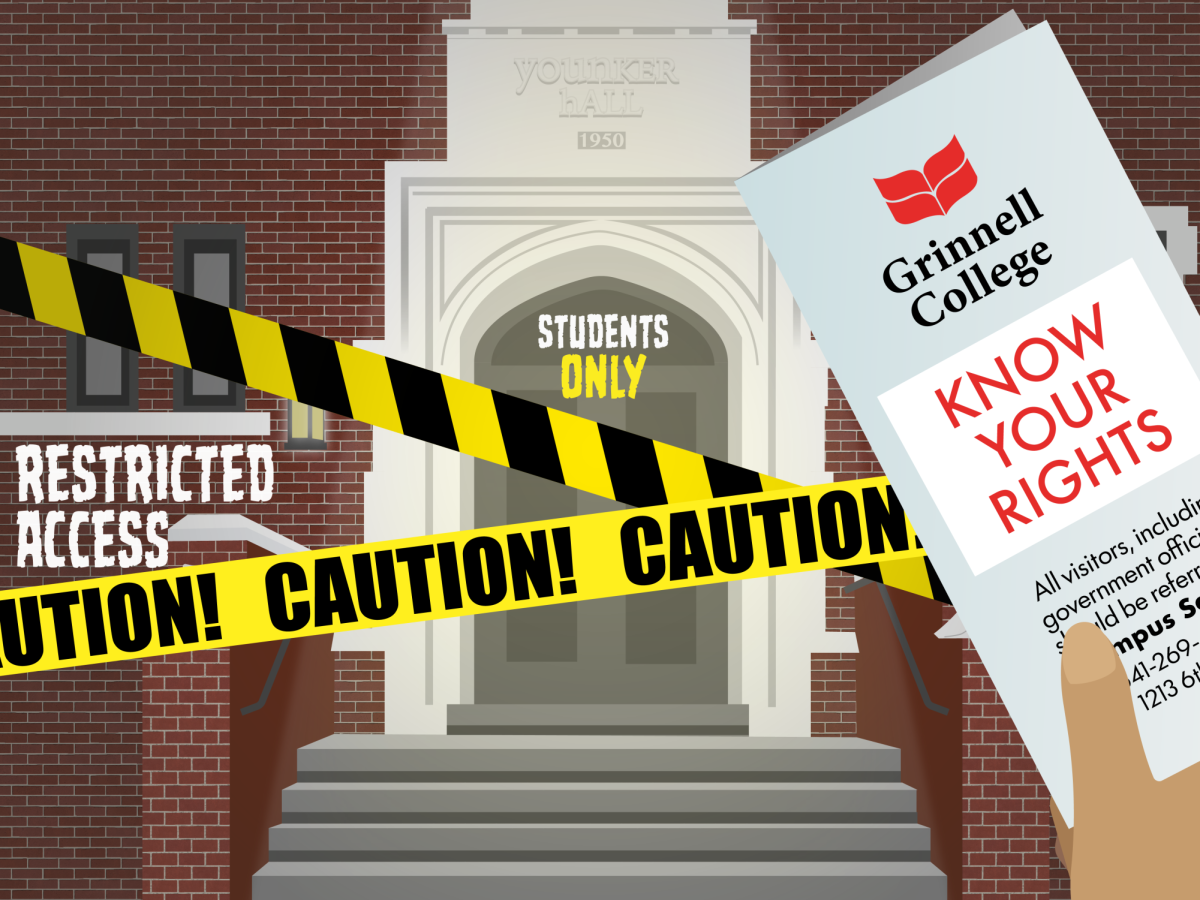
Shropshire also outlined how faculty and staff are being prepared to respond to a potential ICE presence. The College’s Immigration Response Guidance and pocket-sized, printable “Know Your Rights” cards are available through the Campus Forums site on Grinnell SharePoint. He encouraged community members to save the Department of Campus Safety’s phone number, 641-269-4600, to their phones, and advised any international students to carry the appropriate identity documents based on their immigration status.
Training for students and professional staff is currently underway, according to Shropshire, building on last year’s colloquium focused on immigration enforcement. He wrote, “Additional opportunities for learning and engagement are also in development. The College remains committed to educating and empowering our students and employees.”
In the event that ICE or another federal agency arrives on campus, Shropshire indicated that the College is prepared to support students by providing access to resources, information and staff assistance. Students are encouraged to review available materials and to consider their role as active bystanders or individuals.
In an email to The S&B, Karen Edwards, dean for international student affairs, addressed the protection of international students and the College’s responsibilities under the Student and Exchange Visitor Information System (SEVIS). SEVIS, established in 2003, requires institutions that enroll international students or host exchange visitors to report specific biographic, academic, financial and employment information to the federal government. At Grinnell, this work is housed within The Office of International Student Affairs (OISA).
Edwards serves as a Principal Designated School Official (PDSO) and Responsible Officer (RO), two roles that both oversee compliance for F-1 students and J-1 or J-2 exchange visitors. She wrote, “One of the most important ways we can “protect” international students and scholars is to teach them about the benefits and limitations of their non-immigrant status.”
Shropshire and Edwards wrote that they remain committed to listening to student concerns and continue to assess their response as regional and national developments unfold.
James Shropshire: How is the College addressing potential concerns over ICE showing up in disguise/out of uniform, as has been happening at other institutions?
Our security stance for our campus buildings and grounds remains consistent with our practices maintaining a pro-active presence on campus. We accomplish this through regular patrol, active community engagement, and security procedures and infrastructure.
Our model, which relies on community support and information sharing, should position us for success should we encounter an ICE agent or anyone else attempting to hide their identity or intent from the public. It is important to realize that ICE agents may engage a person while not wearing a uniform. There is a non-uniformed division and past practice of utilizing “plain clothes” while in official capacity.
James Shropshire: What is the policy for off-campus housing if a student is facing an immigration issue that is not within the campus’ jurisdiction?
We encourage our off-campus students who may be facing an immigration issue to observe many of the safety and security advice that we have provided to our campus community. Off-campus residents may not have the benefit of the active patrol combined with the safety and security protocols on campus, but they can reduce their risk and increase their safety and security by being prepared and following-up with the most appropriate office on campus for more detailed or specific questions.
James Shropshire: How are staff and faculty prepared to respond to an ICE visit?
We encourage you to visit the Campus Forums site on SharePoint, which includes Immigration Response Guidance and a pocket-sized, printable “Know Your Rights” card. We also ask all community members to save Campus Safety (641-269-4600) in their cell phones. International community members are advised to carry any required identity documents based on their specific status.
The College has been proactive in sharing information and resources with the campus community related to a potential ICE visit. This information sharing is one part of a broader effort focused on education and awareness. Scheduled trainings for students and professional staff are underway, and last year’s colloquium on this topic helped lay important groundwork. Additional opportunities for learning and engagement are also in development.
The College remains committed to educating and empowering our students and employees. We are eager to listen, learn more about the concerns of our campus community, and continue identifying ways to address and alleviate those concerns.
James Shropshire: What are you equipped to help students, in particular international students, in the case of ICE coming to campus?
The College stands ready to provide all of our students the resources, information, and support. We also encourage all community members to review the posted resources and to consider your potential role and capacity to act – either as an individual or an active bystander.
International students may feel (and may be) particularly vulnerable in this moment, and the Office of International Student Affairs has worked to teach and advise this community directly.
Campus Safety, the OISA, and a variety of other staff and faculty are available to discuss your concerns and refer or escalate those that require additional scrutiny from our planning team.
What does it mean to be a SEVIS-designated official? How does one protect international student information while adhering to federal requirements?
Karen Edwards: U.S. institutions that enroll international students, or host exchange visitors, are required to comply with the Student and Exchange Visitor Information System (SEVIS) (which dates back to 2003). Schools must certify “Designated School Officials” (DSO) to manage compliance for F-1 students and recent F-1 alumni; as well as “Responsible Officers” (RO) to manage compliance for Exchange Visitors in J-1 or J-2 status. At Grinnell, this work is housed in the Office of International Student Affairs (OISA). The institution is required to report and offer timely updates on every international student and scholar — specific biographic, academic, financial, and employment related data, to the U.S. government via the SEVIS system. One of the most important ways we can “protect” international students and scholars is to teach them about the benefits and limitations of their non-immigrant status.