



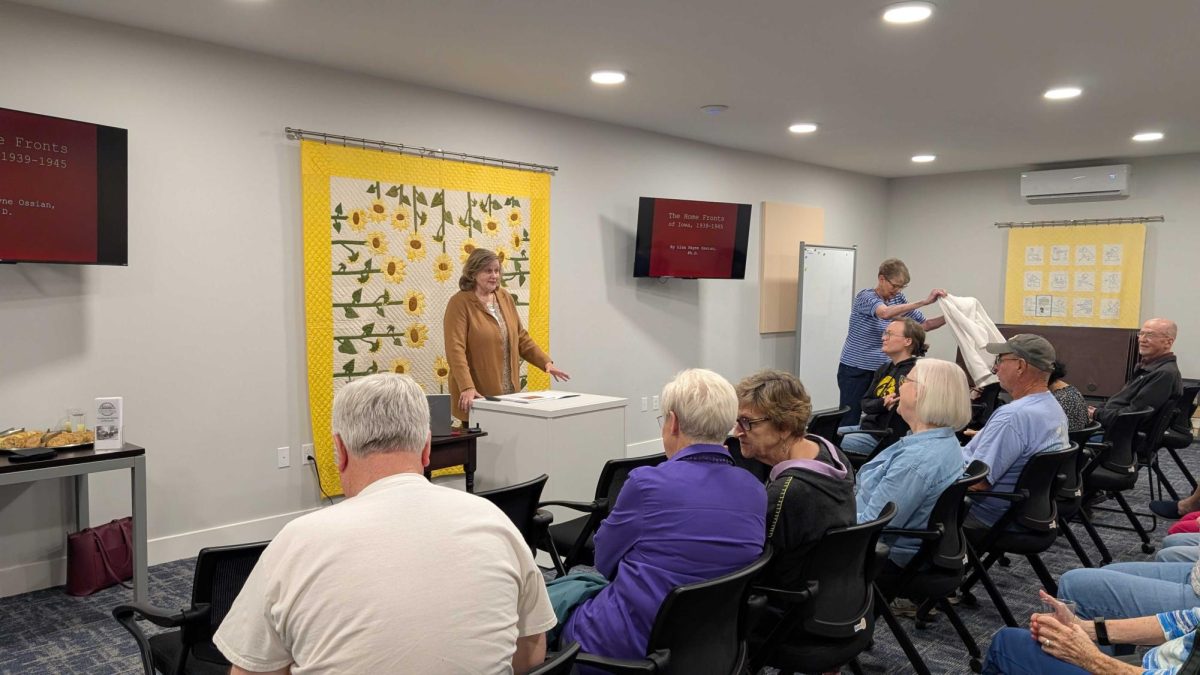



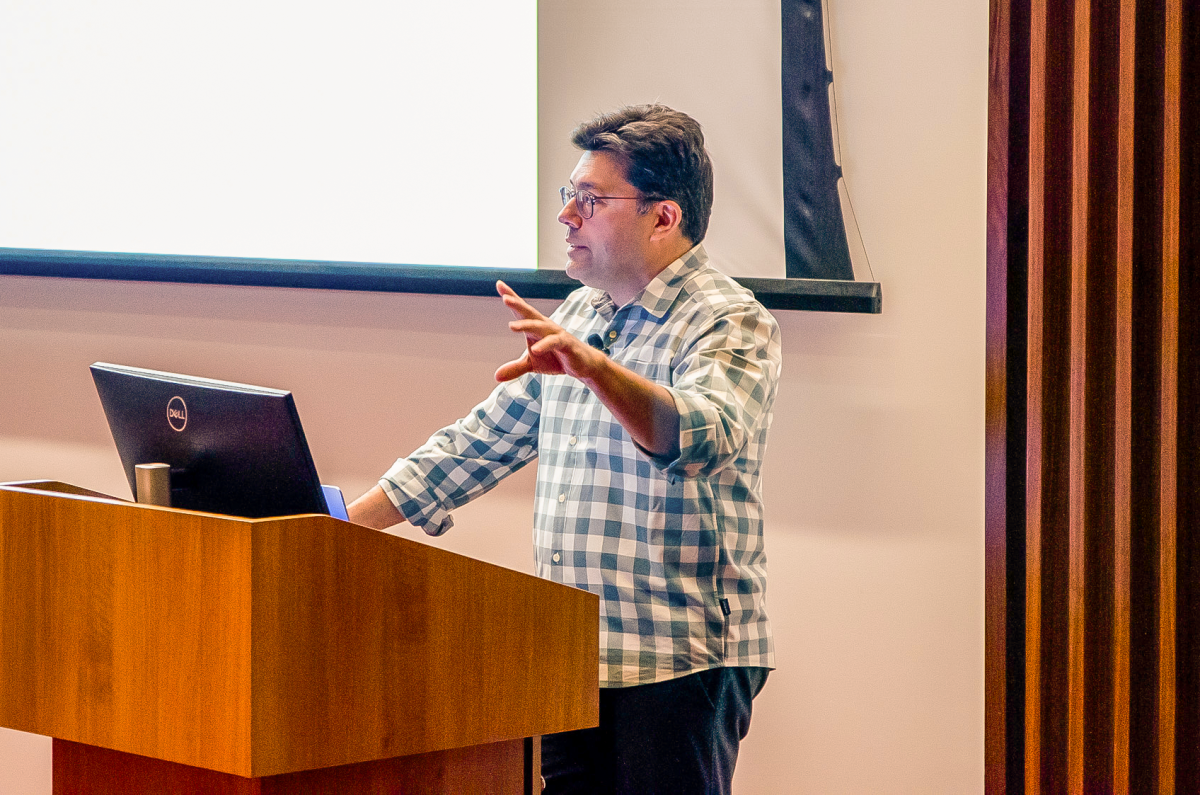




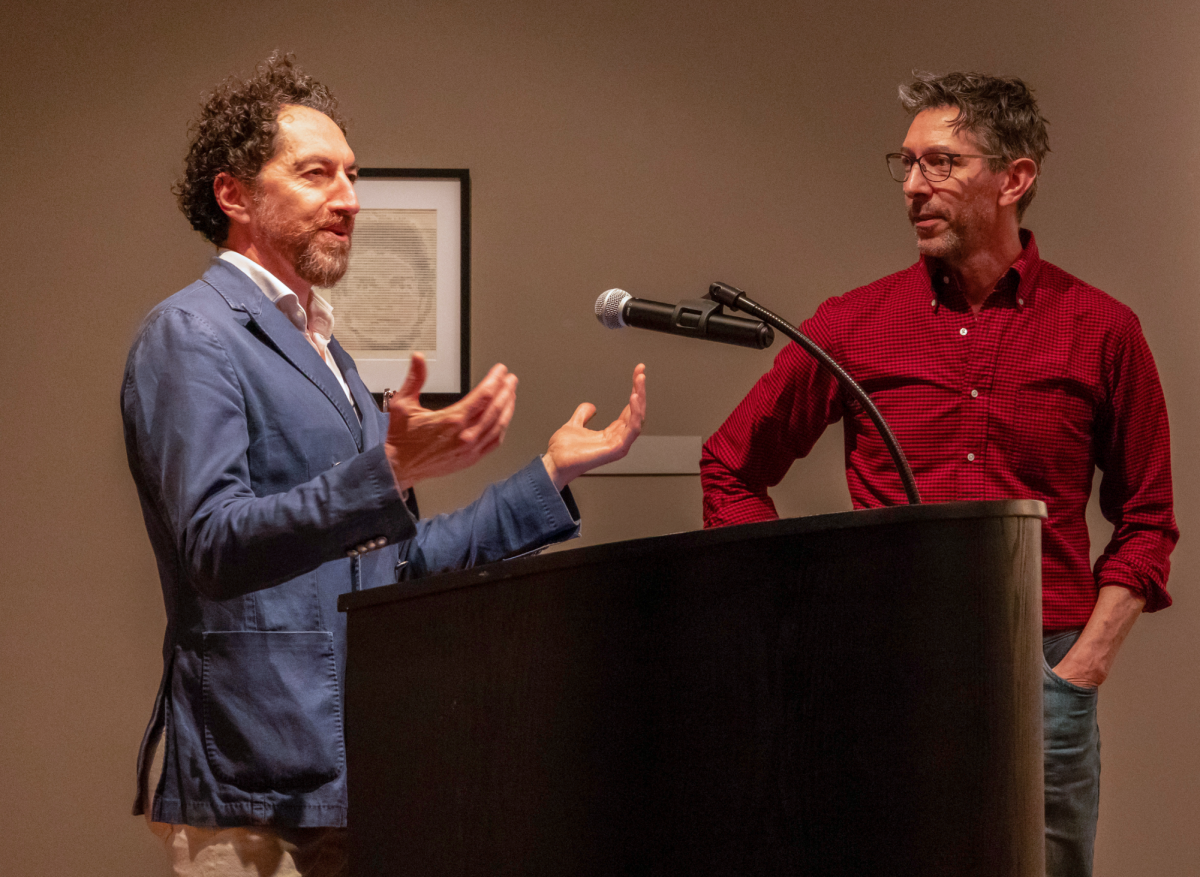
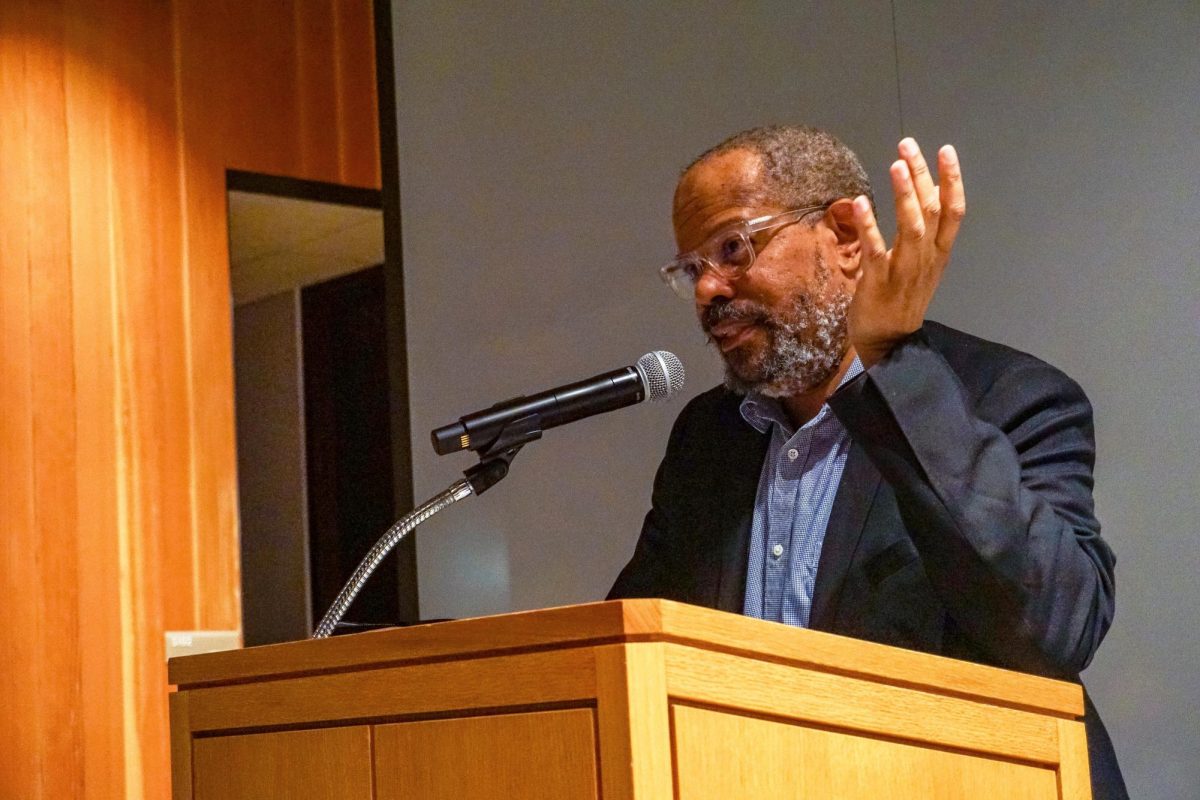































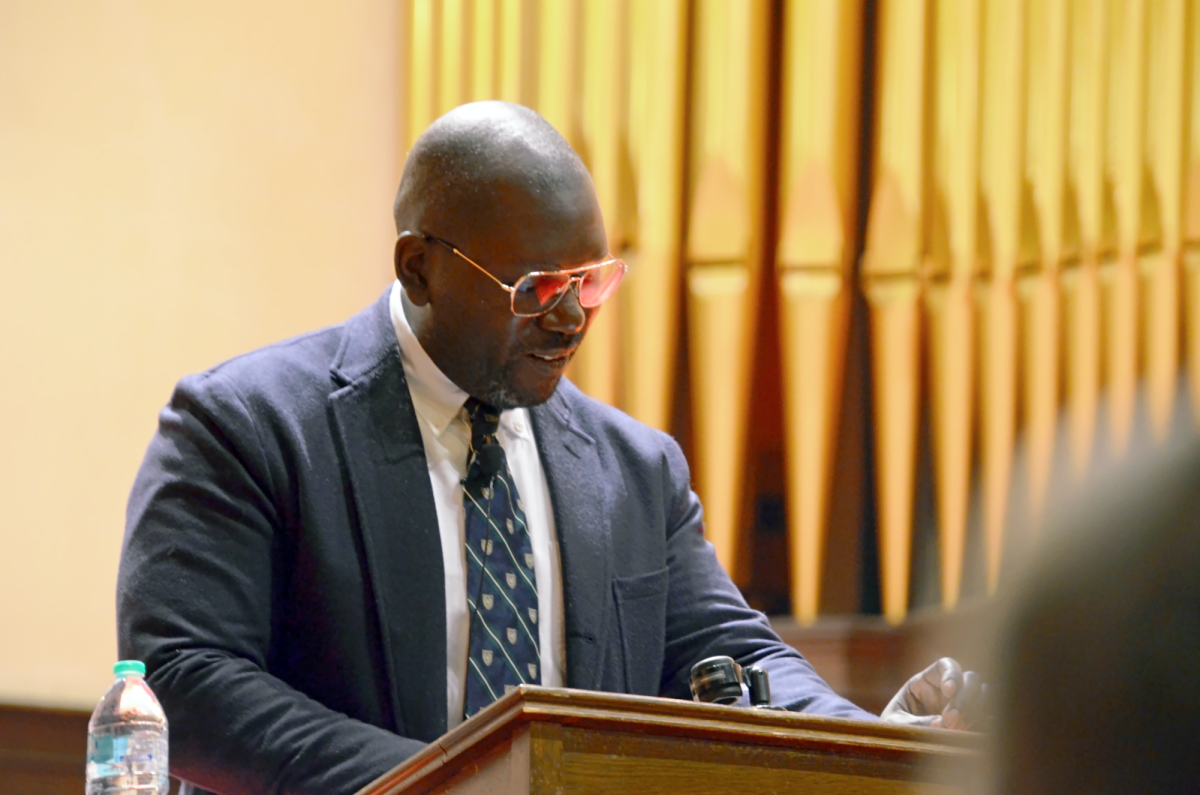
Hundreds of people crowded Herrick Chapel on Thursday night as Jamelle Bouie, opinion columnist for the New York Times, connected Reconstruction-era history to present-day politics at this year’s Martin Luther King Jr. Day celebration.
Bouie has written numerous columns about the Trump administration, Immigrations and Customs Enforcement (ICE), and what he has called “a sickness eating away at American democracy.” His commentary on historical and political issues has recently earned him awards from institutions such as the American Political Science Association and the American Historical Association. Edward Cohn, professor of history and director of the Rosenfield Program, introduced Bouie as one of the most compelling voices in American journalism.
“One of the things I can do, given the resources at my disposal, is just to try to provide context, provide lessons from that context, in order to help people understand what is happening,” said Bouie, who only accepts speaking opportunities outside of New York Times events at educational institutions. “I think that’s my role, that’s why I’m here, that’s sort of my objective.”
Bouie took a similar approach to the talk that he does in all of his work, connecting historical happenings to contemporary politics. He described the 13th, 14th and 15th Amendments to the Constitution, which abolished slavery, guaranteed equal protection and prohibited voting discrimination based upon race, as “transformative changes to the Constitution.”
“They take what was a document that allowed for the subordination of entire groups of people, a document which included a narrow slice of the American public whose vision of self-government was quite limited and quite restricted — it takes this and turns it into a document dedicated to the rejection of subordination,” Bouie explained as attendees nodded along. “There would be no constitutional sanction for subordinating entire groups of people. Not immigrants, not Black Americans, not anyone within the boundaries of the United States.”
As the lecture progressed, he traced the concept of anti-subordination from the abolition movement to the 1960s Civil Rights movement, and finally connected it to the present day.
“Different people called it different things … King called it the beloved community,” Bouie said of a society that ultimately rejects subordination. “But it’s all kind of the same idea, an egalitarian nation, a nation of equals, a nation of people who share a common American citizenship, who engage in a common project of improving a nation for everyone who lives within it.”
Multiple times, Bouie emphasized the importance of choosing to act, not spectate, and fight for an America in which the vision of anti-subordination laid out by the Constitution is reality.
“All of these guys, and many women who were involved in anti-slavery politics and the abolition movement in the 1830s and 40s, did not expect to see the end of slavery, and yet they struggled anyway,” he said. “I think there’s a lesson there, for those of us looking at our own present circumstances, about the importance of just doing the work regardless of what the prospects may seem to be.”
Bouie quoted John Dewey, a prominent American philosopher from the early 20th century, as a way to further illustrate this point. “He conceived of democracy not as a set of institutions, but as a practice … He thought that one of the jobs of education was to cultivate the democratic habit,” Bouie said. “Thinking about citizenship as a thing that you do, again and again and again, in preparation for when it really counts.”
After the talk, Bouie stayed to answer audience members’ questions for nearly 40 minutes. One audience member asked about other moments of history that are applicable to this one, to which Bouie referenced the speed in which the U.S. government enacted major reforms as a part of the 1930s “New Deal.”
“Whatever comes next after this is going to involve rebuilding. Rebuilding and rethinking American government in really fundamental ways,” Bouie said. “And so we can look to other periods of time when that happened.”
Bouie ended the talk on a positive note, emphasizing the impact that regular individuals can have. “The abolition movement was not made of superhumans, the people who wrote the Reconstruction amendments were not superhumans,” he said. “They were regular Americans, ordinary people, together in this world, and they made a choice to make this country a better place and we can make that choice too.”