







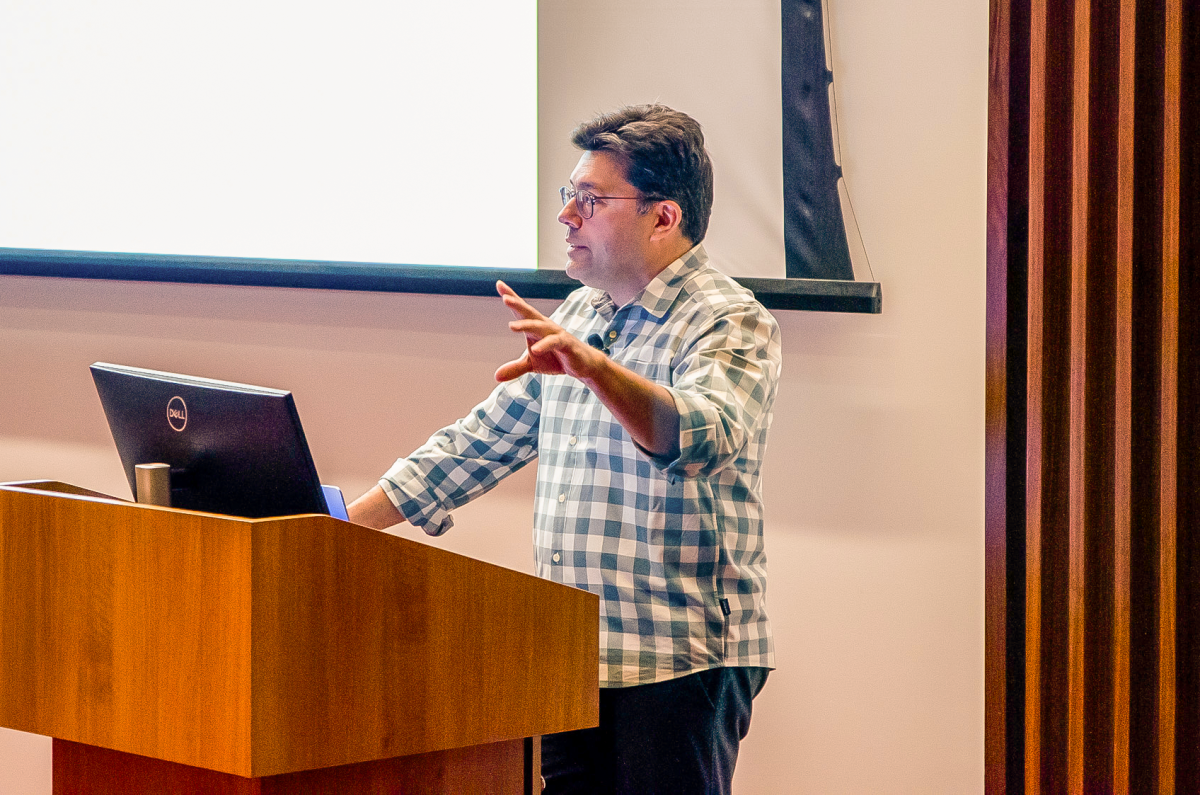































On the day before the add/drop period, Elaine Marzluff, chair of the faculty and professor of chemistry, spent 30 minutes clicking through student profiles one by one, checking which courses her 20 advisees had been assigned and which they had been cut from. There was no button to generate a report or summary.
“I would have that 30 minutes back to email my advisees,” said Marzluff, if she had the ability to generate a report. “Instead, it feels like time I’ve lost to a task that should be automated.”
The scenario shows what administrators identify as key components of workload concerns at Grinnell — technological systems that create inefficiencies in advising, combined with uneven distribution of advising loads and the College’s heavy reliance on term faculty.
Faculty workload concerns is one of four strategic initiatives this academic year, led by Dean Ruth Feingold and the Dean’s Office in coordination with the Executive Council.
The College’s three-year Quality Initiative on Academic Advising, led by Joyce Stern, dean for student success and academic advising, and Andrea Tracy, associate dean for student academic life and associate professor of psychology, has produced action items that address some of these workload concerns. The initiative was launched in the 2023-24 academic year to evaluate the College’s advising program through the National Academic Advising Association’s Enhancing Academic Advising framework, with programmatic recommendations presented at an open retreat during spring 2025 that drew approximately 60 participants, including President Anne Harris and senior leadership.
“Are we creating the time for faculty to do the work that we really value?” said Marzluff. She and Ruth Feingold, vice president for academic affairs and dean of the College, who oversee student and faculty wellbeing and academic life at Grinnell, presented the workload concerns at a November faculty meeting.
At the Nov. 17 faculty meeting, Marzluff and Feingold presented three strategic objectives for faculty workload — ensuring faculty have time and resources to achieve excellence without burnout, aligning rewards with the full range of faculty responsibilities including teaching and service and creating systems for more equitable workload distribution.
Advising as teaching, not service
Unlike many institutions that classify advising as service, Grinnell considers it part of teaching work, Marzluff said. This distinction reflects how seriously the College takes its individually-advised curriculum.
“We have some inequities in advising across the institution,” Marzluff said. The distribution depends largely on whether faculty teach tutorial, which assigns 12 first-year advisees at once, and whether they teach in popular majors.
While Grinnell’s faculty teach the same five-course load equivalent in an academic year, advising responsibilities vary dramatically. Some faculty have as few as three advisees, while others manage 30, 40 or even 50 students, according to Marzluff.
The Quality Initiative proposes redistributing faculty advising loads this academic year by identifying two to three potential models that address departments with high loads, easing the transition from tutorial to second-year major declaration and better utilizing staff advising. The initiative also calls for providing advising load data to department chairs and creating an official staff advising policy.
Moving to one primary adviser
One major reform under discussion would give each student a single primary adviser who handles course registration and formal advising responsibilities, rather than having separate advisers for each major and concentration.
Under this model, students with double majors would designate one primary adviser who approves all courses, while the second major’s adviser would provide guidance without the administrative burden of registration oversight. Additional advisers would be formally recognized as mentors but wouldn’t need to sign off on course selections.
“It could be primarily around the person who is helping on course advising and is the person who signs off on it,” Feingold said.
The Quality Initiative also proposes clarifying distinct roles for tutorial advisers, major advisers and staff advisers like those in the Center for Careers, Life, and Service, as well as specifying what students themselves are responsible for and when different advisers need to coordinate.
Technology creating work
“Right now the reason why we’re hearing from many people that the advising just feels like work is because our technological systems and our registration system feel like they get in the way,” she added.
The Quality Initiative identifies several technology improvements, including enhancing adviser access to student data, improving reporting capabilities for metrics like advising loads and degree progress and, in a longer-term goal, selecting and implementing a new Student Information System responsive to Grinnell’s advising needs.
The initiative also proposes designing “a new technology-based, four-year planning tool for students and their adviser(s) that facilitates curricular and co-curricular planning (versus course scheduling), goal articulation and reflection.”
The College is also considering moving first-year registration to summer, which would decompress the intense 10-12 day period at the start of fall semester when tutorial faculty register their advisees while simultaneously starting classes. If implemented, faculty would be compensated and participation would be voluntary, Marzluff said.
The College is separately examining the academic timetable to reduce course conflicts and better accommodate student schedules. The Curriculum Committee has been exploring options including evening classes and adjustments to convocation hours.
Reducing Reliance on Term Faculty
The Executive Council has made reducing reliance on term faculty a priority. The college typically has 25 to 30 or more term faculty on campus at any time, according to Marzluff.
“That’s a lot of mentoring, that’s a lot of hiring. There are a lot of steps to that process,” she said. In the most recent hiring round, the College converted several term positions, including in Film and Media Studies and American Studies, to tenure-track lines.
This year, the College is conducting 14 tenure-track searches, according to Feingold.
Grinnell’s sabbatical policy contributes to term hiring needs. Faculty become eligible for sabbatical leave after six years of full-time service and can take them as frequently as every three years, though the faculty handbook notes that “an interval of at least three years between leaves is necessary to provide the continuity of instruction and advising that is central to Grinnell’s residential college community.”
When multiple faculty from the same department take leave in the same year while others take no leave, the College must hire visiting term faculty to maintain the curriculum.
“If we had one person go on leave every year, instead of hiring visitors, we could just hire an additional faculty member in the department,” Feingold explained.
The College is working with departments to coordinate sabbaticals more evenly, which requires faculty to plan their leaves around departmental needs rather than taking them whenever they become eligible. This represents a shift from the current practice where faculty exercise considerable autonomy over when they take their earned sabbaticals.
Building an advising framework
The Quality Initiative’s recommendations fall into two main categories — creating a substantive framework for advising as a program and making tactical improvements to reduce adviser workload.
Tactical improvements beginning this year include creating an Advising Hub, a centralized web repository of advising information and tools, updating the Alumni Careers by Major visualization, improving curriculum visibility for students and advisers and developing better communication plans about registration.
The Tutorial and Advising Committee will convene in spring of 2026 to advance this work.