







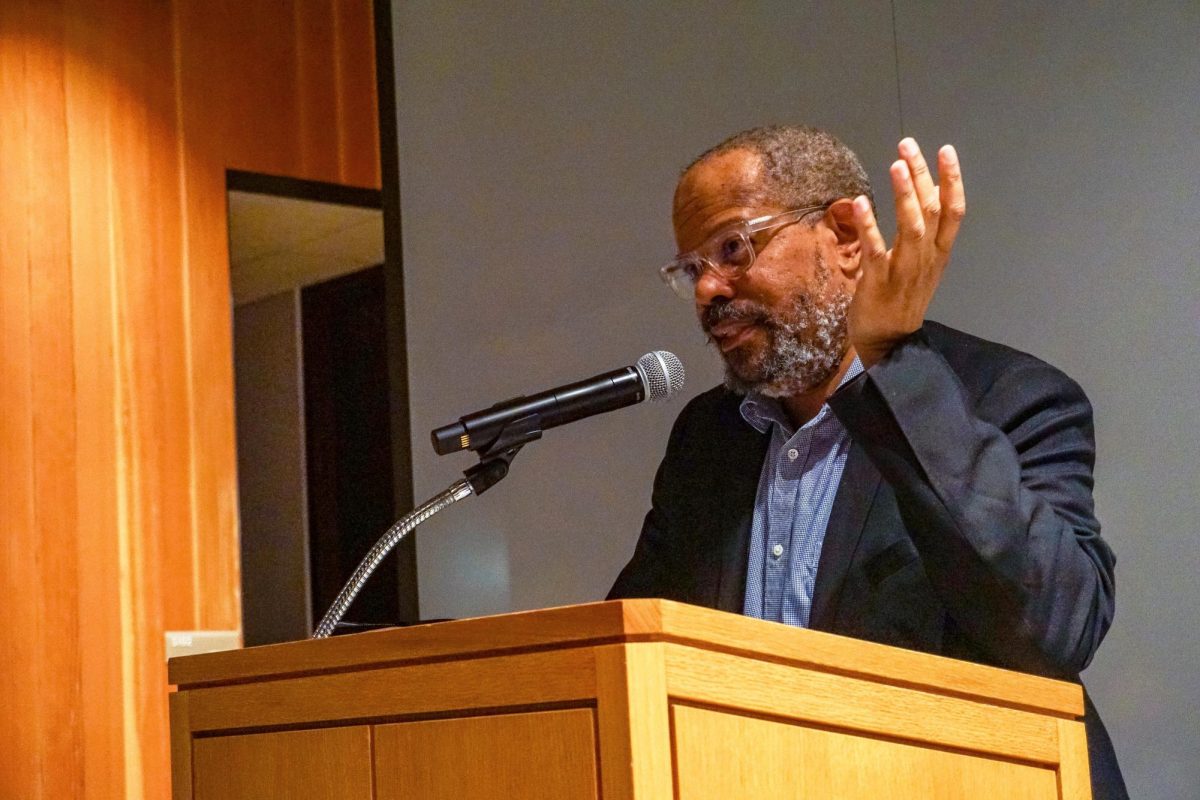























Dr. Frank Kanawha Lake, of the Karuk and Yurok tribes in Northern California, reframed fire as medicine — a tool used not only to revitalize environments, but also Indigenous ways of life — in his Scholar’s Convocation talk sponsored by the Center for Humanities.
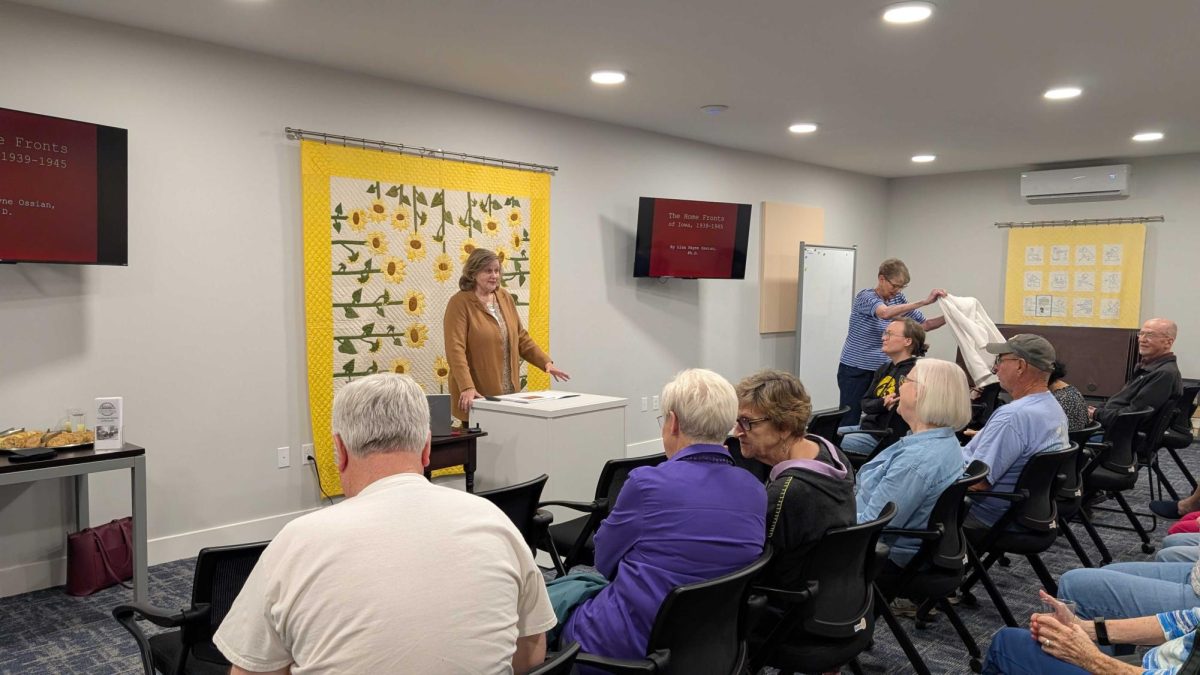
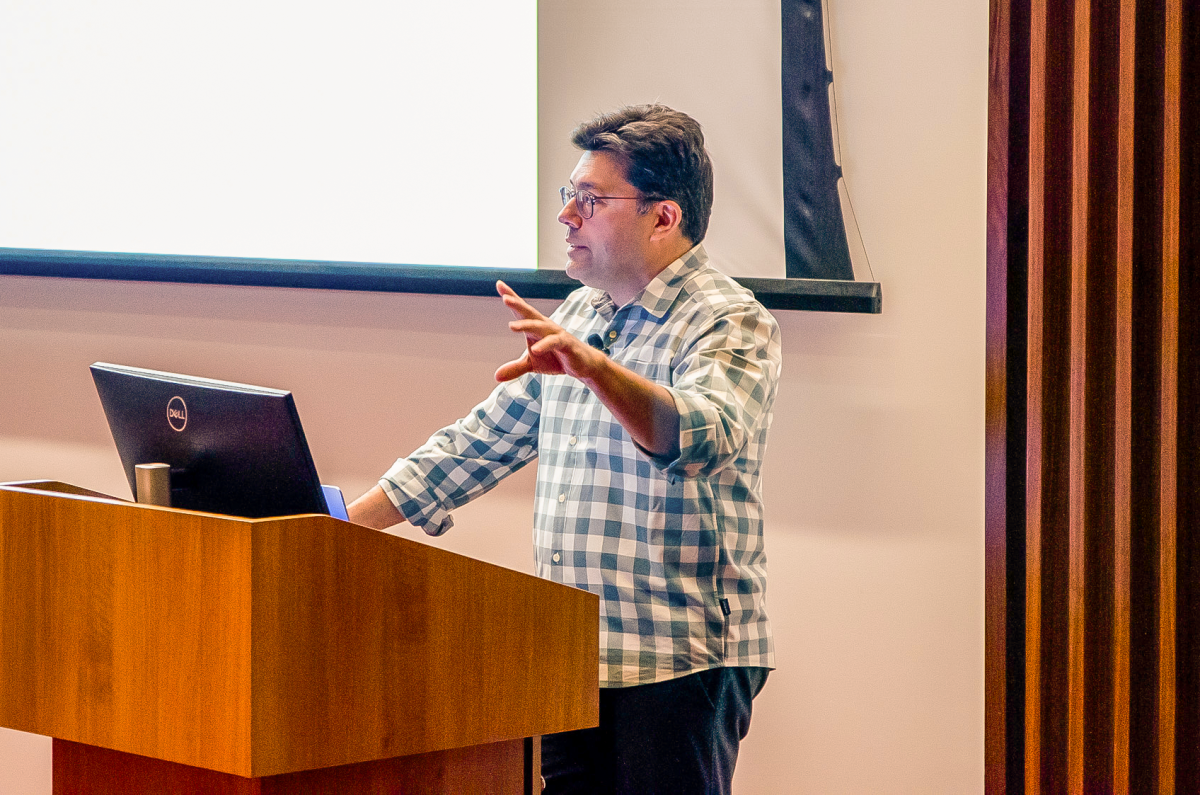
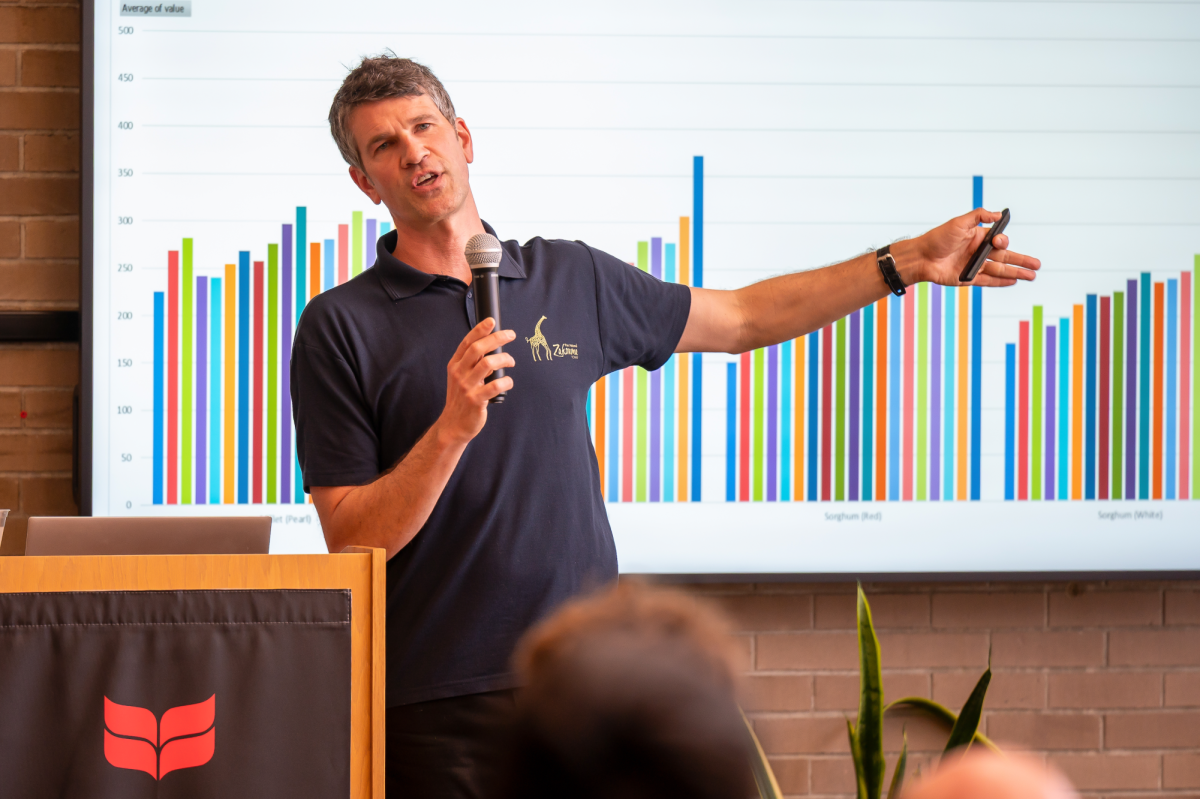
Lake presented “Indigenous Fire Stewardship: Sacred Responsibilities for Fire, Water, Air, and Earth, and the Challenge of Climate Change” in the Joe Rosenfield `25 Center on Nov. 13.
Steve Andrews, professor of English and director of the Center for Humanities, opened the talk with a quote of Lake’s from a recent Washington Post article.
“The landscape is sick. Due to the prevention of traditional cultural burning in the ancestral home of the Karu and Yurak peoples, this home is people. With the restoration of cultural burning in 2024, that sick landscape can now be brought back to health,” Andrews said. “If properly stewarded, [fire] has the power to heal.”
Lake is a federal researcher with a doctorate. in environmental science.
He uses the Indigenous knowledge of his tribes in combination with academic research to prescribe burns and ultimately help revitalize local ecologies. With over 25 years of experience working with wildland fire, he is one of the first federally recognized total fire practitioners in the state of California.
Lake argued that fire stewardship, the way we care for an environment, is essential for maintaining local tribes and ecosystems’ adaptive capacity.
He said that caring for the environment requires providing human services for the environment so that we may nurture its resistance to and resilience in the results of climate change like drought, flood and fire.
Lake said the environments that were naturally maintained by fire were often stewarded by native peoples.
He said prescribed burns increase the resiliency of local ecologies and local peoples by reducing forest floor build up, removing non-drought tolerant plant species and promoting species diversity.
“Most of those plants that are out there are used as foods, medicines, materials and other items,” Lake said. “Those local ecosystems … are considered as your supermarket, your hardware store, your pharmacy.”
When Western science talks about restoring natural ecosystems, Lake argues that, included in ecosystem restoration, is restoration of fire stewardship and Indigenous knowledge and practices.
“We’re doing restoration based on the understanding that we’re restoring prairie as to emulate that historical condition,” Lake said. “The historical condition was as a result of tribal management and stewardship. That’s part of that revitalization.”
As a recognized total fire practitioner, Lake is able to carry out prescribed burns on his tribal lands in the State of California without any additional permitting.
“What that means for me is fire back, land is back,” Lake said.
Not only has Lake worked to restore ecologies on the Karuk and Yurok tribal lands in Northern California, he sees his knowledge as a responsibility to help restore the Indigenous practices of other tribes and communities across the country as well.
“I think the important thing in sharing is just saying this is one way that our community has done this and that there might be useful parts of that that can be considered or adopted by other communities and tribes,” Lake said.
The Center for Humanities, who brought Lake to campus, also invited local firefighters and members of the Meskwaki Nations to attend the talk for that same purpose of cross community sharing.
Dan Sicard, the fire chief for Grinnell, attended the talk and said that the department does similar things with prescribed burning on city property to restore local prairies, although they do not think of their fire stewardship practices as Indigenous knowledge.
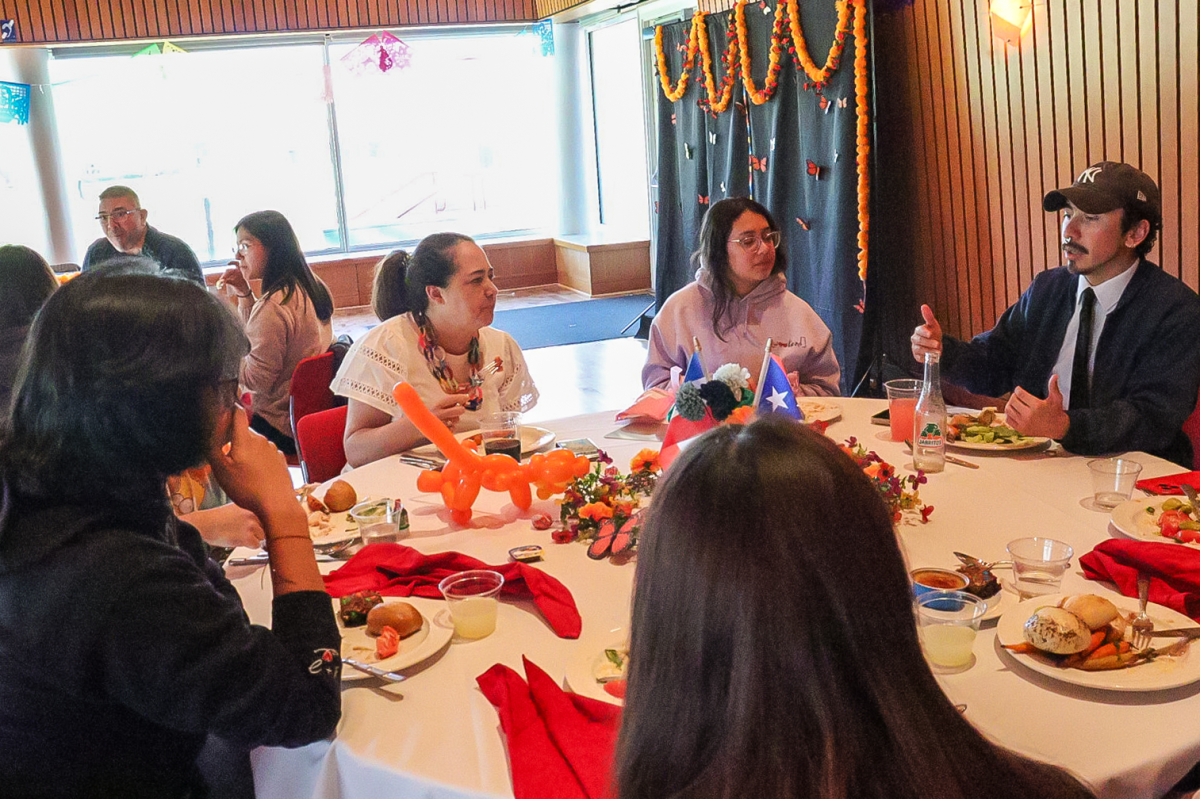
In addition to giving the talk, Lake also shared lunch with the Grinnell fire department and took a tour of CERA, to discuss local fire stewardship practices in Grinnell.
“At some point we have to … learn to live with fire, but more on our terms, right? We often fear what we don’t understand or what we don’t know, and fire, we’ve been taught to fear fire,” Lake said. “When are we going to turn the corner on that as a society, right, because it’s going to happen anyway. You want it to happen on your terms.”
Lake’s talk fits into a larger theme of climate change, Indigenous knowledge and the liberal arts that has guided the Center for Humanities in choosing Convocation speakers.
Andrews said adopting this theme was an intentional move by the Center to push for programs and educational experience centered on climate and Indigenous studies, and that such programming allows the Center to offer education in a way that combines academic disciplines.
“We do think about the elements of a liberal education and what it means, and, you know, we can add to that as well, right?” Andrews said. “We’re not a closed system, we can redevelop around climate change.”
Roxanne Smith `28, a biology and history double major with an interest in conservation, said the talk directly related to the Indigenous stewardship practices that she has learned about in other classes and talks.
“I think it’s like putting people at the forefront of your ecology project in this indigenous way,” Smith said. “That I feel like is really important to me, like to the work that I theoretically want to do.”
Andrews encourages those interested in Lake’s talk to interact with the Conard Environmental Research Area (CERA), the climate change committee, Indigenous studies and the Indigenous studies working group at Grinnell.