

































In the past few years, the Conard Environmental Research Area (CERA) implemented various renovations, including to an apartment refashioned for visiting scholar, artist and science residencies, according to Peter Jacobson, faculty director of CERA, chair of environmental studies concentration and professor of biology. These renovations to CERA — 365-acre biological field station owned by Grinnell College — were made possible due to Roy J. Carver Charitable Trust’s $200,000 grant grant, issued in August 2024, and other donations.
In 2025, CERA spent nearly half of the Carver Trust’s grant on the expansion of the maintenance shop, which stores equipment for fieldwork and electric four-by-four utility vehicles for facilitating navigation of the land. This funding also allowed new fencing to be put up around CERA’s property and a wall display highlighting CERA’s work in Noyce Science Center.
Capital improvements to the two-bedroom apartment above the Graham Lab, an aquatic geochemistry lab in the basement of the building, attracted the most public enthusiasm, according to Jacobson, From 1982 to 2018, a CERA caretaker occupied the residence but has been largely unoccupied since then.
This September, an anonymous donation from an alumnus helped to finalize the apartment’s renovations. The lodging is decorated with pieces that reflect the local landscape and capture moments of bonding at CERA — pastel landscapes created by Rachel Melis `01 during her undergraduate time at the College and photographs of the site taken by Justin Hayworth, a photographer of the College.
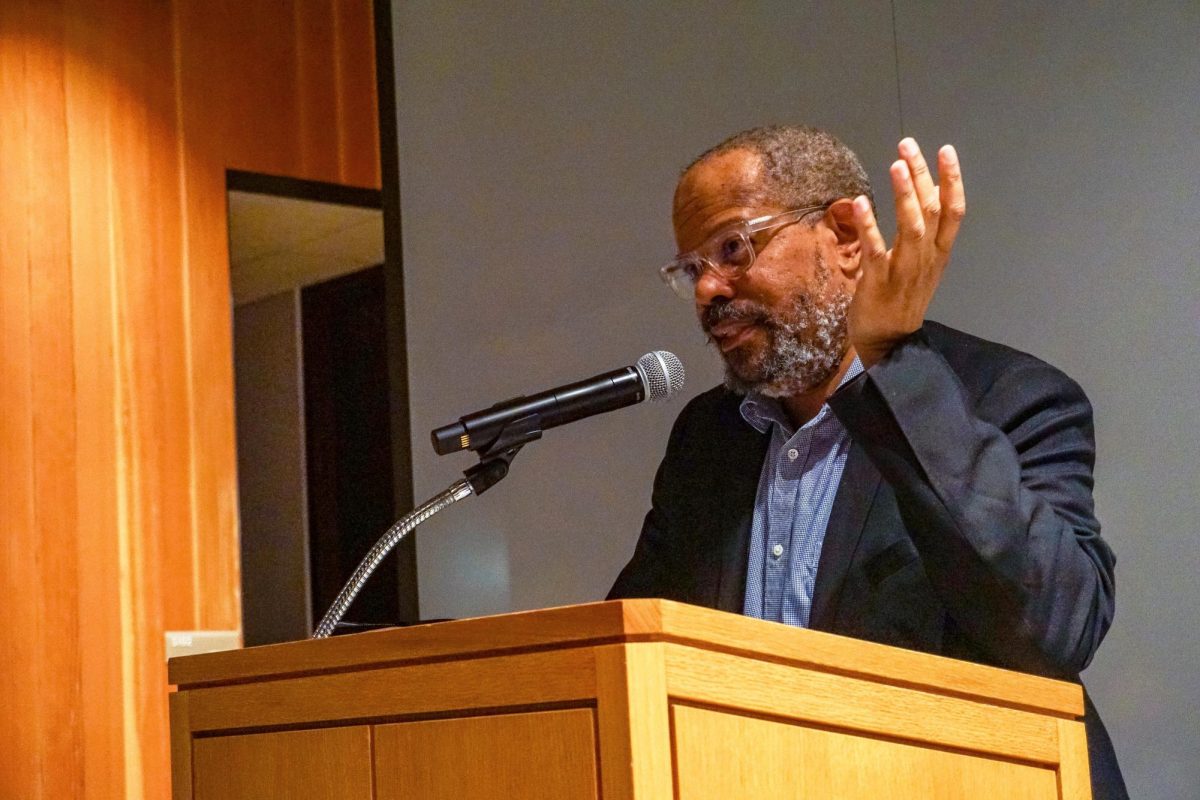
Maria Pinto — a writer and educator of mycology who visited Grinnell for a Writers@Grinnell reading and led a mushroom walk at CERA — was the first artist-in-residence and stayed the week of Oct. 6.
Pinto was the first to experience living in the newly renovated lodging, which she described as a beautiful, minimalist space to The S&B. The back of the house is all glass that overlooks the 14-acre Perry Pond. Looking through the telescope inside the lodging, she said she watched a deer grazing on algae in the pond. She was the first to sign the bright red guestbook.
“We want to provide the prairie as a site of inspiration for art and for literature and for other people to be inspired by the work that is done there but also by what Iowa has to share,” said Cori Jakubiak, director of the Center for Prairie Studies (CPS), in an article about Pinto published Oct. 8.
Jacobson said he asked Pinto for the proverbial Airbnb review. “She hopes to come back,” said Jacobson.
For over 20 years, the Center for Prairie Studies and the biology department had a vision of CERA being more connected to the College as a whole to Iowa’s natural landscapes, according to Jacobson.
“It’s really about getting more folks using it than just the biologists,” said Jacobson.
In 1968, the College purchased CERA for the purpose of being a field station geared toward biology classes. In 2005, the addition of the Environmental Engagement Center with two teaching spaces encouraged more visitors beyond those affiliated with biology.
CERA became a destination not only for biology class treks and inquiries but for nature walks hosted by CPS and community retreats. In some more peculiar uses, CERA was the scene for creative productions — one water dance as a part of the National Water Dance project aimed to bring attention to U.S. water issues, and a walking play called “Nature” was performed in 2015 about the friendship between Henry David Thoreau and Ralph Waldo Emerson.
The work done by the CPS is intertwined with CERA. Emily Klein, CERA manager and CPS outreach coordinator, said that she has been a part of reinvigorating CERA, since she was two months into her position when the College shut down due to the COVID-19 lockdown.
Since 2023, CERA has worked to improve trails and increase accessibility to every corner of the property through bridges, culverts, fences and raised boardwalks. Regardless of the weather conditions of the seasons, people can get around safely.
Visitors with limited mobility can use electric four-by-four utility vehicles, acquired before Klein worked at CERA. They also worked with the College’s campus safety to improve signage.
“It’s been a busier fall semester than I think we’ve ever had in the past,” said Klein. “It’s been all good things.”
CERA is a part of the College’s “Knowledge into Action” 2030 strategic plan, an initiative led by College President Anne Harris and approved by the Board of Trustees in fall 2023. As one of four initiatives this year, greater use of CERA will contribute to the goal of combating climate change. Jacobson said that CERA is at the crosshairs of the fraught state and national policies on the environment, sustainability and agriculture.
“CERA sits at this critical intersection between natural habitats and agricultural landscapes that’s a really important part of Iowa’s identity, the environmental history of the state,” said Jacobson. “It also reflects the global challenge that humanity has in managing agricultural production and protecting biodiversity and water in a changing climate.”
Klein said that she likes to highlight the prairie remnant, a piece of original prairie land that has not been uprooted or sprayed with any chemicals.
Going forward, Jacobson said that the environmental studies concentration hopes to expand to become a major and a department with the help of CERA as the host for classes.
In fall 2027, the environmental studies concentration hopes to pilot a semester at CERA for around 16 to 18 students. Led by Andrew Graham, professor of chemistry and environmental studies, these students would take three classes at CERA with three professors from the three divisions (humanities, social sciences and sciences) and conduct a directed research study. This semester would be analogous to the Grinnell-in-London off-campus study program, except students would not be able to live on CERA premises.