


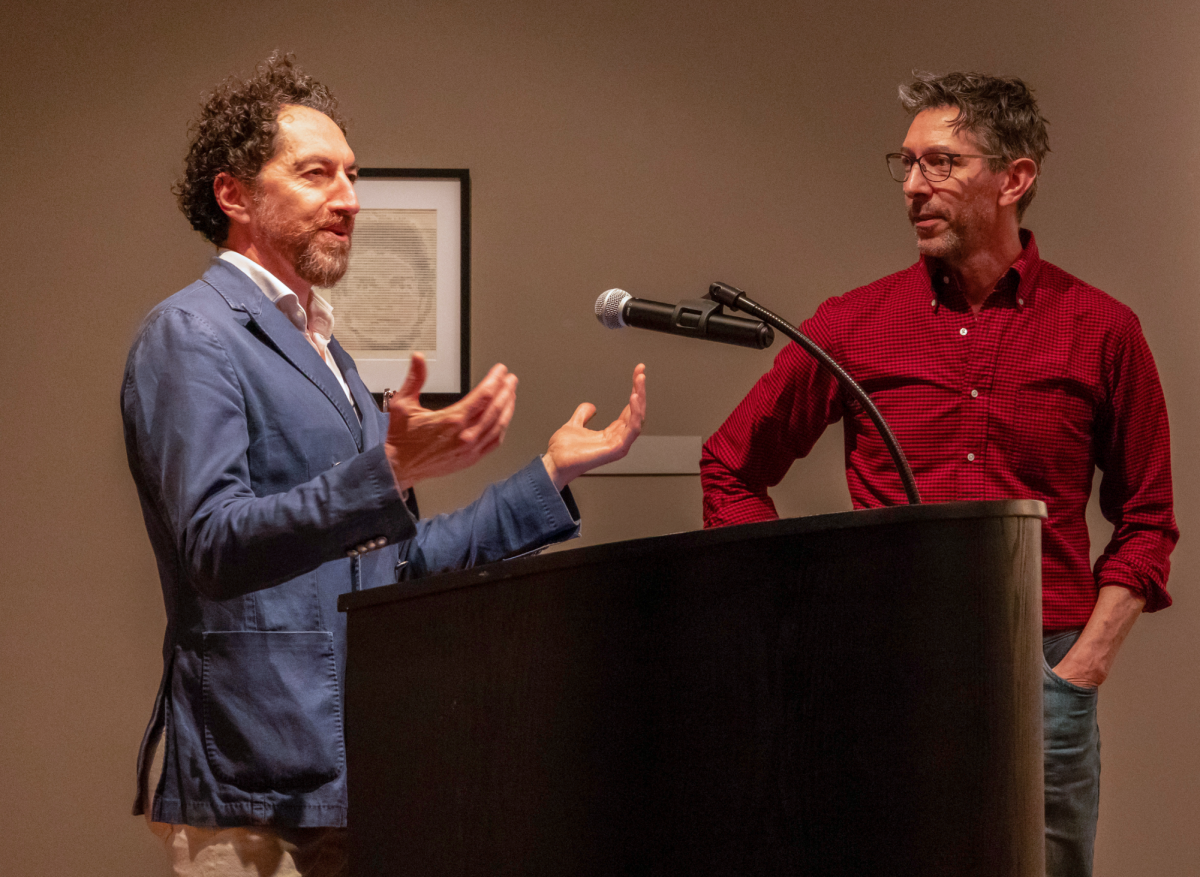


















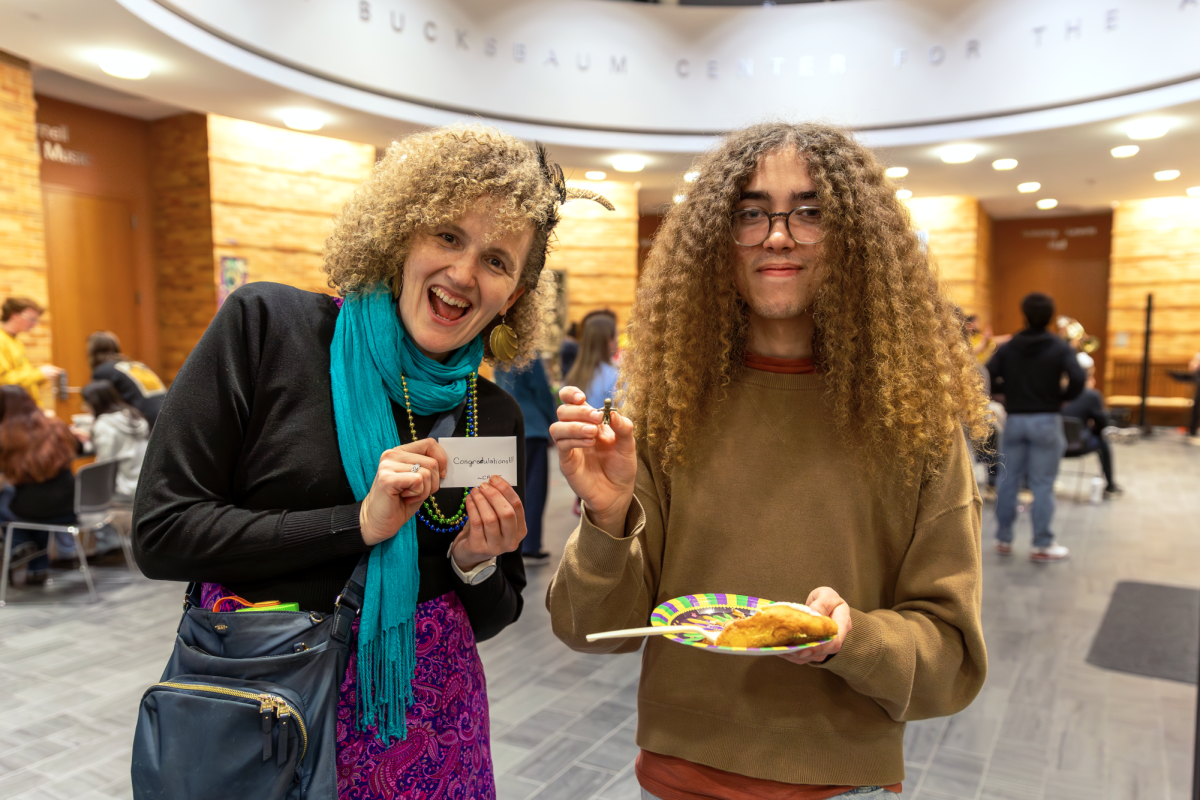

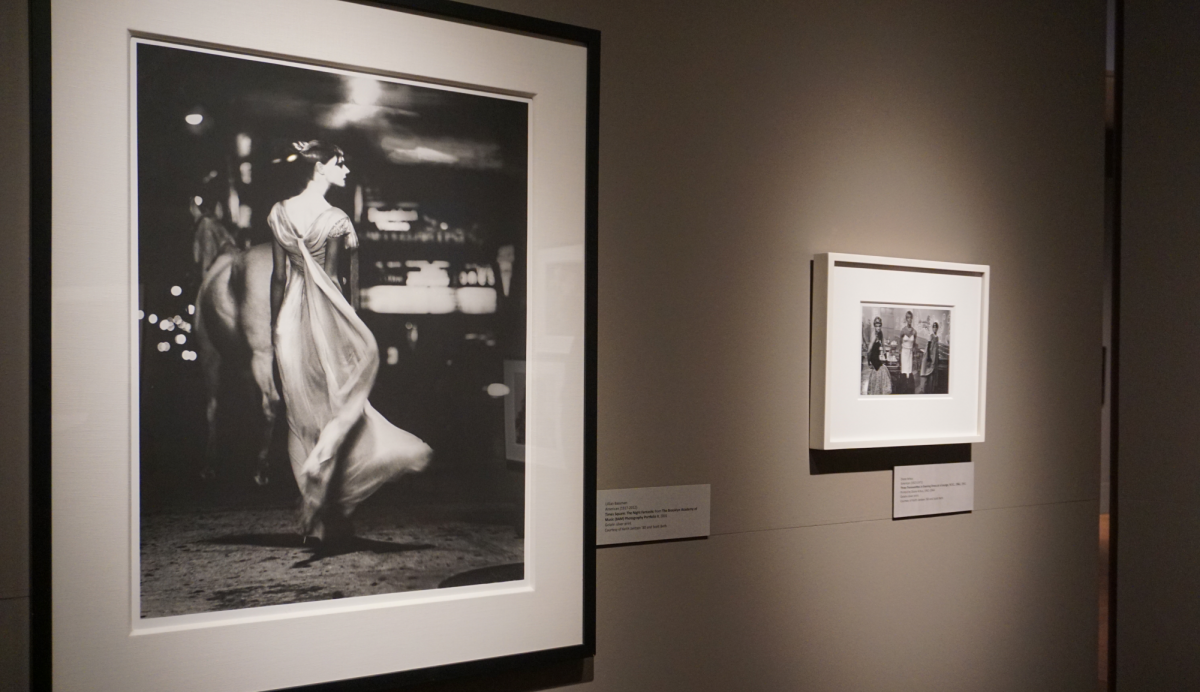
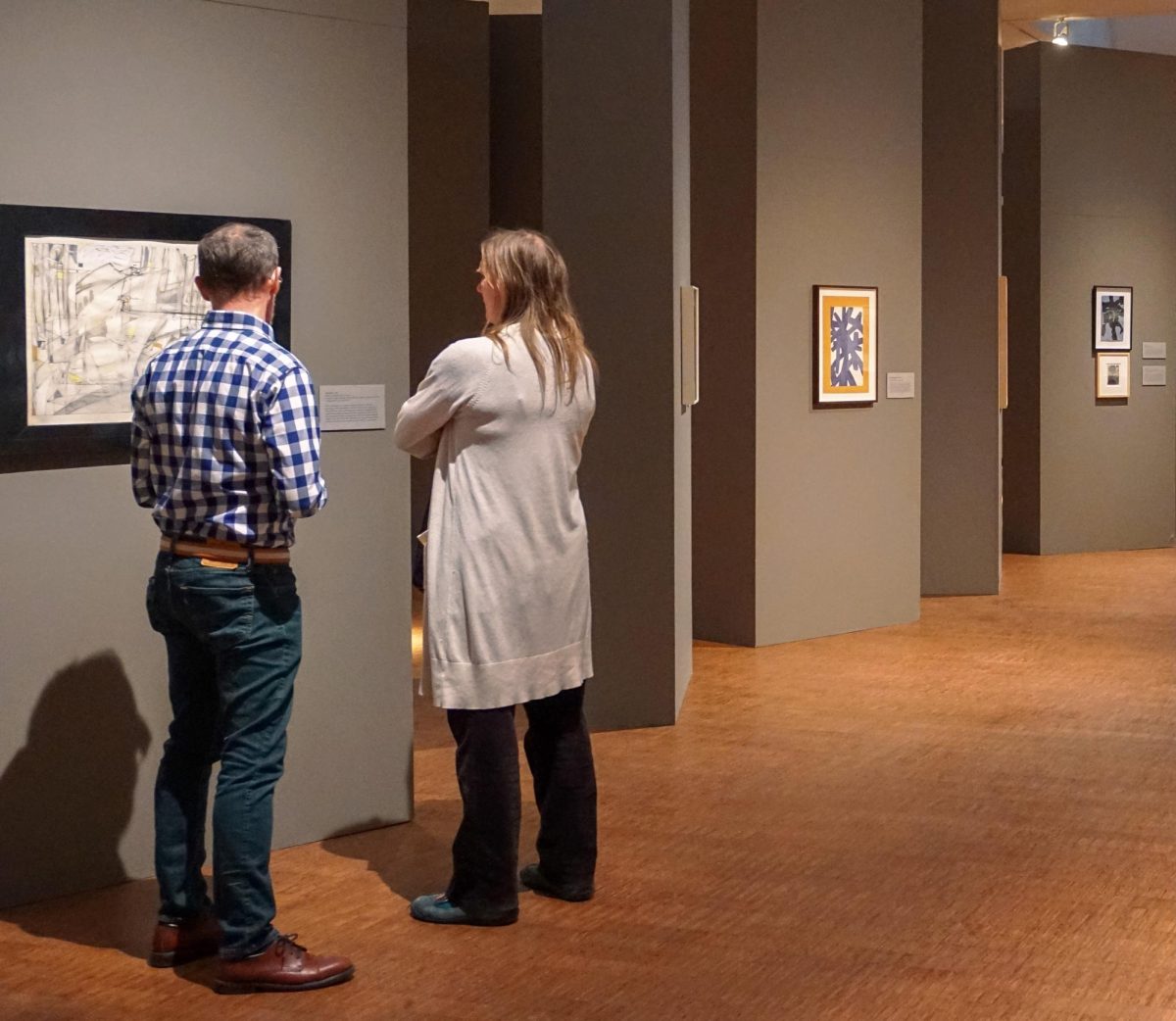
The Grinnell College Museum of Art (GCMoA) celebrated the opening of two new exhibitions. The east gallery features “Unruly Lines: The Art of Sonia Sekula,” curated by Jenny Anger and Dan Strong, while the west side holds “Rhizomatic Intimacies: Photography from the Collection of Keith Jantzen and Scott Beth,” curated by students from Michael Mackenzie’s ARH 360: Exhibition Seminar.
Mackenzie takes into consideration the tangible crossover between the two exhibitions, highlighting why it is important that they share the same space. “It is unusual that both exhibitions were led by faculty,” Mackenzie said. “There was one student who worked on both, Amy Kan. But they both really came out of the art history department.”
Mackenzie posed a question to the viewer of each exhibition. “How do both of these exhibitions reflect the work that is being done in the art history department?” he said. “And, for me, the answer is collaborative work between faculty and students.”
Jenny Anger, professor of art history, curated the Sekula exhibition and has been a longtime scholar on her. “It started nine years ago,” she said. “I was really fascinated by the art of Sonja Sekula.”
Anger’s research on Sekula led to a couple of articles and a chapter of a book that is scheduled for publication in March titled Surrealist Women Artists and Mental Illness.
Anger credits Strong, associate director and curator of exhibitions at the GCMoA, with supporting her research. Strong encouraged the College to buy pieces of Sekula’s, she said.
“Other than a couple of galleries in the country, we have the largest collection of Sekula,” Anger said.
“Unruly Lines” presents Sekula’s art in an almost completely chronological manner, other than a few pieces arranged out of order for aesthetic purposes. “It was really the most logical way of organizing her work because part of what is interesting about her work … is that she’s so varied,” Anger said. “So it didn’t make sense to show any consistency in her style.”
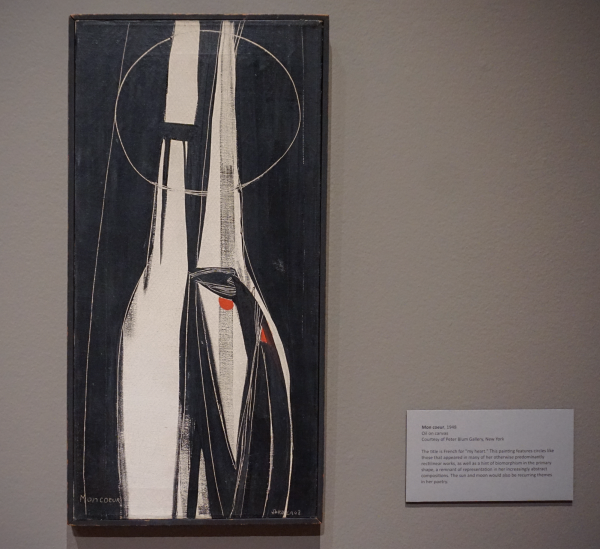
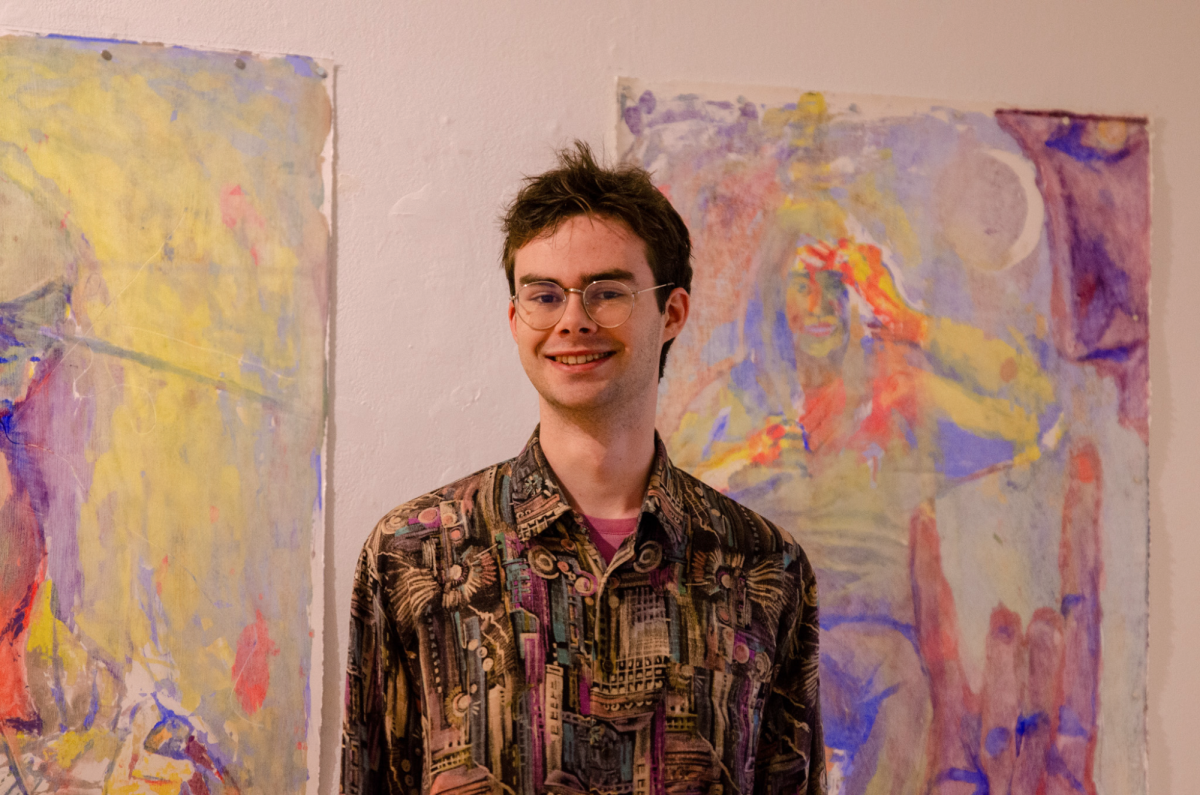
“Unruly Lines” showcases the work of Sekula, a mid-20th century artist whose vivid, experimental works reflected her experiences as a queer woman living with schizophrenia. Amy Kan `27, who worked as a collections assistant under Collections Manager and Registrar Jocelyn Krueger, authored both the exhibition catalogue essay and a portion of the wall texts within the exhibit.
“I feel like a lot of the things that she touches on seem to be really deep, universal conditions,” Kan said about Sekula’s art. “This feeling of being out of place, I’m sure that everyone has felt that at some point in their lives.”
Kan’s role in the creation of this exhibition and its catalogue began in July, the summer after their first year. They worked in the Museum’s inventory doing standard collections work until they were assigned to the Sekula project. They described their work on the catalogue essay as a different kind of challenge.
“The catalogue essay was like a marathon, but I got through it,” Kan said.
Anger reveals that one of the reasons behind the curation of the exhibition and her own fascination with Sekula’s work is her portrayal of how she dealt with her mental illness.
“It’s very joyful for me to see that someone who suffered so much could produce such beautiful art,” Anger said. She believes one thing students should get out of the exhibition is joy.
“Her work is so exciting and inspirational,” Anger said. “I would like that first intuitive, thrilled response.” To explain Sekula’s complex and defiant relationship with identity, Kan said, “She kind of slipped out of all of the boxes that tried to catch her.”
“Rhizomatic Intimacies” explores similar themes of defying boundaries and categories through photography. The student-curated exhibition features photographs from the collection of Keith Jantzen `80 and his partner Scott Beth. The title “rhizomatic” — a botanical term referring to interconnected root systems — reflects the diverse ways intimacy manifests across the collection.
Student curator Kiele Calhoun `26 said, “Because of the nature of our show and how each photo is so drastically different, it shows how people can experience intimacy in such different ways.”
“We tried to be as collaborative as possible,” said student curator Sugi Lucas `27. “We were all kind of tossing out what themes we were seeing in the collection, and one that was coming out a lot was the idea of intimacy and connection.”
Michael Mackenzie, professor of art history and instructor of the Exhibition Seminar, said the students developed the exhibition’s central concept independently. “They developed the theme of rhizomatic intimacy,” he said. “In fact, one day they just presented that to me, completely formed.”
“I knew that there were about 10 photographs from the permanent collection that had been given to us by a trustee and alumnus, Keith Jantzen,” Mackenzie said.
“I was visiting them … and I pitched this idea to them, and they were really excited by it, and immediately threw open their collection for the students to draw on,” Mackenzie said about Jantzen Beth.
“Keith and Scott are partners and they have a big focus on collecting the work of queer photographers,” Lucas said. He said he suspected there would be a vested interest in the work of the artists that were included in the seminar’s curriculum. “I think that it is, in art history generally, and in the humanities generally, a real interest in exploring queer identity,” he said.
“Peter Hujar is one of the most famous queer photographers from the 70s, so there is a big celebration of queerness throughout their whole collection,” Mackenzie said.
Mackenzie also added that not all the photographers and subjects in the exhibition are queer, but that he thought students would still be interested in those in the exhibition who are.
“I think, top of mind, is just how important it is to represent right now,” Mackenzie said of queer identity. In a moment, a cultural, political, historical moment when a kind of embrace of differences in gender, difference in sexuality, is facing a push-back.”