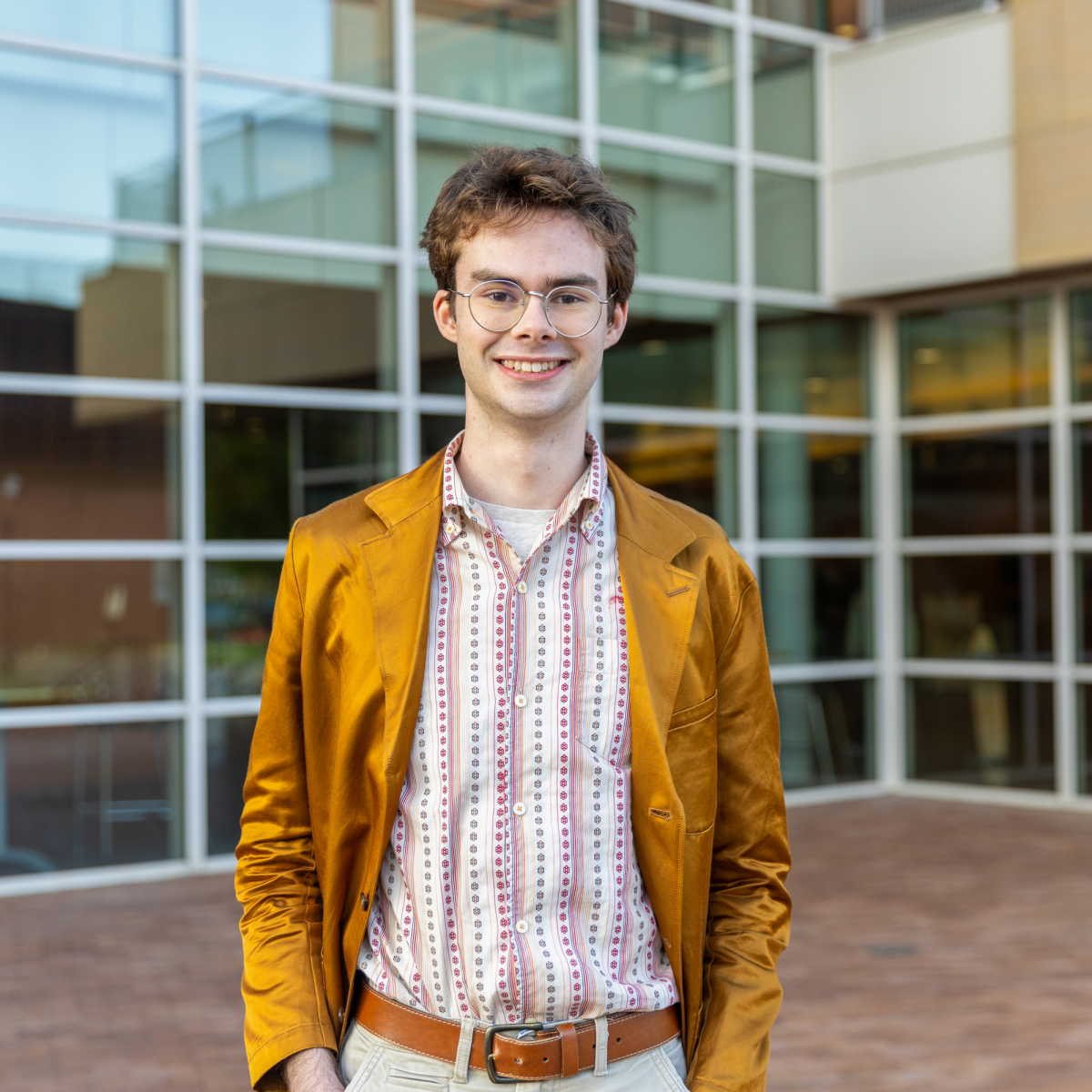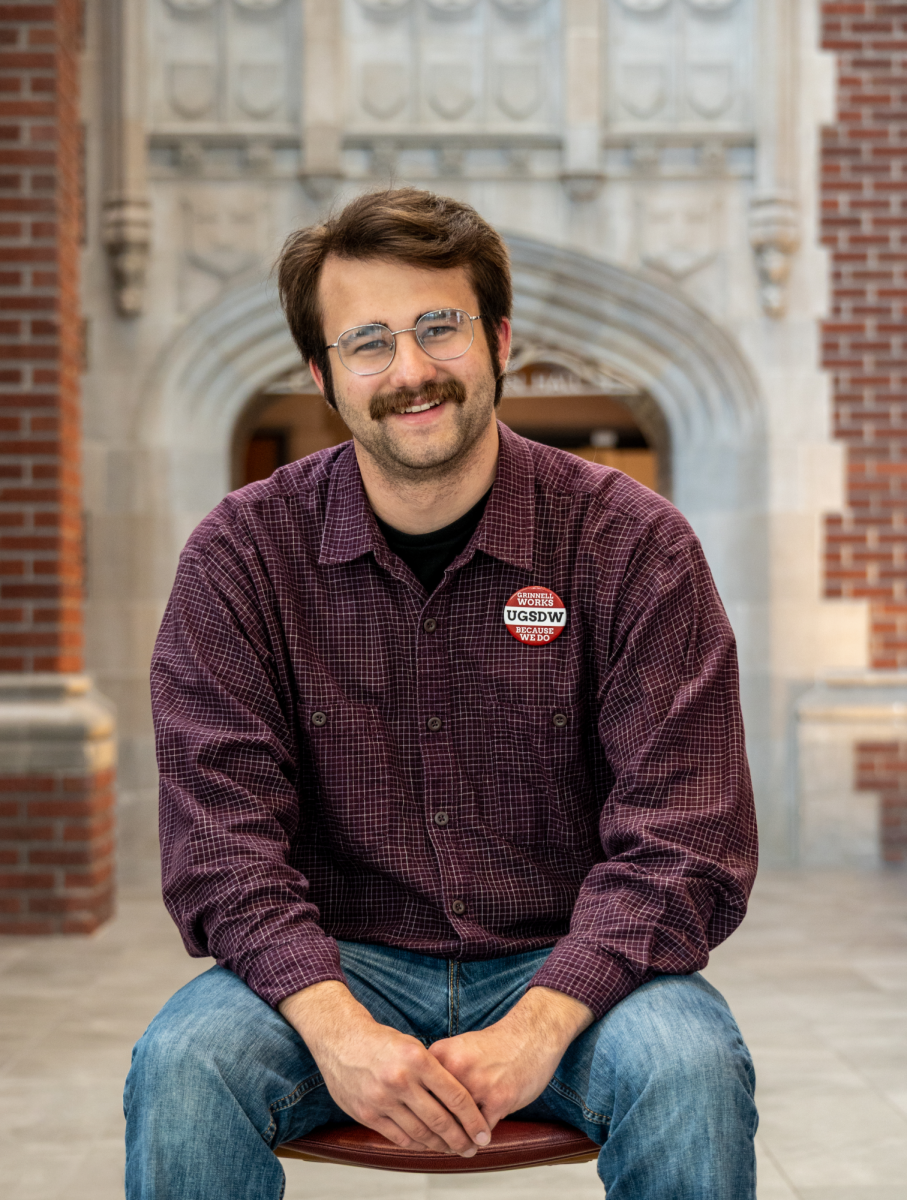
During the evening, while most students stay on campus, Ezra Turner `26 is driving out of Grinnell, past cornfields and into correctional facilities, where the classrooms look different but the lesson content remains the same.
For the past three semesters, Turner has been one of two student workers for Grinnell’s Liberal Arts in Prison Program (LAPP). The LAPP offers incarcerated individuals in Iowa college credit-bearing classes. Turner tutors and supports incarcerated students at the Newton Correctional Facility (NCF) and the Iowa Correctional Institute for Women (ICIW). “It’s been one of the most meaningful experiences of my life,” he said.
“I recognize that what I tutor — Ancient Greek, or Greek Tragedy, or Emotions of the Greeks, or Classical Myth, what have you — isn’t super applicable to the modern day,” said Turner. “But what I can do is, I can help teach the students to articulate themselves clearly. If that means that later on, they can write a better letter, or they can write a better job application, or they can just make themselves heard through the written word, then that’s a good thing, right? I think those are the skills that I’m really hoping that I’ve had a positive impact on.”
One student Turner worked with recently visited campus after being released from prison, and is now applying for admissions to Grinnell as a nontraditional student. “That was really awesome, because I had worked with them for multiple semesters as a writing tutor for their class and I worked directly with them on a number of papers. Seeing them on campus and sharing a meal with them in D-Hall was awesome,” said Turner. “They’re also very brilliant, so I’m hoping that they do end up being able to come here.”
An anthropology and classics double major, Turner first encountered the program during the spring of his second year when he took Classical Mythology with Classics Professor Dustin Dixon, who regularly teaches for the LAPP. The class was taught in correspondence with the incarcerated students at NCF who were taking the course simultaneously. Turner said they exchanged letters, art and essay responses.
“It was through this back and forth with the students at NCF that I knew I wanted to get involved,” Turner said. “We were getting back a lot of deeply rich and also amusing material from the students at NCF. And so that was awesome — a lot of very different takes from what you would get in a campus class.”
The class also solidified his interest in the major. “I took Ancient Greek as a whim, and then I declared after Classical Mythology, and really liked the class and correspondence with the prison program,” said Turner. He now works as an Ancient Greek tutor and serves on the Classics Student Educational Policy Committee (SEPC) on campus.
Turner came to college planning to major in biology, but quickly realized it wasn’t holding his attention. Grinnell’s liberal arts education and his tutorial advisor encouraged him to take anthropology in his first year.
He credited Professor Owen Kohl for his ultimate decision to major in anthropology. “Everyone should take a class with Professor Kohl if you can. Owen Kohl is a great man who cares very much about making the field accessible,” Turner said. “So that’s how I fell into anthropology because I was falling asleep during biology.”
Looking back, Turner said what stands out about Grinnell is the community. “We all have our own special interests. We all care about our little slices of the world, and I would say that we do a really good job of caring for other people’s super niche interests. So, in my experience, that’s been good,” Turner said.
“My research is about religion, mostly. Either ancient religion or modern religion. I’ve got two theses this semester,” Turner said. “And to be honest, no one cares about Greek sacrificial ritual, but I’ve been really surprised about the willingness of my friends and the community members around me to show up and listen to me talk about something ridiculous.”
Additionally, he said his time at Grinnell helped him learn to broaden his perspective. “Sort of accepting that, okay, my education is important, but it is not necessarily the most important thing in life,” Turner said. “So that’s been a big change, and that’s something I’ve grown a lot during my four years, and I think that’s something that Grinnell’s been very good for me for.”
His favorite memories at Grinnell include running the chocolate milk mile, where he vomited alongside one of his dear friends, and campus traditions such as Farmstock.
He said it’s the little moments that stand out. “It’s a little corny, but the long hours shared with people in the library of burning the midnight candle to get something done for finals week. Ironically enough, that’s where I think I found my closest friendships.”
After graduation, Turner hopes to go into nonprofit work and has been exploring funded fellowships at homeless shelters. He also hopes to remain involved in prison programs, continuing the work that has shaped much of his time at Grinnell.