
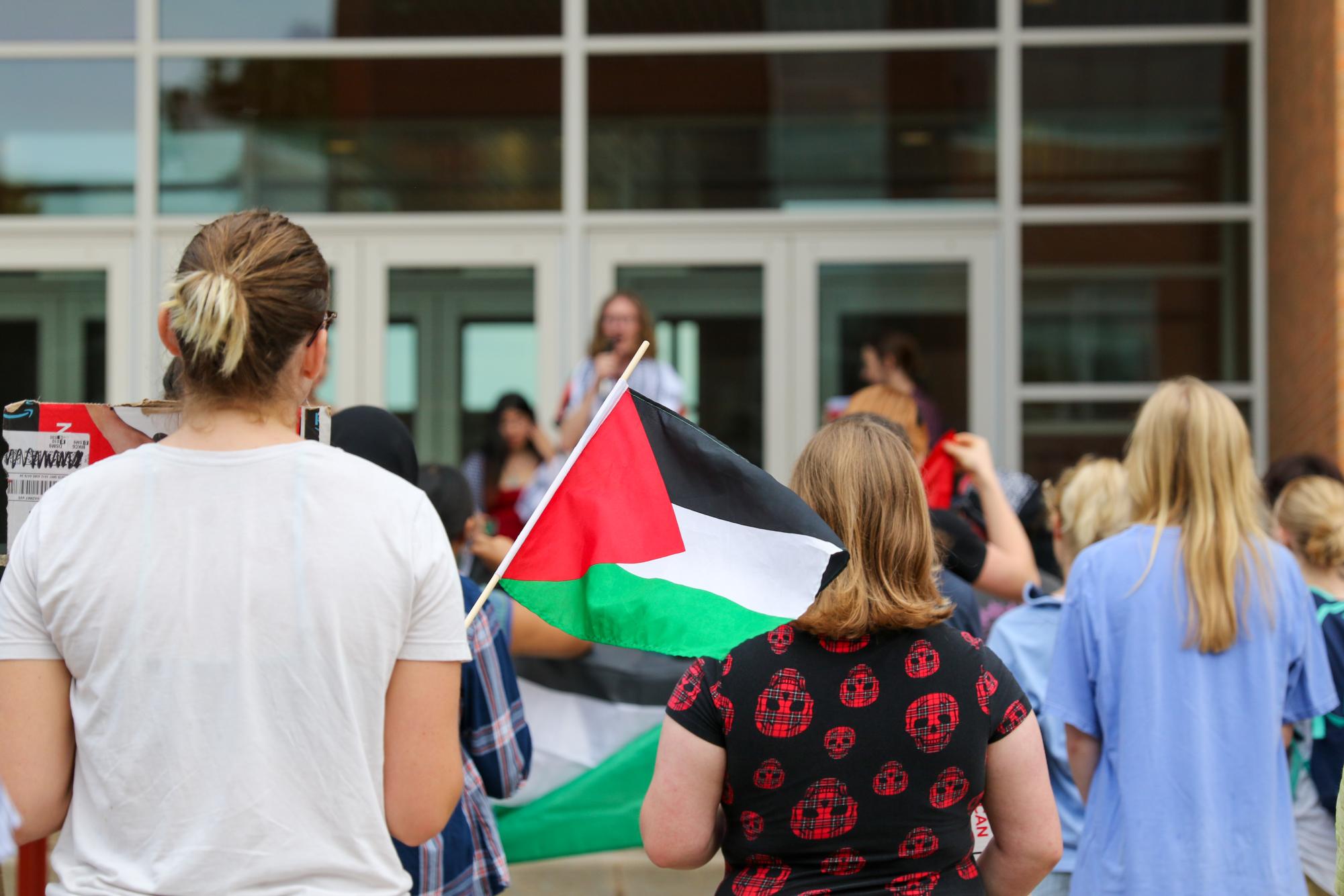
Grinnell College has taken to monitoring the language that student organizations use on public-facing written material, like publications, fliers or social media posts — specifically regarding the word genocide when used to refer to the war in Gaza. The change is in response to the Iowa Code Chapter 216, Section 216F.1, also known as IA Code § 216F.1. Iowa lawmakers updated the state code in July 2024 to include a new provision regarding the definition of antisemitic language.
Within the state code, Iowa now uses the definition outlined by the International Holocaust Remembrance Alliance (IHRA) when defining and addressing cases of antisemitism. Although it was originally introduced in February 2022, prior to October 7 and the war in Gaza, its application has started to be tied to rhetoric surrounding the conflict.
“A lot of what the College has been saying [to SJP] has not really been in written work through emails this year and last year for the RSO tabling,” said Catherine Kim `27, who is a member of Students for Justice in Palestine (SJP). In the past, she said SJP members were prevented from handing out educational zines because the word genocide had been used on them.
“We haven’t talked specifically or directly with their lawyers,” said SJP member Adelaide Creegan `27, referring to the College’s lawyers. “But we understand that the way that their lawyers are interpreting the law for them is the reason that they’ve told us we can’t use the word genocide.”
As for the reasoning behind the interpretation of the code, Creegan said that the College had pointed back to the wording of the IHRA’s definition. “They’ve said that because of the way that the IHRA description of antisemitism is written, that if it includes anything related to genocide, apartheid — anything like that would get the College in trouble. And so therefore we’re not allowed to say that or use it on posters or zines or any of our material,” said Creegan.
In an email to The S&B, Ellen de Graffenreid, vice president of communications and marketing, pointed to the August 2024 Colloquium presentation, which explains contemporary examples of antisemitism under the IHRA definition and references how the College is interpreting the new law. A couple examples provided in the code are “Calling for, aiding, or justifying the killing or harming of Jews in the name of a radical ideology or an extremist view of religion” and “Accusing Jews as a people of being responsible for real or imagined wrongdoing committed by a single Jewish person or group, or even for acts committed by non-Jews.”
Victor Thorne `26, president of Free Speech Club, said that he had also been approached by college administration about a debate topic relating to Israel that the club had promoted on posters.
Although the posters did mention Israel, the exact wording did not include the word genocide or any reference to the war in Gaza. “It was something like, ‘how should the U.S. treat Israel?’ I didn’t use the word genocide at all. I think they thought that the word genocide might come up,” said Thorne. “My interpretation of the situation was that they were trying to intimidate us into not talking about this.”
While SJP has an official stance on the conflict, Free Speech Club maintains a non-partisan identity. Both SJP and Free Speech Club have expressed that they wish to continue publicly addressing the topics despite intervention from the College.
“I don’t want to be intimidated. I wasn’t using the word genocide in the first place because we’re a non-partisan group,” said Thorne. “I want to try and frame topics as neutrally as possible when I’m announcing them, so that people, of all opinions, feel comfortable coming.”
“I think there’s a point where we understand that the censorship is wrong and that it’s not even constitutional. So we’ve chosen to just ignore it, and if we got in trouble for that, we’d be okay with that,” said Creegan.
De Graffenreid wrote that discussion between Student Affairs and an organization who used the word genocide on an event poster was simply meant to inform the students of Iowa 216F.
This article has been updated to specify that the written material the College is monitoring is public facing. Updated on 12/8/2025.





Brandon Lloyd • Dec 17, 2025 at 5:20 pm
As a Grinnell college alum, I made a significant contribution last year. However, I do NOT expect to do so again until the college divests from all Israeli linked companies. I do not wish to help fund companies like Amazon Google Palantir and Microsoft that help the Israeli government (w data and AI) target and murder healthcare & aid workers, journalists, civil servants, and civilians in Gaza.
I hope that Grinnell students will push back against the college’s absurd restrictions on free speech.
With Israeli officials and most of Israeli society calling for the removal or death of Palestinians, most of the buildings in Gaza leveled, what else do you call Israeli actions except with the G word?