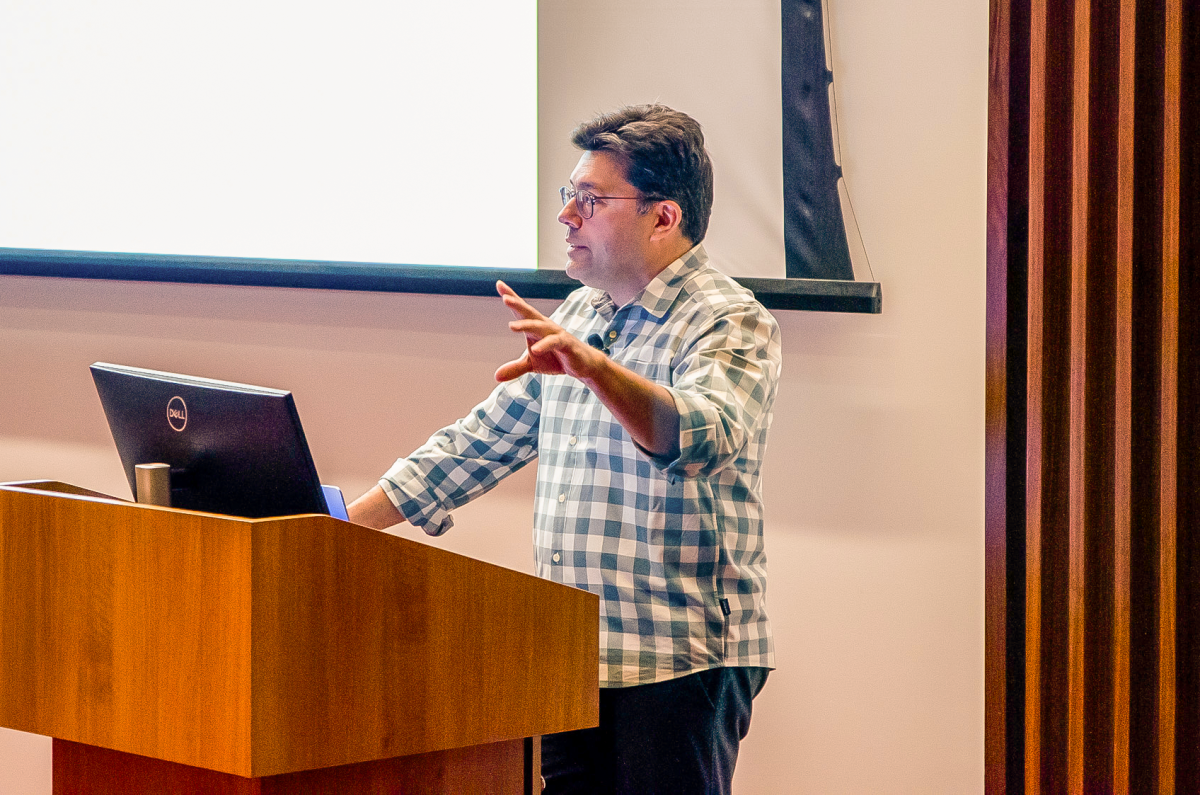
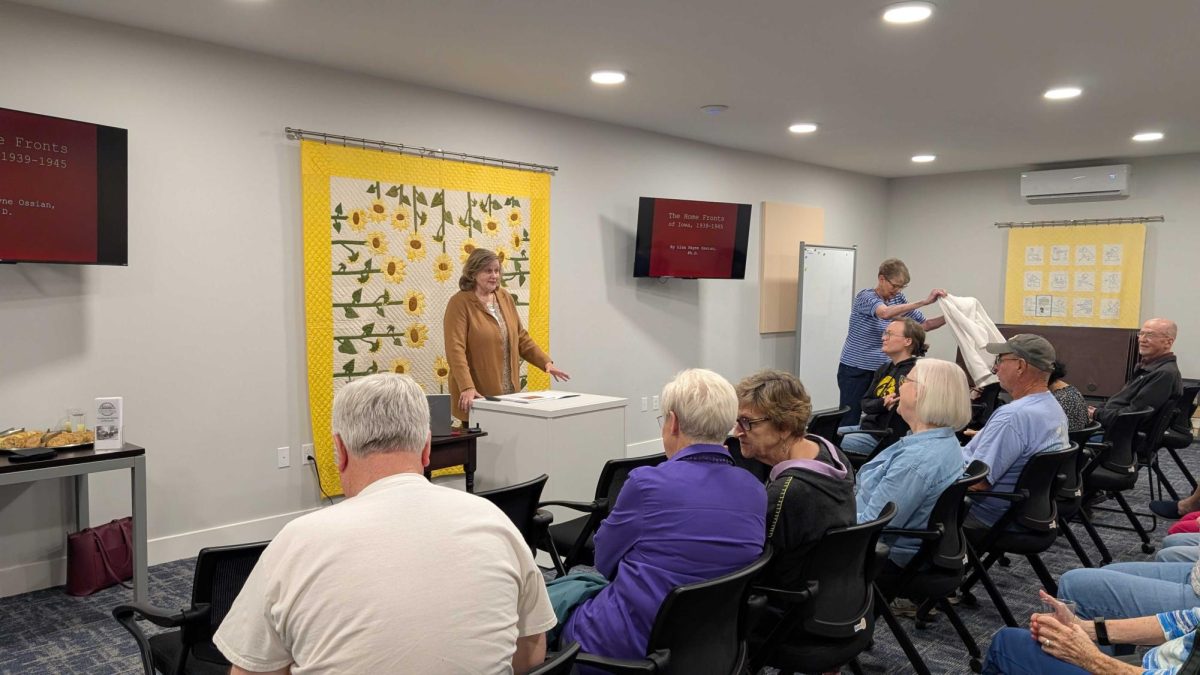
Dr. Kyrah Malika Daniels presented Haitian vodou ritual flags, called drapo, as visual testimonies, documenting four centuries of collective trauma and acts of divine intervention.
Her presentation on Nov. 6 traced the resistance of Haitian communities who have preserved their history through sacred art during periods of war, persecution, natural disaster and pandemics. Dr. Daniels launched Grinnell College’s Haitian Arts Digital Crossroads (HADC) project “Healing the Narrative” campaign ahead of the portal’s November 21 public presentation.
“The Haitian vodou spirits have not forgotten their children,” Daniels said, displaying images of beadwork depicting spirits wearing masks during COVID-19 and offering aid during the 2010 earthquake. The ritual flags contain 18,000 to 20,000 beads each.
The flags Daniels discussed are part of the same Waterloo collection that Dr. Petrouchka Moïse, assistant professor and cultural and community-based digital curator, has been digitizing since 2020. The collection of over 6,000 Haitian artworks, including 400 ritual flags, had been sitting with no digital presence for nearly 75 years before the HADC project began.
Daniels mentioned that attendees can see ritual flags locally in the Waterloo Museum’s collection.
Daniels’ convocation is the first of three major events in the “Healing the Narrative” launch campaign. The HADC Lunch & Learn followed on Nov. 11, where the research team shared their digitization work via livestream. The campaign ends on Nov. 20 at the Waterloo Center for the Arts with a reception and keynote address by guest speaker Yvena Despagne, a Haitian-American artist, curator and cultural practitioner, on “The Façade and Futures of Haitian Art.”
Daniels structured her presentation around four historical periods of Haitian crisis. She began with the Haitian Revolution, Haiti’s war for independence from 1791 to 1804, showing the evolution of ritual flags into military banners. The anti-superstition campaigns of the 1880s through 1940s produced flags that went underground when vodou practitioners faced persecution.
Daniels pointed to the artist Bonali Edmond, who survived the 2010 earthquake but could not create a flag depicting it for over a decade. “Emotionally, he said it was too difficult,” Daniels said.
After the 2021 earthquake, Edmond completed his 2010 earthquake flag, depicting a scene where “bold metropolis has become a necropolis.”
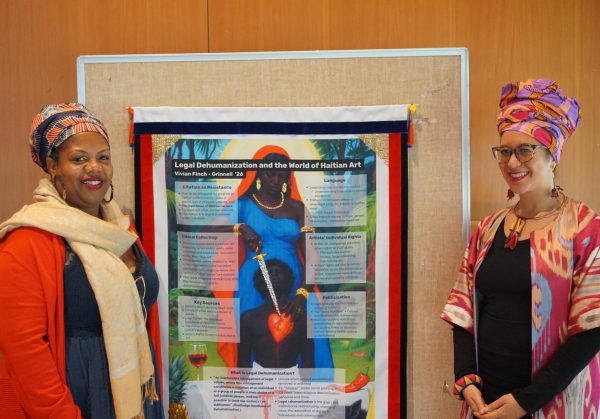
Daniels showed how Haitian artists have documented the COVID-19 pandemic through sacred art, displaying flags where vodou spirits appear wearing surgical masks. In one image, the healing spirits Gede and Baron — associated with death and rebirth — appear as “COVID doctors” fighting coronavirus particles.
“Here we bear witness to the spirits’ healer-warrior status as they fight to keep their COVID-positive children alive,” Daniels said. She introduced the concept of “divine reflexivity” as the idea that deities adapt to contemporary challenges. The Haitian artworks focus on collective healing rather than blame.
Daniels distinguished between flags created for ritual use — those that danced on the backs of initiates during ceremonies — and those made for commercial export. She said both serve as cultural preservation, especially as Haiti faces compound traumas. The 2021 earthquake struck almost exactly 230 years after the Bois Caïman ceremony that launched the Haitian Revolution, a timing that artists incorporated into their compositions.
During the Q&A portion of her talk, Daniels said this was her first visit to Iowa. She had visited the Waterloo Museum’s vaults, which house 6,000 Haitian artworks — 2,000 of which are being digitized.
“We have now just acquired Kansas University, so now we have the entire Midwest part about the HADC project,” Dr. Moïse said.
Daniels concluded with a work depicting a seemingly Catholic bishop spirit alongside a vodou practitioner wife, both united in fighting COVID-19. “Imagine what we could accomplish if we were more open to interfaith collaboration,” she said. “It’s not the vodouists who have a problem collaborating — it’s the evangelical Christians.” She said that evangelicals blamed the 2010 earthquake on vodou practice.
An audience member asked about the absence of blame in COVID-19 depictions, contrasting it with U.S. rhetoric. Daniels said this might be because COVID-19 “wasn’t as much of a threat for the same scale of population as it was in the U.S.” “Haitians are very cautious about placing blame on those who are innocent,” she said. Daniels attributed this to historical accusations against Haitians, citing the 1980s Centers for Disease Control and Prevention (CDC) classification of Haitians as HIV/AIDS carriers and the 2010 cholera epidemic brought by U.N. troops.
Her presentation addressed theodicy — questions about why disasters occur — through Haitian artists’ responses to suffering. Dr. Daniels said that artists’ work contains the power to become “ritual methods to reinvigorate the balance of the universe.”