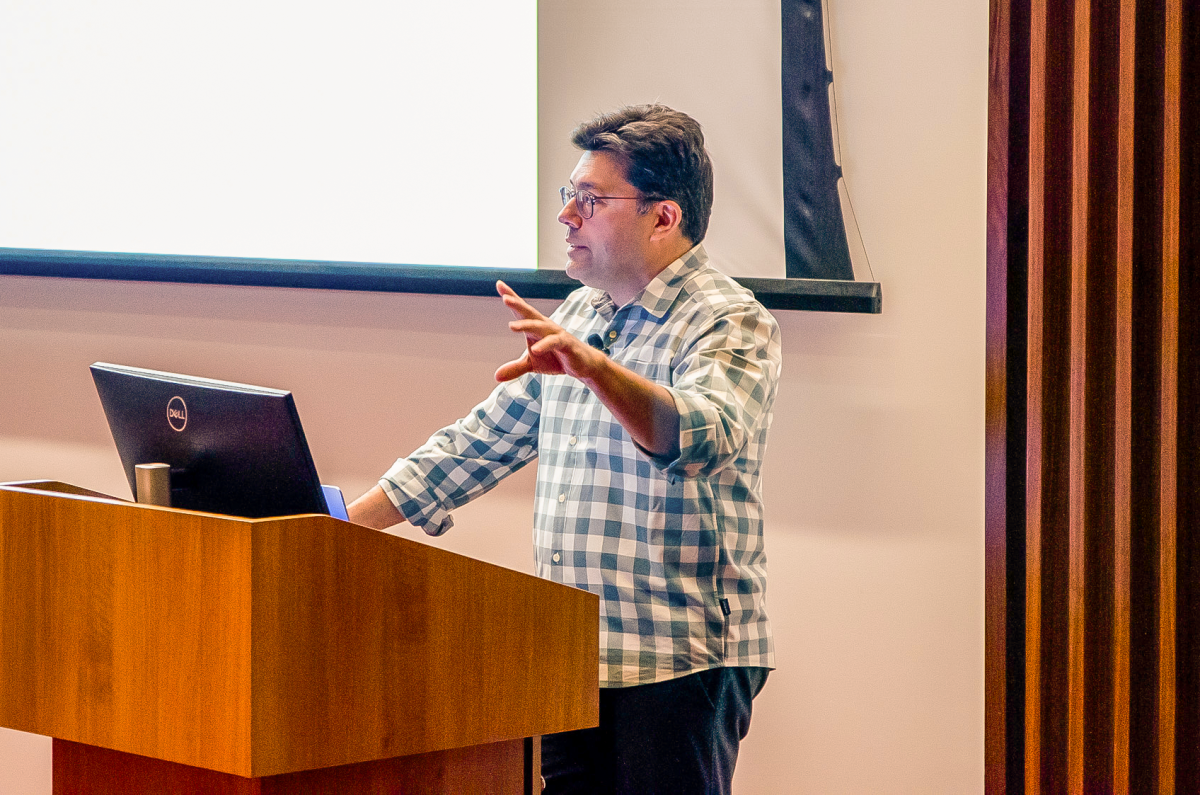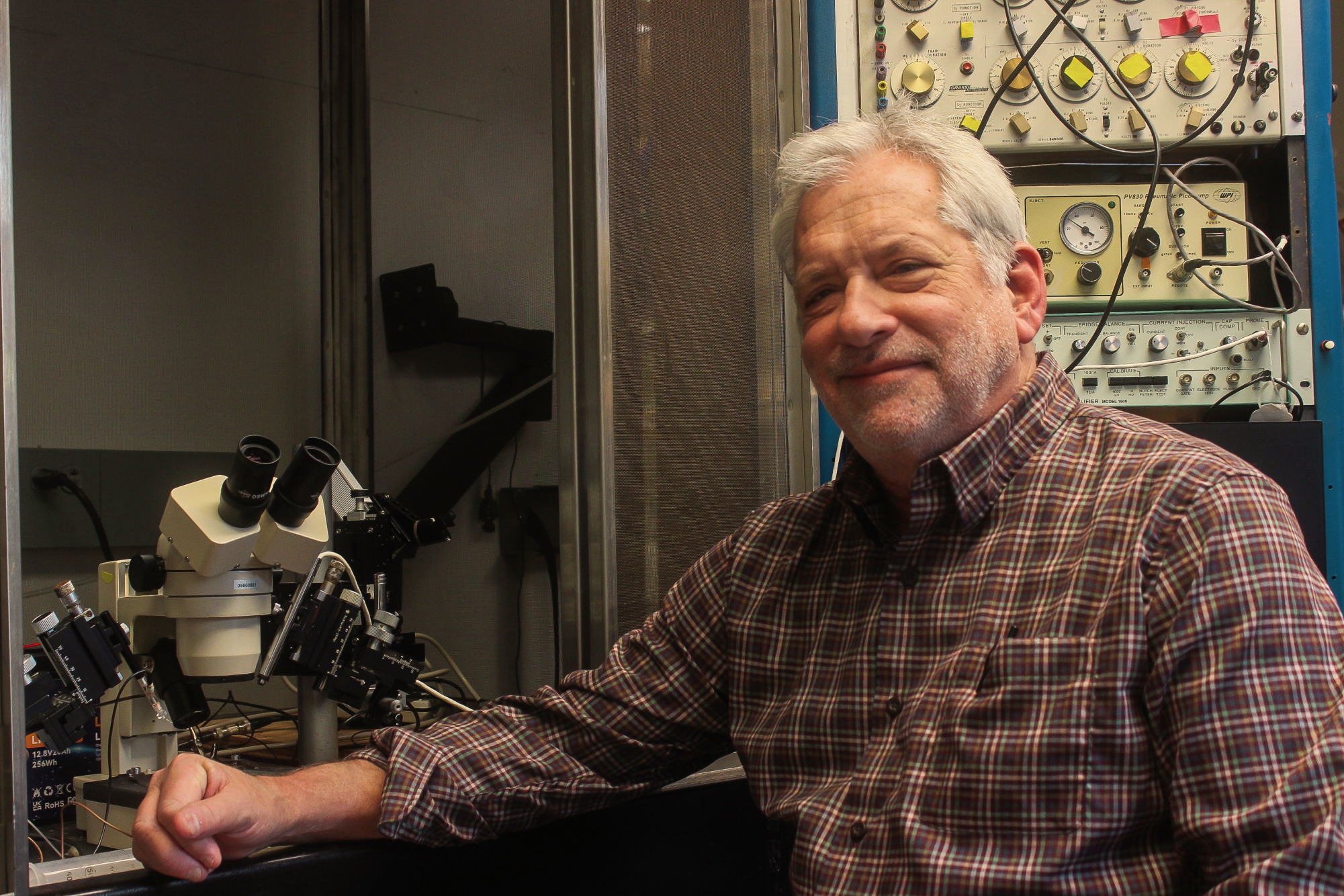
When Clark Lindgren, professor of neuroscience, first began investigating synapses, the points where nerve cells communicate, he was fascinated by one question — how does the brain stay stable when its connections are constantly changing?
With a $515,078 grant from the National Institutes of Health (NIH), Lindgren is pursuing this mystery by studying a process known as synaptic homeostasis, or how neurons support balance while adapting to added information.
“A synapse is where a presynaptic cell communicates with a postsynaptic cell by releasing neurotransmitters that bind to receptors and produce a response,” Lindgren said.
“But if that process is disrupted, say, if fewer receptors are available, the presynaptic cell responds by increasing neurotransmitter release.”
That adjustment is what keeps communication between neurons stable, a process that is crucial to learning, remembering and overall brain function.
“It’s like a homeostatic control mechanism that allows the synapse to keep working despite what’s happening around it,” Lindgren said.
Lindgren’s current project aims to uncover how the presynaptic neuron knows when to “talk louder.” He likens it to a conversation.
“If we were talking and you suddenly lost half your hearing, I’d have to start speaking louder,” he said. “But how would I know to do that unless you somehow signaled back to me?”
Lindgren and his team suspect that the signal in the brain may come from an unexpected source — protons, also known as hydrogen ions.
“It’s a very novel idea,” he said. “Usually, we think of neurotransmitters as large, complex molecules like glutamate or acetylcholine. But this would be the simplest signal in the universe, just a single proton, helping support stable communication between neurons.”
The grant will allow Lindgren and his team to investigate this potentialsignaling mechanism over the next three years.
Working alongside him are student researchers Erich Raumann `27, Mahiro Noda `26 and Rene Briones `26.
“Undergraduate research is a core part of what we do here at Grinnell,” Lindgren said. “This award reflects not only innovative ideas, but also our students’ past success, producing work that has been published and peer reviewed.”
That distinction sets Grinnell’s program apart, he added. “A lot of students at other institutions do research, but it doesn’t always reach the level of publication. For our students, this award recognizes that we’re not just doing research for the experience, we’re doing research that contributes to the field.”
The NIH grant marks the fourth time Lindgren has received funding from the agency. Each award supports three years of work, meaning he has spent more than a decade advancing this line of research.
What keeps Lindgren motivated is simple — curiosity and mentorship.
“I like puzzles,” he said. “I’ve always liked figuring things out. And I really enjoy seeing students develop into confident scientists, people who can ask their own questions and go out and find answers.”
For neuroscience students like Briones and Noda, that mentorship has made a very lasting impact.
Briones described his time in Lindgren’s lab as “really transformative.”
”One of the biggest things I’ve learned is to be patient, consistent and flexible at the same time,” Briones wrote in an email to The S&B. “There’s always something changing in the lab, so you have to be ready to adjust and try new things. I’m very thankful for getting to work with Professor Lindgren.”
His current project focuses on investigating the viability of visually recording the process of presynaptic homeostatic potentiation (PHP) at the Drosophila neuromuscular junction.
“Even these model systems that have been used for many years can continue to provide new and fascinating avenues of study,” he wrote.
Briones added that Lindgren’s mentorship style gives students freedom to explore while offering guidance when needed.
“He’s not the kind of principal investigator to hold your hand through everything,” he wrote. “But he’s always there to push us through the harder times and support us when we need it.”
Noda echoed those sentiments, emphasizing how the lab environment has shaped her path.
“I’ve grown to love the research work and being a part of the team,” Noda wrote in an email to The S&B. “Joining the Lindgren lab has been one of the biggest highlights of my time at Grinnell.”
Noda began in the lab as a summer mentored advanced project (MAP) student in 2024 and now serves as a senior researcher.
She applies computational simulations to study the role of protons in synaptic stability and collaborates with researchers at the Salk Institute in California.
”This research has solidified my passion for neuroscience,” she wrote. “I hope to pursue a Ph.D. and eventually lead collaborative research that connects academia and industry.”
As the project continues, Lindgren hopes to shed light on one of neuroscience’s most intriguing topics on how the brain supports stability amidst constant change, and how even the smallest signals can make the biggest difference in science.
Correction: This article has been updated to clarify that Briones’ and Noda’s statements were over email.