When Damon Davis emailed Grinnell College Museum of Art (GCMoA) this fall, he had a question — What’s the secret sauce?
The St. Louis, Missouri-based artist had been producing prints elsewhere, but none matched the quality of the work he created during his month-long residency at Grinnell College in 2019. During his 2019 month-long residency, Davis had created over 100 works, including prints, mixed media sculptures and body castings.
The answer to Davis’ question, according to Tilly Woodward, curator of academic and community outreach at GCMoA, was an Epson large-format printer belonging to the art department, with support from 3-D art technician Matty Clark.
This printer was what brought him back to campus the week of Nov. 3 for an Artists@Grinnell residency — a week-long stay where he focused on engaging with students and developing new prints for GCMoA’s collection.
Davis came to the GCMoA’s attention again through his “All Hands On Deck” series, created in 2021 in response to the shooting of Michael Brown in Ferguson, MO. The work is now in the National Museum of African American History and Culture, which has a focus on social justice.
“The pieces really resonated with our collection, with what was happening in the country at the time, the importance of speaking up, the importance of art as a vehicle for speaking up and bringing people together in face of horrific tragedy,” Woodward said.
This time, Davis said, he returned for something less tangible — a space to think and create.
“The internet is loud, the world is loud. And I think it’s intentional to keep us supposed to forget our humanity, for us to forget the humanity of others,” he said. “I just needed some space and a break.”
Since his 2019 visit, Davis has experienced profound loss and created some of his most personal work.
“I just lost my mom about two months before I got here in 2019. Since then, I lost my father, some of my best friends. I’ve lost a lot of people,” Davis said at his artist’s talk, held at GCMoA on Tuesday, Nov. 4.
That grief shaped his solo exhibition “Gods in the Garden of Low Hanging Heavens,” which premiered in St. Louis in 2018 and traveled to Art Basel Miami. The exhibition includes “Cracks,” a series of sculptures exploring male vulnerability. They were created during his 2019 Grinnell residency, where students’ bodies were cast in plaster to make full-body pieces. The museum acquired one of his sculptures from the series and uses his work in teaching.
“One of the only things, the golden rule for being a little boy, is that you do not cry no matter what happens,” said Davis. “When my mom died, it was always talked about for your sisters, for any woman … but I was supposed to hold on.” The Cracks sculptures showed what is revealed when that outer armor breaks.

In St. Louis, Davis knows everybody. In Grinnell, he can work without interruption.
“When I’m in a place where nobody really knows me, there’s nobody really to bother me,” Davis said in an interview with The Scarlet & Black. “It’s just a space. It’s a free feeling to get to just be here and work on this stuff.”
This week, Davis said, he is printing and “rediscovering and reinterpreting” digital works from 2020. As part of his residency, he is also producing artwork using the Epson printer that will become a part of the GCMoA’s collection.
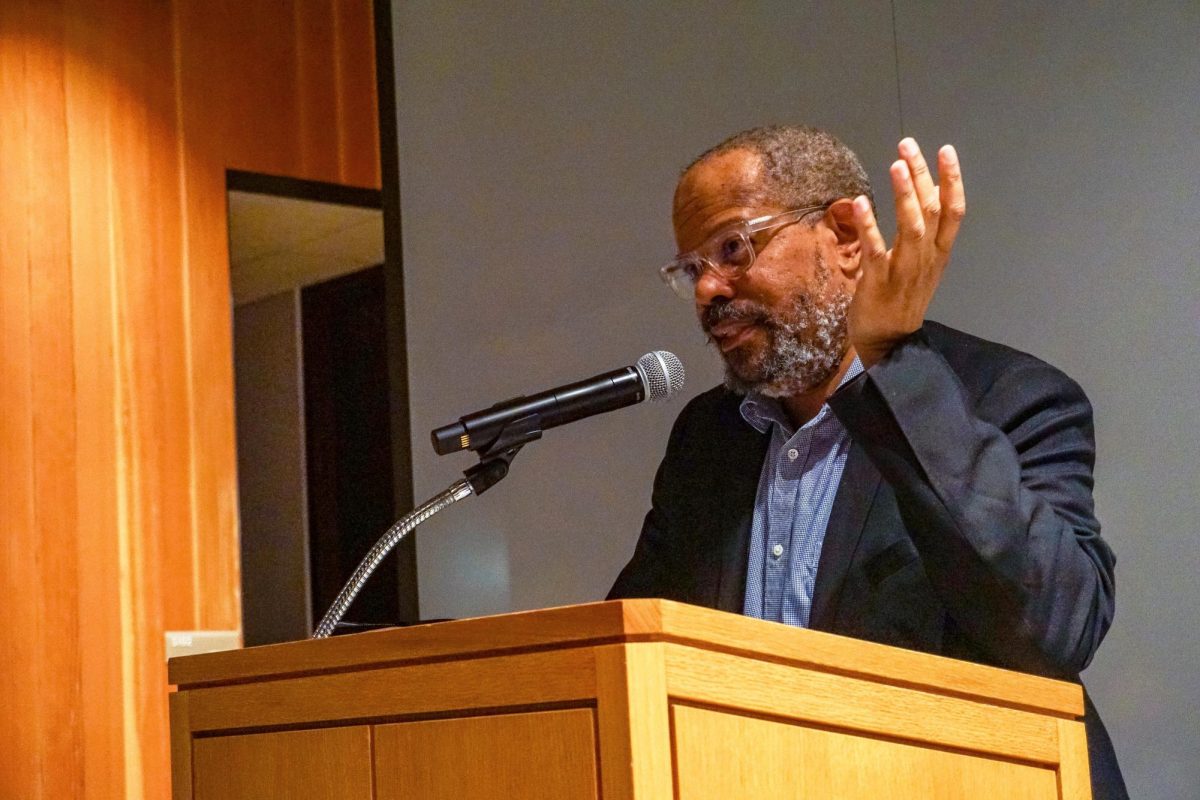
At Tuesday’s talk, Davis said his practice centers on three pillars — identity, power and mythology. He discussed developing his own visual alphabet as a system of symbols that recur across his work.
“My goal is, once I make this alphabet, if you pay attention to my work, these symbols repeat in front of different contexts the same way,” he said.
“This body of work is about grief, dealing with transformation, dealing with things that we don’t like to talk about in society,” he said in the talk. Davis also discussed other works he has completed over the years, which span multiple mediums and explore different themes.
In 2023, Davis created “Pillars of the Valley,” a public monument in St. Louis made of limestone and hourglass shapes, marking a historically Black neighborhood erased by urban renewal in the 1940s. White outlines on the ground show where houses once stood.
“When you step inside of this white outline, you were literally standing where somebody lived,” Davis said.
Another 2023 work, “The Boy in the Bottle,” is a short film about a boy who lives in a bottle with a ghost, kept by a dragon who feeds him pain. Davis said that the film was an exploration of domestic violence and generational trauma.
In 2024, Davis also teamed up with Alarm Sound, a 16-piece chamber orchestra, to create a two-hour sci-fi radio opera titled “Legeia Mare.” It will be released as an eight-episode podcast, with potential for a stage and film release. A 20-minute episode premiered at Carnegie Hall, but the full piece remains unreleased.
According to Woodward, the Artists@Grinnell program was developed approximately 10 to 15 years ago by former director Lesley Wright. The program brings artists to campus for extended periods rather than single-day visits.
“If artists are here for longer, they have the chance to work with students intensely, and the artists also get to develop a work or a series of work that might be pivotal in their career,” Woodward said. “We try to be a catalyst, maybe support for artists at important points in their careers.”
Woodward said partnership is central to the program’s success. “Doing things in partnership is a really important way of working. I think it’s important to Damon’s work and how he thinks about community,” she said. “Damon is also really great at developing relationships with people. In a month’s time, he had made connections with people in the community.”
Davis told students, “Don’t be afraid to mess up, just make stuff. Your artistic voice, your artistic identity, even your own overarching identity may be revealed to you by doing this. This is a practice.”
Davis’ residency continued through the week. Works produced from this residency will join his work from 2019 in the GCMoA’s permanent collection.