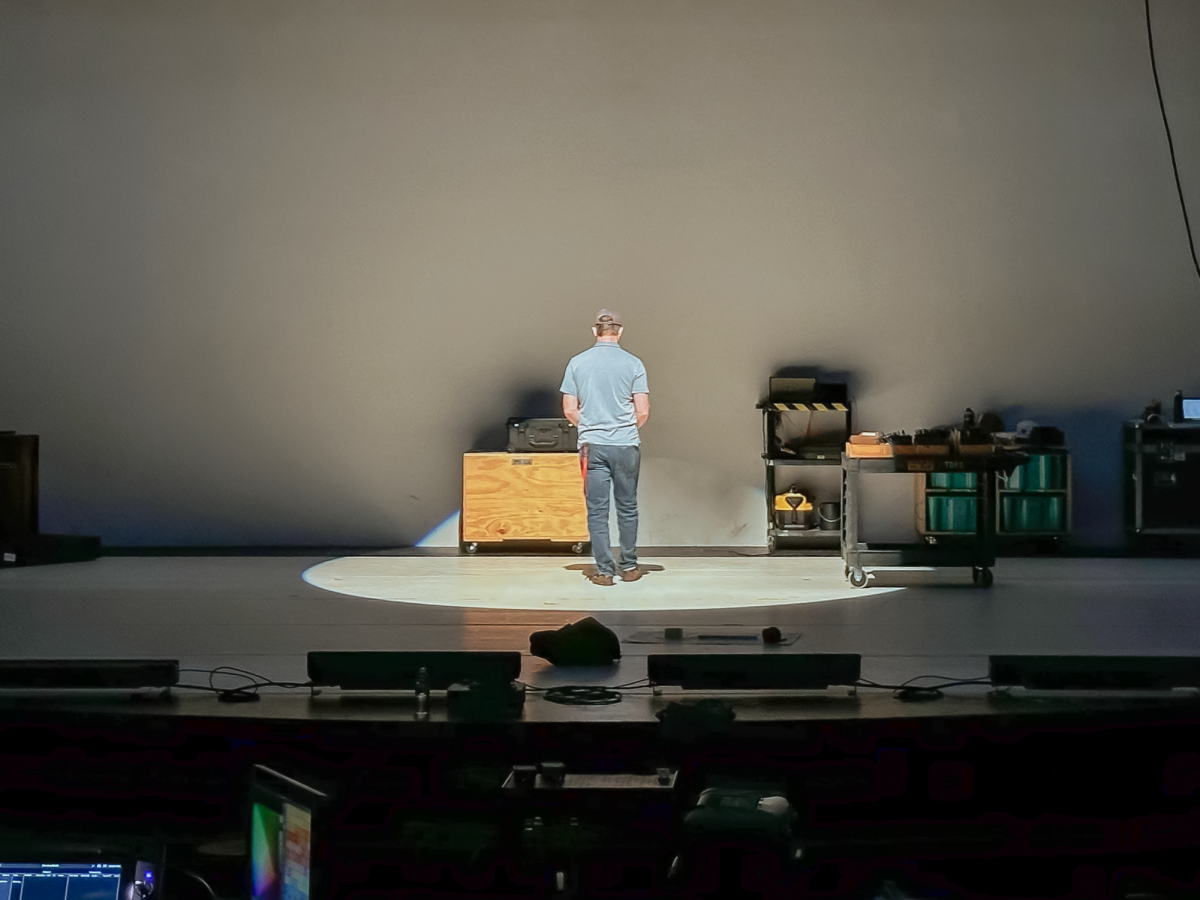
“In ‘Body of the State,’ you have the power,” announced performer Francis Miller to an audience of roughly 20 people, standing on a long white strip of paper laid across the floor as an aisle runner. The 40-minute, no-intervention show took place over two consecutive days, on the evenings of Wednesday, Oct. 15, and Thursday, Oct. 16, in the Grinnell College Bucksbaum Center for the Arts.
Body of the State is “an urgent solo performance piece that explores one person’s pursuit of gender-affirming care, theatricalizing their experience of gender, bureaucracy, community and how it feels to exist in a body that is regulated and legislated by their own government,” according to Miller’s artist portfolio.
In “Body of the State,” the audience is given control over Miller’s performance, through a balloting process that Miller called “one of the most vital parts of the play.” As attendees entered, they received a square cardstock paper with five categories: “MAKE ME CHOOSE,” “MAKE ME MOVE,” “MAKE ME SUFFER,” “MAKE ME SPEAK” and “MAKE ME SING.” Each category offered two options — for example, boy or girl; morning or evening; intake or output; whereas or therefore; stranger or sweet. Audience members were asked to mark their choices on one of the two options in each category for the right to control the flow and outcome of the show.
“The phrase I always used when describing the ballots is that people seem so interested and eager to vote on what trans people get to do with their bodies. So, I just wanted to give audiences a chance for them to control mine in this performance,” Miller said.
The Scarlet & Black attended a version of the show where the first category of the ballot, “MAKE ME CHOOSE,” began with the option “boy” instead of “girl.” Throughout the play, audience members participated by responding to Miller’s cues, where Miller would say “uh,” prompting the audience to collectively shout back “men.” Miller said that this gave the audience a sense of control in the performance.
“I believe the work is always trying to reckon with what it means to be a trans person in the United States, or what it is to be a person whose rights are on the ballot,” they said.
Miller told The S&B about some of the different possible outcomes — for example, in a version that instead began with the option “MAKE ME CHOOSE: girl.”
“A girl has a matching piece,” said Miller. “I asked for a little kissy ‘mauh’ sound.” The “kissy” cue, Miller explained, plays with the contrast between how audiences respond to the “boy” and “girl” versions, shaping both the tone and meaning of the piece. “The meaning of the play is absolutely different, depending on what place they are, what pieces are chosen, but the heart of the play remains the same.”
At the beginning of the performance, Miller took time to personally greet each audience member, shaking their hand firmly and maintaining direct eye contact while saying, “Thank you so much for this opportunity. I’m so grateful.”
Miller ended the performance with the same gesture of gratitude, shaking each audience member’s hand again. This time, however, the gesture held a softer, more emotional warmth, Miller’s tears visible from the intensity of the performance.
“There are some people that I really stood there for what felt like a while, because neither of us are really ready to let go of each other yet,” they said. “I don’t know exactly what we’re communicating, but I always feel I know I’m always sending this message of like, ‘We’re okay, right now. We’re both okay. We’re both alive. We’re both here.’”
In the post-show Q&A, Miller reflected on the purpose behind their moments of gratitude with the audience.
“The gratitude at the end started as an impulse to make the audience feel uncomfortable, yet they actually had the opposite reaction. They wanted to be there, and it became something softer and gentler,” Miller said.
Miller said that fitting with the show’s theme of the nature of transformation, many elements of the play itself have undergone changes — “I started working on it when I was in graduate school, but it has since changed a lot. It’s more than doubled in length, and a lot of the content has changed.”
“There was actually a version where the paper was supposed to be used as a track for ink handprints so you could trace the movement, but it sounded better than it worked in execution because it would last for weeks and wasn’t healthy,” they said in the Q&A. “But the paper stayed and transformed into something else.”
In addition to the personal and political nature of the play, the concept of place also played a key factor in each performance. Miller explained that performing in Chicago offered a unique experience for experimental work, largely because the city’s theater scene is already well established. While general audiences reacted positively, Miller noticed that students, in particular, engaged with the work more enthusiastically.
“Students that I’ve performed for have been a lot hungrier for this kind of work, and like the hunger is just not as intense here in the city unaffiliated with the university or college,” Miller said. “It always feels a little bit more meaningful to be back on a college campus.”