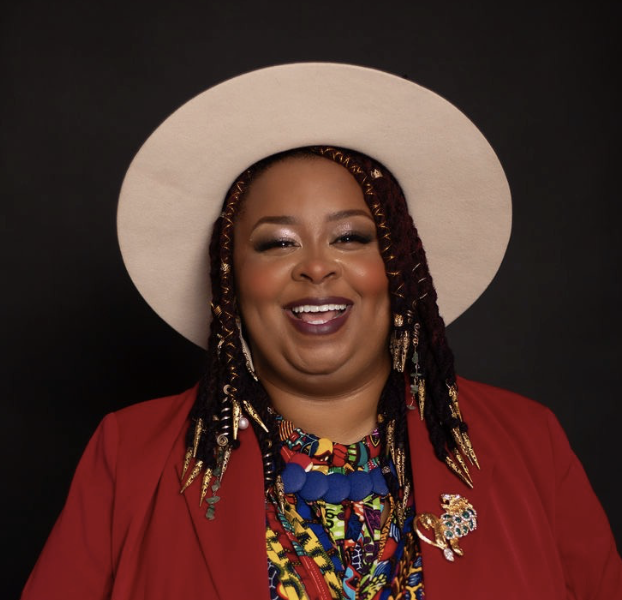
Dr. John Thabiti Willis, inaugural Kesho Scott Endowed Chair in African Diaspora Studies, pushed Grinnell’s community to look beyond familiar narratives regarding the African diaspora by moving from triangles to what he called webs of global connection.
The traditional “triangle” of diaspora studies — Africa, Europe and the Americas connected by the Atlantic slave trade — is incomplete, Willis argued.
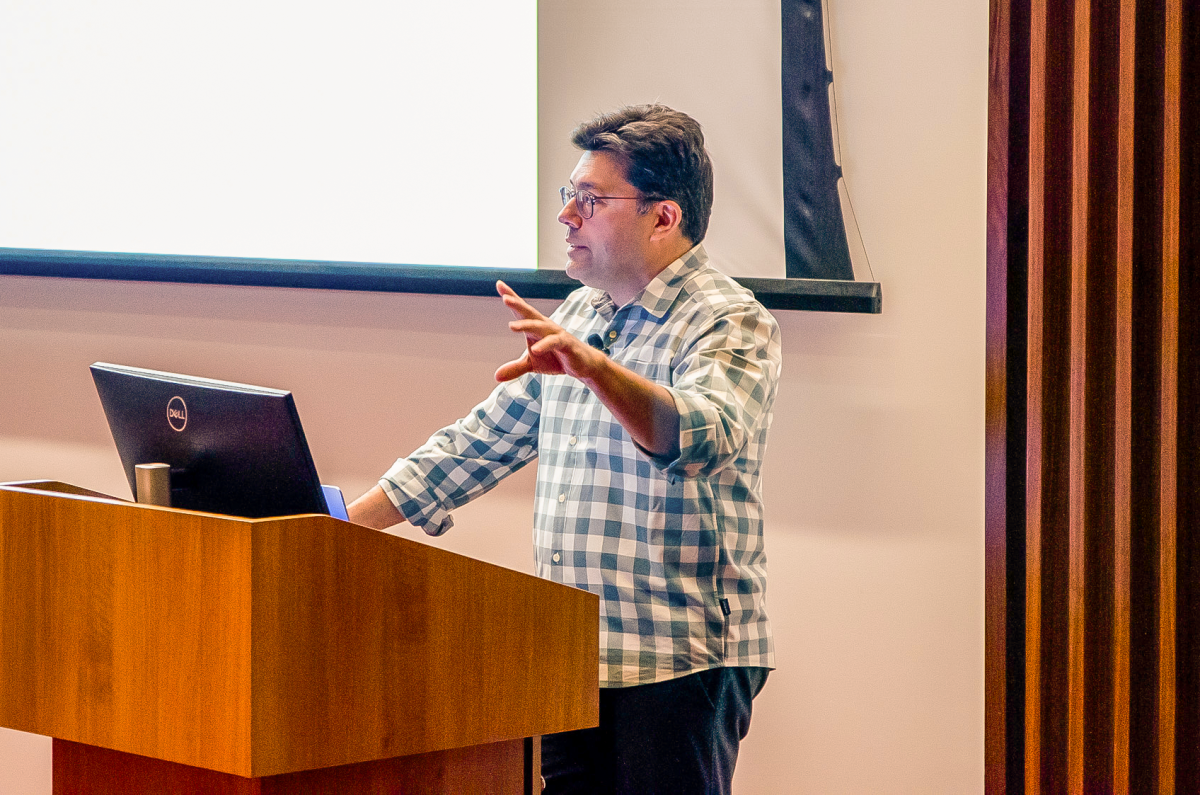
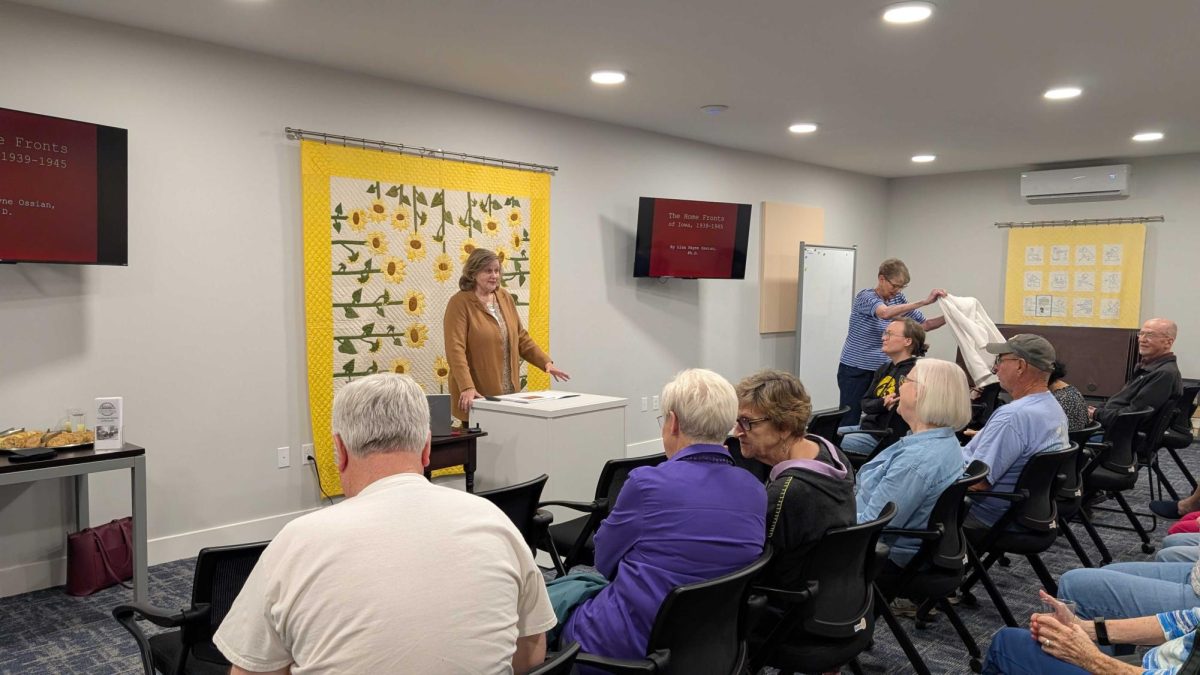
Willis presented “Webs, Not Triangles: Yoruba and Swahili Routes toward African Diaspora Studies at Grinnell” to an audience of around 90 in the Joe Rosenfield `25 Center on Oct. 15. Drawing on his research in Nigeria and the Persian Gulf region, he outlined a vision for Grinnell’s newest academic department that challenges conventional approaches to Black studies.
Willis said that his presentation aimed to connect two distant research projects — one in Nigeria and one in the Persian Gulf — to illustrate why studying the African diaspora requires expanding past conventional Atlantic-focused narratives. He said two key questions have driven his work. The first — how does centering the cultural practices and visions of Africans who crossed the Atlantic transform our understanding of the worlds they built? The second, implicit in his Gulf research — how do we understand the African diaspora beyond the Atlantic entirely?
The first half of Willis’s presentation focused on egungun, ancestral masquerade traditions among Yoruba speakers in southwestern Nigeria. He screened footage from a documentary project filmed between 2004 and 2010 in Ilaro, a town near Lagos.
“Much of the existing scholarship on Yoruba egungun tradition portrays it as a male-centered religious, political order and practice used by men to discipline and restrict women,” Willis said. “Nineteenth-century missionaries were the first to articulate this view.”
Willis shared the history of three figures in late 19th-century Ilaro — a warrior named Arugunmola, “he who became wealth at war,” Osunbola, the warrior’s senior wife and a cloth merchant and Monikewu, a female keeper of an ancestral masquerade.
When Monikewu agreed to marry Arugunmola, she had one condition — he must ensure that her family’s masquerading tradition continued. Osunbola financed and organized the first egungun performance in town. This introduced an elaborate style that displayed about 25 different cloths, a dramatic show of the family’s wealth and status.
“I focus on women’s agency as wives and that cooperation as long-standing, historically constructed and essential to the practice of masquerading,” Willis said. He said Osunbola became the first person to hold the chief title of Iyaloja, representing women merchants on the town council. Osunbola’s descendants still hold the chief title of Iyaloja.

The presentation then shifted continents to Willis’s recent work on pearl diving heritage in Bahrain and the broader Persian/Arabian Gulf region. He said the grueling labor consisted of crews of 20 to 40 people. Divers descended on weighted ropes held by pullers, contorting their bodies in extremely salty water to grab oyster shells from the seafloor.
Willis also discussed fidjeri, a musical genre associated with pearl divers. According to tradition, three friends encountered supernatural jinn performing the music near a mosque. Willis explained that musicologist Dianne Rainey interprets the jinn not as mystical beings, but as “stand-ins for foreign or people of overseas origin — possibly Africa — as the first performers.”
“This interpretation aligns with known mobility of African people, practices and aesthetics across the Indian Ocean region,” Willis said. “Not as a pure local creation, but as a diaspora tradition shaped by centuries of cultural circulation.”
Yet, heritage sites in the Gulf focus almost exclusively on Arab merchants and boat captains, with divers and pullers remaining “ethnically, racially unspecified,” Willis said. Using British manumission records from the 1920s to 1940s, he documents the brutal experiences of enslaved Africans in pearl diving — stories erased from official narratives.
His two projects together demonstrate this incompleteness. African people, practices, and cultural forms moved in multiple directions — across the Atlantic, but also across the Indian Ocean, creating webs of connection that link Nigeria to Brazil and Cuba and East Africa to the Gulf states.
“Pearling dhows sail from the Gulf, continuously stopped at ports along the Swahili coast,” Willis said. “These circuits often carry more than people and goods. They transport sounds, language and performance practices.” This web-like circulation is what Willis said he envisions as the framework for African Diaspora Studies at Grinnell.
Willis’s research projects also demonstrate the interdisciplinary methods that will define the department. Willis uses ethnography and archival research, film, geographic information systems (GIS) mapping and analysis of contemporary media representations. He said that in both Nigeria and the Gulf, themes of performance, culture, power, and gender emerge as central to understanding diaspora.
Willis said that African Diaspora Studies at Grinnell must be extremely interdisciplinary, engaging not just humanities but sciences, medicine, health and technology. He celebrated existing work excavating the histories of Black Grinnellians and expressed interest in exploring how surveillance technologies and social media construct understandings of race and belonging. “The arts must be a critical part,” he added.
One student asked Willis about critical race theory in the curriculum. Willis said that while theory will be woven throughout courses, the department envisions specific courses on intellectual traditions and foundations. He said he is planning workshops to help faculty across campus think about different ways of framing their work.