Each semester, Grinnell’s Neverland Players face the same challenge — transform stories written by local elementary school children into a full-length theatrical performance. The stories arrive wild and unpredictable — a dragon who travels between California and Grinnell, a preppy girl’s hat crisis that escalates across Starbucks and Target, a spy detective archer ninja man who teams up with Greg Heffley from Diary of a Wimpy Kid to fight wasps.
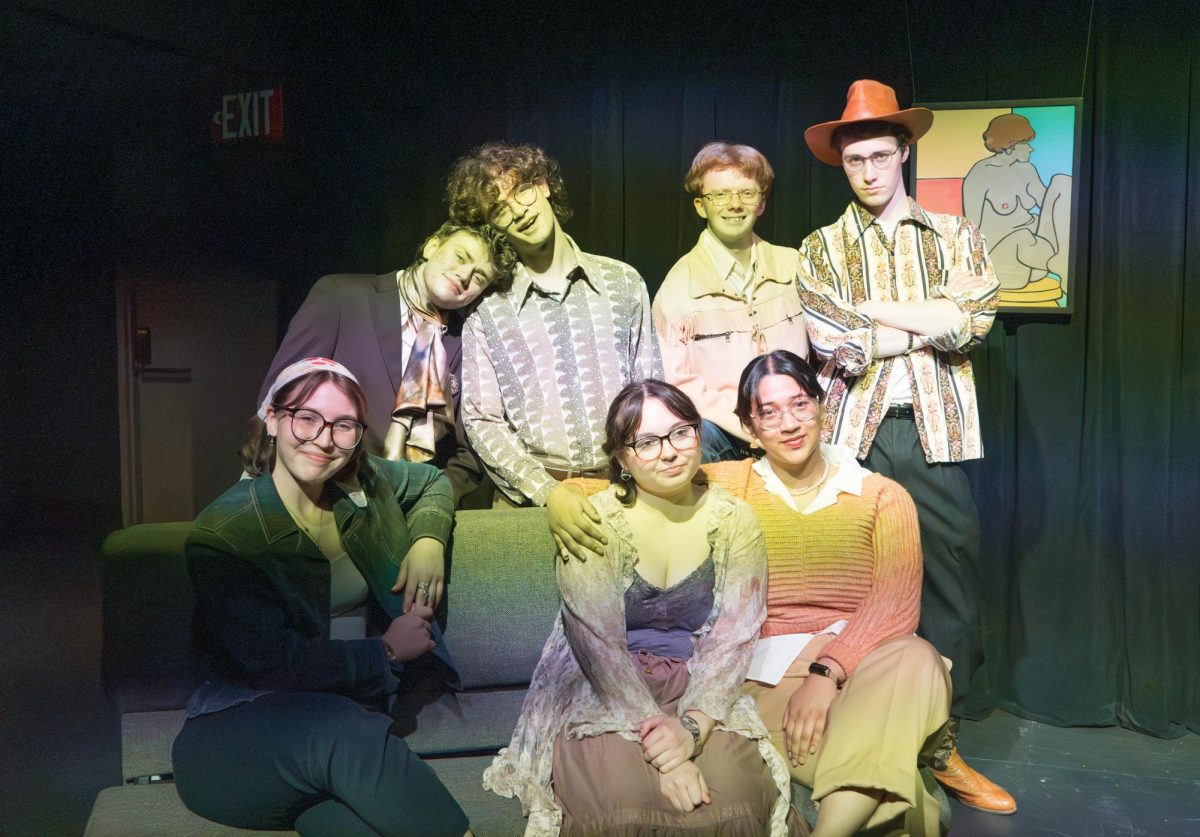
For co-directors Maya Albanese `26 and Jana Vadillo `26, the work is finding coherence without losing the original spirit. “These stories are so silly and out there,” Vadillo said. “We want to bring them to life without making them the butt of the joke.”
The process begins weeks before rehearsals, when Albanese and Vadillo reach out to two after-school programs, Studio 6 at the Grinnell Arts Council and LINK Grinnell at Fairview Elementary. Monica St. Angelo facilitates writing sessions at Studio 6, while Jordan Wiesel leads LINK. The directors email both programs asking to collect stories, sometimes visiting in person to watch kids dictate their tales.
What arrives ranges from traditional hero’s journeys to magnificently weird premises. This semester brought capybara kings riding royal crocodile steeds named Jeffery JimBob, bees so big they sleep outside their hives and a frog-and-toad friendship nearly destroyed by a spontaneous move to Paris.
Consider “A Dragon That is a Friend” by RJ Byers, one of the children who authored a story. In the Neverland adaptation, the dragon and his friend become Grinnell College students who get evicted from their residence hall and try to buy Hotel Grinnell — only to discover they’re short on payment. In the end, they offer basketball lessons to the hotel owner instead of macaroons.
Then, there’s “The Series of Events That Happened When the Dog Spirit Captured the Cat Spirit” by Emil Rodrigues. It begins with the Almighty Cat Spirit being tricked into a portal to the imagination world by the All-Not-So-Mighty Dog Spirit, sparking World War Pet. On the imagination planet, the Cat Spirit receives a hint of escape from a giant — conjuring three gems is the only way to open a portal back home.
One story this semester came with a PowerPoint presentation. “The kids are aware it’s happening now,” Vadillo said of the Neverland productions. “Someone heard Neverland was coming and went home like, ‘Hey Mom, let’s work on this.’ They made slides with images — it was really sweet.”
With stories in hand, the troupe begins a month-long rehearsal process. With stories in hand, rehearsals begin with a week of “chemistry tests,” according to Vadillo. “We see who works well together, what tone people bring,” Vadillo explained. The directors pull up old stories to test different cast combinations, watching how actors play off each other.

For the next two to three weeks, the cast meets three times weekly for two-hour rehearsals, the stories get performed repeatedly until the improvisation solidifies. By opening night, actors know their characters and storylines intimately, even if nothing’s written down.
At each rehearsal’s end, the directors gather everyone for notes that push actors to find coherence in chaos. “We want to pay respect to the original story that the kids wrote and try to bring it to life,” Vadillo said. “We try to strike a balance between embracing the silliness without making it too nonsensical.”
Every Neverland show culminates in an “epic” — a longer musical narrative stitching together multiple stories. It’s written in a single week during tech week, starting with a ritual called “Brunchland.”
“From 11:30 to 1 on Sunday, we meet in the White Room in D-Hall with whiteboard markers,” Albanese said. The directors arrive having selected bigger, more dramatic stories that might combine well. “We combine those all into a Google Doc and share it with all the actors. We take turns reading all the stories together while we eat.”
Then the surgery begins. “You basically write out all the plot points that exist in the story already,” Albanese explained. “Then you start to find moments where they cross over.” They list every character that could be assigned to actors, figure out which narrative threads can weave together, and start assembling a plot.
This semester’s epic combined “The Fight of the Dragon” — featuring a “normal guy” played by Signe Van Wyk `28 who receives an impenetrable marble from a unicorn played by Maggie Morris `26. Van Wyk then battles warring empires and a spirit realm dragon, encountering bears, pandas, and capybara kingdoms along the way. “One of the stories we had was very epic and long, and it had songs in it,” Albanese said. The challenge was finding where these wildly different narratives could intersect.
By Sunday’s end, they’ve also chosen opening and closing songs for the full cast. On Monday, the entire cast gathers to create their tie-dyed shirts as the performers’ signature costumes — “There’s so many things about Neverland that it’s like, I don’t know the origin, but that’s just how it is,” Albanese said. On Tuesday, individual groups write lyrics for character-specific songs. Wednesday and Thursday bring full tech runs with piano, lights and other elements integrated.
“It’s chaotic,” Vadillo admitted, “but everything somehow comes together.”
The directors give actors wide latitude. “That choreography? All them,” Albanese said. “People just go off on their own and think of what they’re gonna do for their scene. They just brought that up, and it was amazing.”
“We don’t have a lot of ‘I want it done this way,’” Vadillo explained. “It’s usually more pointing out ‘if you want this type of effect, you should try this.’ But actors can just ignore us. We have a really solid cast of lots of really good people. If they think it’s better that way, they can have it.”
The philosophy extends to auditions. “It’s not about being a singer,” Vadillo said. “It’s more just to test, are you able to sing in public? Can you put character into it?”
Patric Desir `29, one of this semester’s newcomers, showed up “completely unprepared,” he said, singing “Happy Birthday.” He made the cast. “The point is to be playful,” Vadillo said. “If you don’t put pressure on perfection, people do good work. You gotta trust.”
Certain rituals anchor the chaos. Same baseline set curve every semester. Same props. Minimal costumes beyond tie-dye. The epic, always written the Sunday before tech week. Then there are the meal traditions — Dinnerland, Lunchland, Brunchland — and the mysterious “Bread and Butter,” where the cast eats the nearest thing offered at the dining hall closest to the representation of bread and butter.
“Every single time, it comes together.” For Albanese, in her fourth Neverland, and Vadillo, in her fifth, that consistency creates space for wild experimentation.
Albanese said the theme this year was “Friendship is magic.” Neverland is an effort to create something silly, light-hearted, whimsical. “The importance of whimsy,” she said.
“There’s not a lot that’s just light-hearted and silly and weird,” Vadillo said. “It’s sweet watching stories written by kids that have wholesome happy endings.”
As the cast winds down, the magic isn’t just in watching Greg Heffley meet Dog Man or seeing a capybara king ride his royal crocodile steed. It’s in trusting that chaos and creativity can coexist — that children’s imaginations deserve to be taken seriously, even when they’re wonderfully absurd.