Pressed for print: Inside The S&B’s printing process


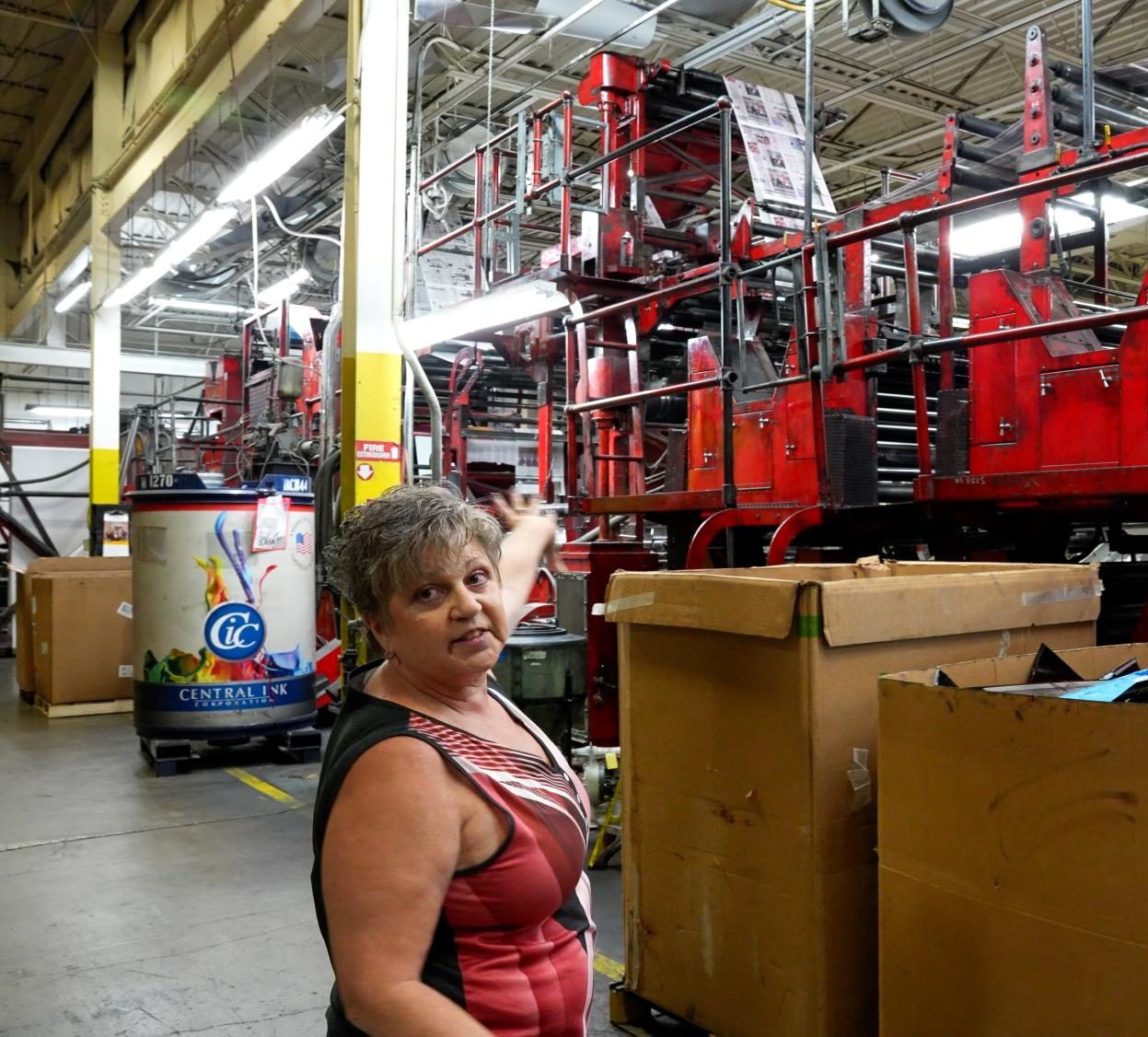
Every Sunday night, 107 miles away from Grinnell College, the Webster City Daily Freeman-Journal (DFJ) is hard at work printing hundreds of copies of The Scarlet & Black. They’ve got a deadline to meet — the paper has to be here by 7 a.m. the next morning.
The DFJ prints over 100 newspapers, weekly shoppers and inserts a month for clients across the state of Iowa, estimates Angie Anderson, 62, production and plant manager of the Daily Freeman-Journal. They also print their own award-winning paper in-house Monday through Friday. This year alone, the paper has won 17 awards from the Iowa Newspaper Association contest.
In addition to running an award-winning newsroom, the DFJ houses one of the few remaining production facilities for newspapers in the state. Anderson, who has worked in the business for 28 years, said she is not fazed by the decline of printed newspapers in recent years. “The print isn’t going anywhere,” she said.
Since 2022, The S&B has been printing the physical edition of the paper at the DFJ. Each Sunday night at the DFJ, The S&B’s print job starts with the prepress process. First, a prepress operator, like Steve Pannkuk of the DFJ, tones any colored photos on the paper if necessary.
Then, for each page of The S&B — which is eight in a typical edition — an image setter lasers The S&B for that week onto aluminum plates. For colored pages, four plates of cyan, magenta, yellow and black ink each are needed. Black and white pages only require one plate. In a typical edition of the paper, the front and back page are the only ones in color.
Prepress operations have become more automated over the years, but many, like Pannkuk and Anderson, remember a time when jobs were done by hand.
“He, years ago, had to strip up negatives together,” Anderson, who also worked as a prepress operator in the past, said of Pankkuk. “And he’s probably one of the best strippers.”
After the plates are ready for production, they are brought over to the web printing press and are then recycled after the DFJ is finished with them. “Everything that we use is recyclable,” Anderson said. “We don’t waste anything.” Even the ink that the DFJ uses is soy-based, she said.
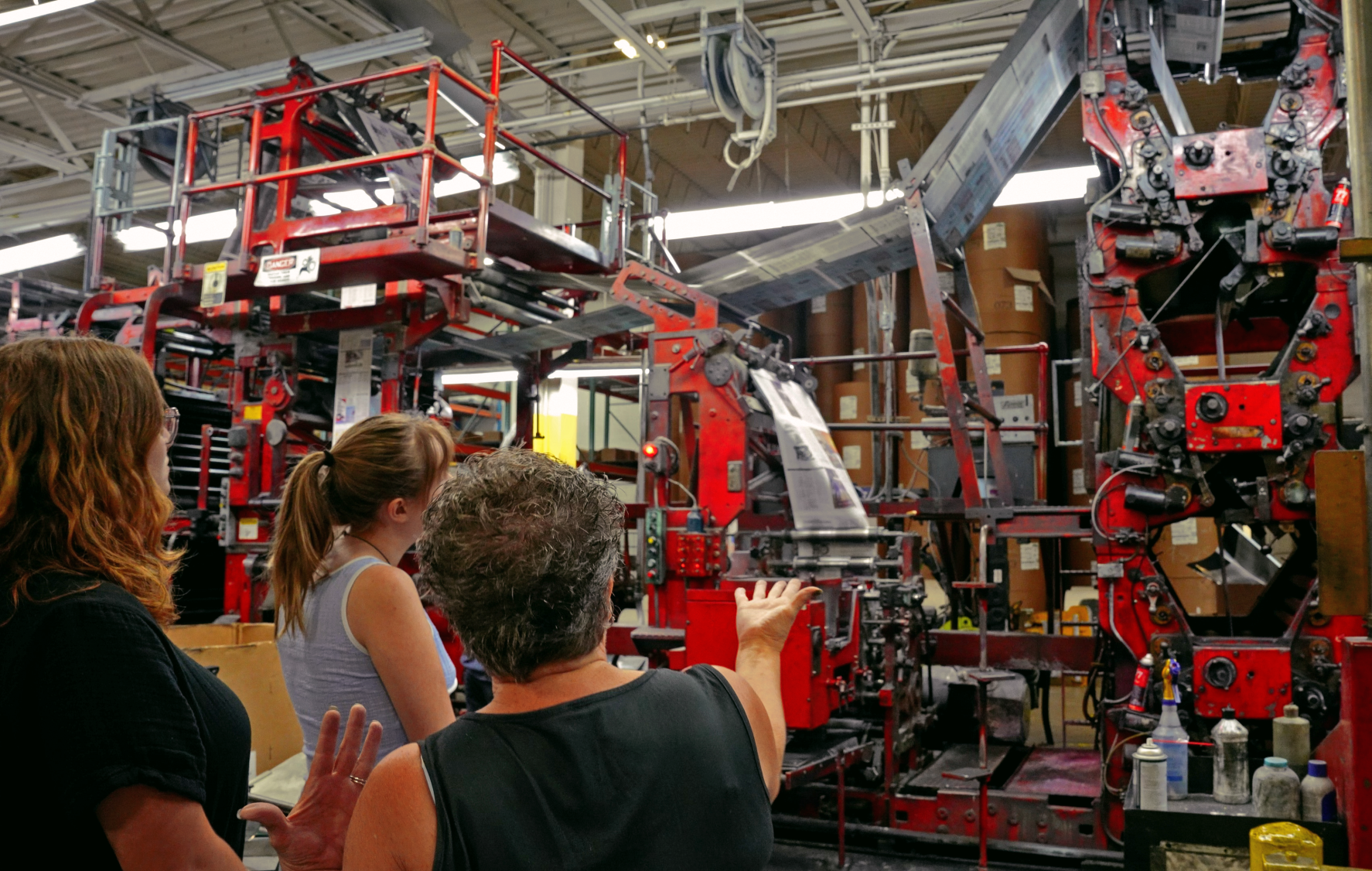
A typical print job of The S&B can be completed from start to finish in approximately 45 minutes to an hour, Anderson said. The web press can print around 6,000 copies per hour normally, but when under a tight deadline, that number can increase.
The S&B usually prints 450 copies to distribute around campus and the wider community — the DFJ has to print much more than that. The first hundred or so print copies tend to have muddy, smeared colors. Pressmen check the quality of papers, ensuring that the colors look good and that no pages are in the wrong order before ramping the speed up on the web press. Dozens of copies fly down the press, collecting at the end of a chute for a flyer, the pressman who bundles the papers, to collect. Then, papers are packaged up for delivery.
On some of their busier days, plant workers are printing copies almost nonstop from 8 a.m. until past 4 a.m.
The final countdown begins at what the DFJ calls drop dead — the time that plant workers need to drop everything and leave to ensure that papers get delivered on time. Drop dead to deliver The S&B is at 5 a.m. The DFJ first delivers the paper to the Marshalltown Times-Republican before it is finally delivered to the Joe Rosenfield `25 Center.