This story incorporates first-person narration.
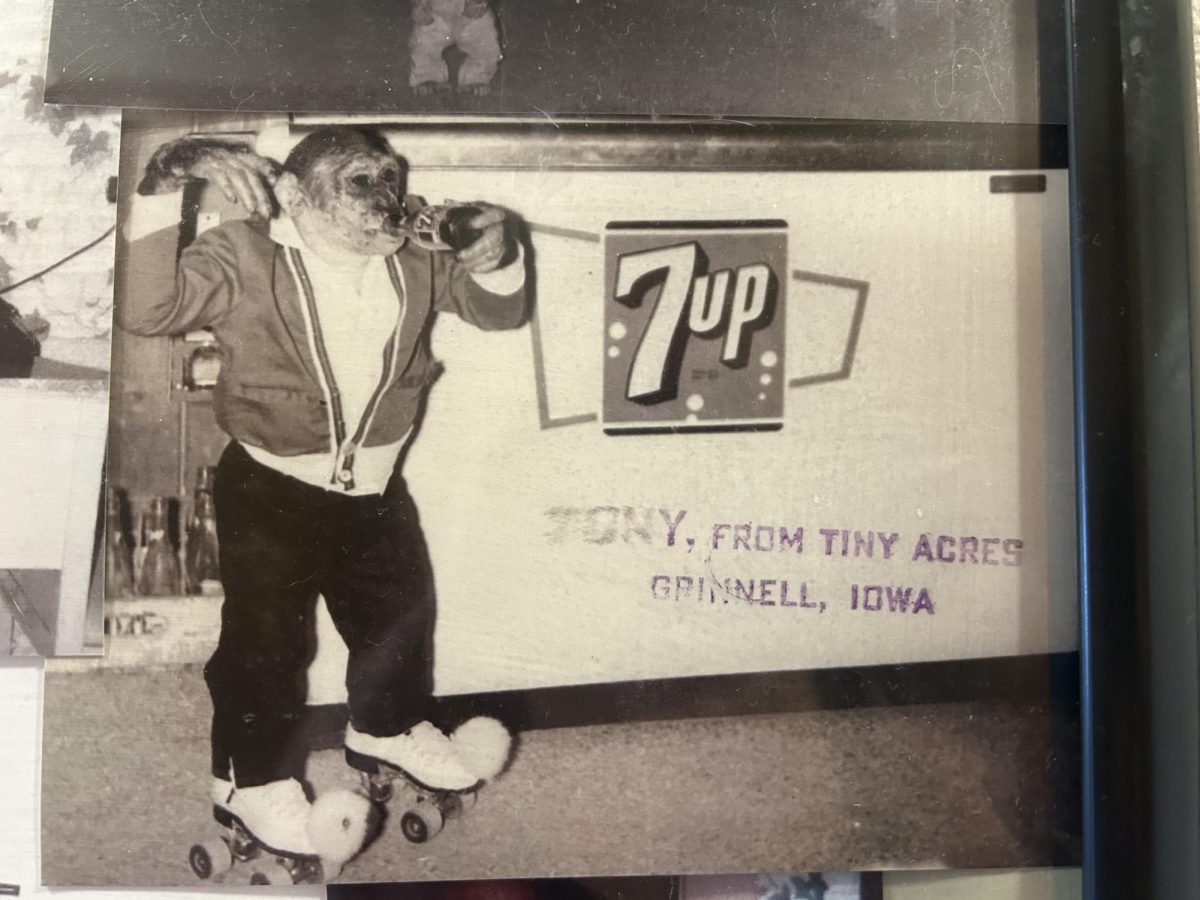
Shipped in a small cage, Tony the Wonder Chimp arrived in Grinnell sometime during the mid-to-late 1950s from Boston, Mass., where he remained as a trained employee and performer of Tiny Acres, a local manufacturing business, until his tragic death. Beloved not only by his handlers, Farrell and Edith Murphy, and Eddie Andersen, but also by the entire Grinnell community, Tony was known and doted upon. Now, Tony is a memory, preserved in media — his signature rollerblades, a cigarette in his mouth, a beer bottle in his hand with his arms stretched in the air.
Displayed just outside the bathrooms of West Side Diner on Sixth Ave. is a framed collage of photographs and clippings of Tony’s time in Grinnell. A clipping titled “The Chimpanzee Story” includes Andersen’s first-hand account of Tony’s story.
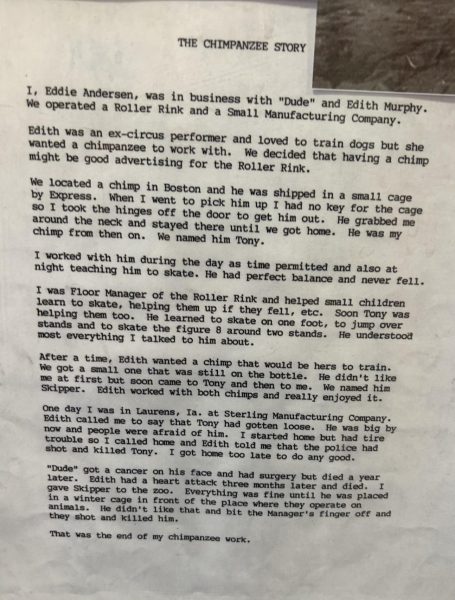
Andersen, alongside the Murphys, owned and operated Tiny Acres, which notably included a roller rink, where Tony spent most of his time. According to Andersen, “Edith was an ex-circus performer and loved to train dogs, but she wanted a chimpanzee to work with.” Collectively, the Murphys and Andersen decided that advertising Tony could draw attention to the rink.
Throughout much of Tony’s press coverage, he notably smoked cigarettes, consumed alcohol and drove go-karts. Tony did not acquire these things on his own — they were given to him and became part of his advertised image.
From an ad published on Nov. 13, 1961 in the Grinnell Herald-Register, Tony was set to appear in the National Skate Queen Contest in Miami, Fla., the weekend of publication. He also later performed in Detroit, Mich. That same month, he was televised in the Hudson Parade that Thanksgiving Day.
One of Andersen’s roles at the rink was floor manager, where he wrote that he helped small children learn how to skate and helped them back onto their feet when they fell. He wrote, “Soon Tony was helping them too. He learned to skate on one foot, to jump over stands, and to skate the figure eight around two stands. He understood most everything I talked to him about.”
Additionally, Anderson wrote that Edith Murphy expressed an interest in having a chimp of her own to train after Tony’s acquisition. They got a small chimp still “on the bottle,” and named him Skipper. He took fondly to Tony, and images in the West Side Diner depict Tony holding Skipper, his arms wrapped around Tony’s neck.
My interest in Tony grew out of a story I co-wrote in spring 2024, following my viewing of “Songs of the Scarlet and Wayback,” a devised production spearheaded by Jennifer Shook, assistant professor of theater, dance and performance studies, with assistance from student performers, writers and researchers from Shook’s fall 2022 and spring 2024 Playwriting and Intro to Performance Studies courses.
I was drawn to the archives, and that is when I found a 2019 blog post authored by Daniel Kaiser, professor emeritus of History, where he wrote about the connections between Grinnell pastoralism and press coverage of a 1967 murder-suicide at Tiny Acres, supported by various Grinnell publication clippings.
On Thursday, Sept. 16, 1965, the Grinnell Herald-Register published a sensational story, “Chimp On Loose Here Is Killed.” According to the news clipping, on Tuesday, Sept. 14, Tony was shot and killed by law enforcement officers after escaping from his cage to “gain freedom.”
Edith Murphy said that once Tony was on the loose, he resisted any attempts to return him to his enclosure and that he clawed at Farrell when he tried to return Tony.
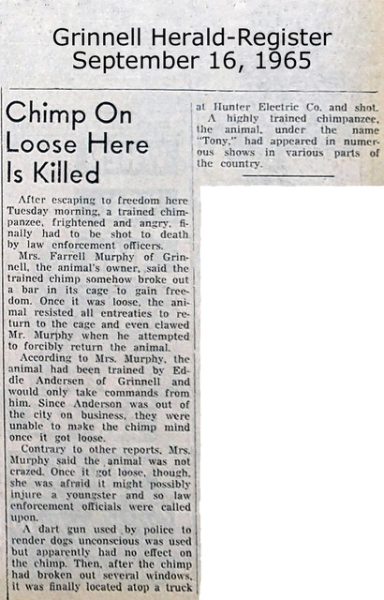
The Grinnell-Herald Register reported that other sources said that Tony was crazed, but that Edith Murphy said, “the animal was not crazed.” She was, however, worried that he could potentially “injure a youngster,” calling police to the scene. Their first attempt at restraining Tony was with a dart gun, but it did not affect him. After breaking down multiple windows, he “was finally located atop a truck at Hunter Electric Co. and shot.”
In Andersen’s report on Tony, he wrote that he was in Laurens, Iowa at Sterling Manufacturing Company the day of Tony’s death. According to Andersen, Edith Murphy called him to inform him that Tony was on the loose. Unfortunately, Andersen had “tire trouble” and did not make it back to Grinnell in time to “do any good.”
After the Murphys passed within three months of each other, Andersen gave Skipper to a zoo. Like Tony, he met an untimely death — Skipper was shot and killed after biting a manager’s finger off. “That was the end of my chimpanzee work,” Andersen wrote.
As I reflect on Tony’s story, I am left pondering a few ethical dilemmas. Was Tony driven to madness because of his treatment? How do we train animals in a socially responsible way? What is the line between human and non-human? How do we learn from Tony’s legacy as we continue to evolve as a species? What does Tony’s impact have to say about rural living?
While the chimpanzees both met an unfortunately tragic end, their impact on Grinnell lives on.