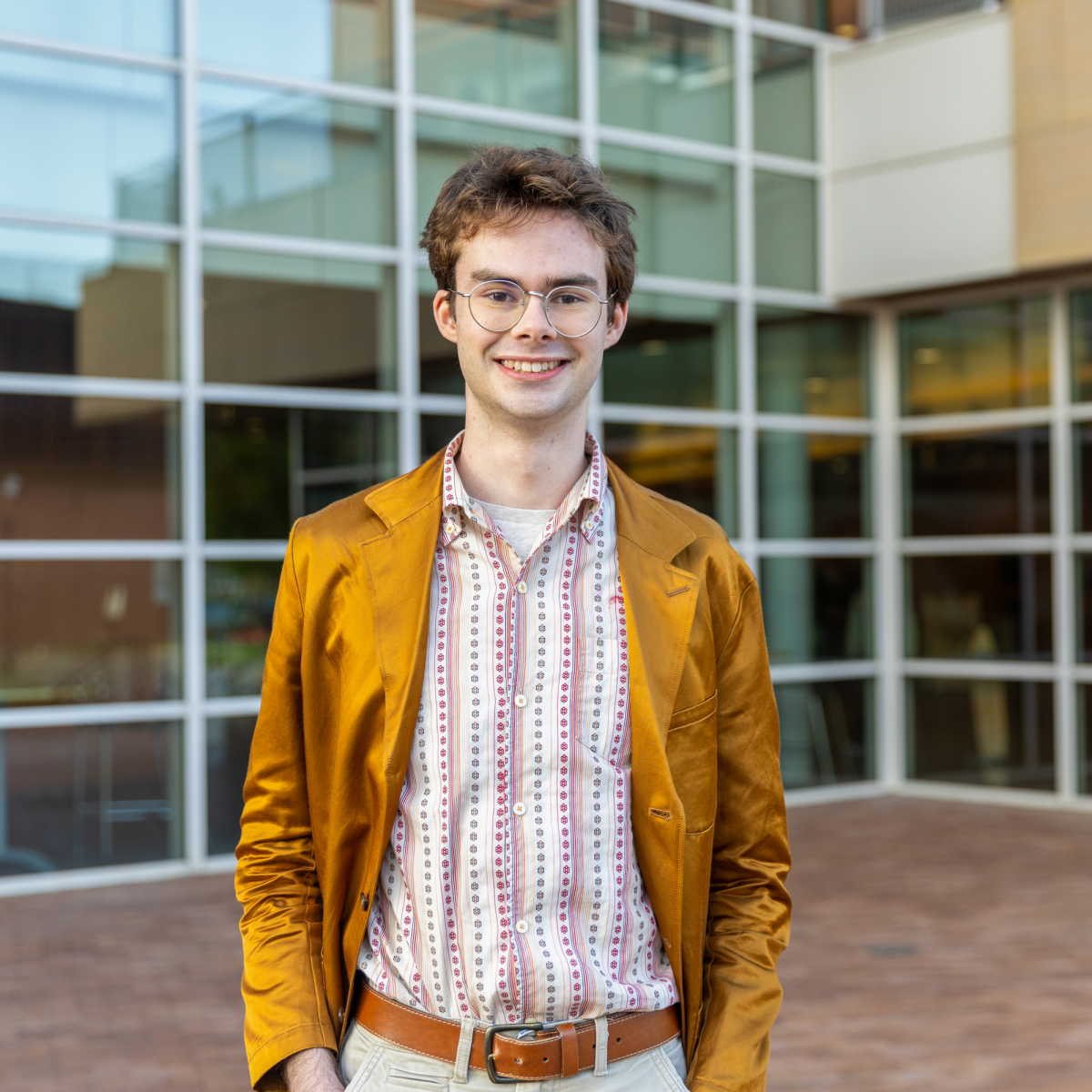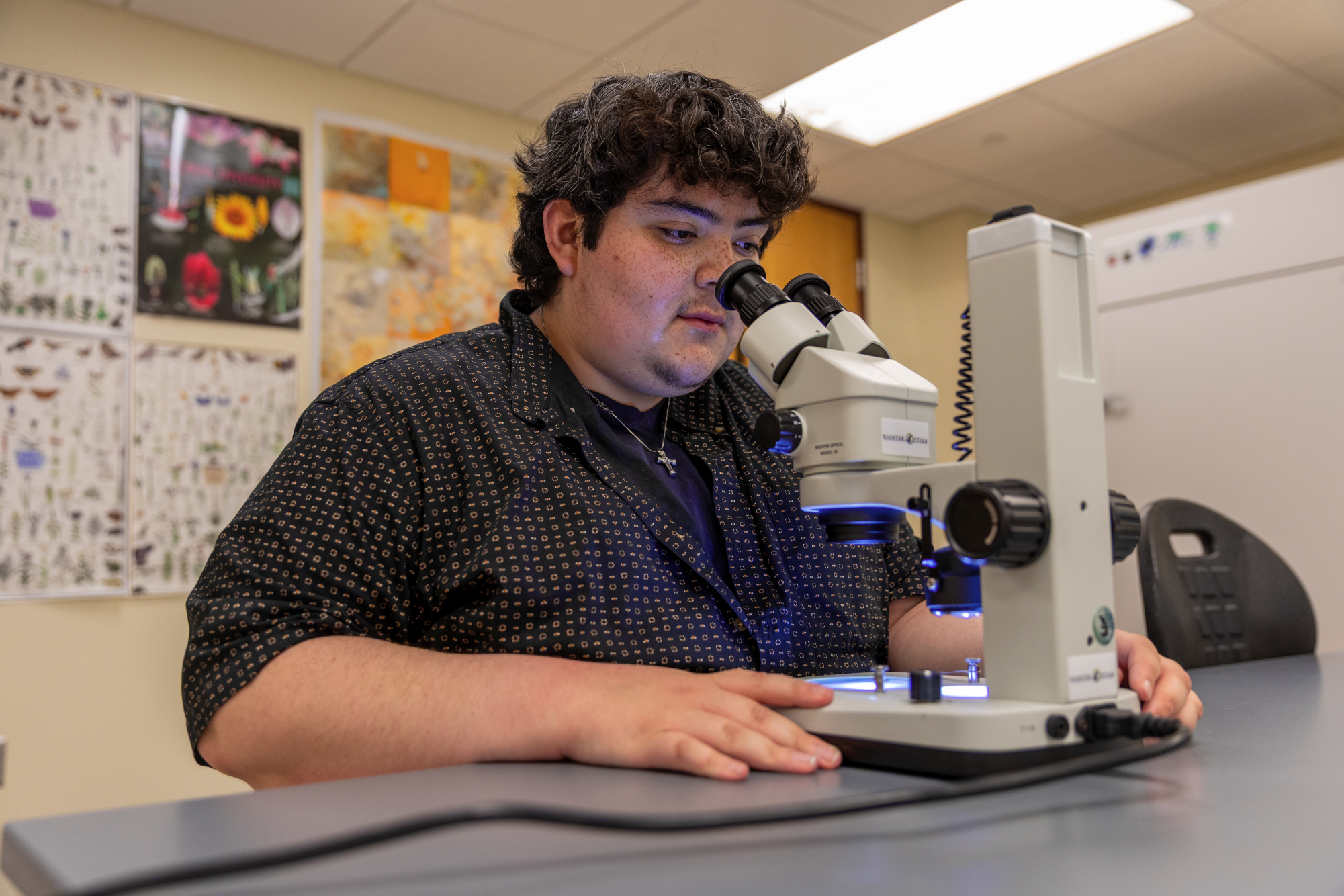
All the way from Texas, Rene Briones `26 found himself at Grinnell College with an interest in biology. The rest of his plan, though, was up in the air. “Freshman year was a tough time,” he said. “I was unsure if I was doing things correctly, if I was making progress.”
Now, as he prepares to graduate and begin a neuroscience Ph.D. program at the University of Iowa, Briones describes himself differently — outgoing, confident and laid back.
“I was stressing over everything. Every grade, every assignment,” he says. “It was not good. I was burning out quickly.”
Over time Briones changed his perspective. Instead of trying to chase perfection, he focused on progress and growth as a student. “I learned to just go with it. Like, ‘Oh, I got this grade, it’s not the end of the world.’ You fix what you got wrong and move on.”
Briones came to Grinnell intending to major in biology as “it was the class I hated the least in high school,” he joked, but his initial interest widened immediately throughout his four years.
Through research and mentorship, he said he discovered a passion for neuroscience, particularly at the molecular and cellular level.
“There’s still so much we don’t know about the brain,” he says. “I love learning about neural connections and how those processes actually work.”
As a researcher, Briones studied neuron activity at the neuromuscular junction using fluorescence techniques to track calcium signaling. He said that while that project didn’t yield the expected results, it led him to consider another study’s findings more closely.
“It didn’t show what we thought it would,” he said, “but it supported another study’s findings. That was still meaningful.”
Beyond the lab, Briones has played a key role in the classroom. He served as both a Science Community Leader (SCL) and a teaching assistant, working closely with students in biology and neuroscience courses.
“I really like teaching,” he says. “Seeing students go from the beginning of the course to the end, you can tell how much progress they’ve made.”
Briones said that experience helped shape his future goals. While he’s open to working in the private sector, Briones said he hopes to eventually become a professor, combining research with teaching.
A major influence in that journey has been mentorship, particularly from Professor Clark Lindgren, who served as Briones’s advisor, research mentor and as Briones describes him, “foundation” at Grinnell.
“I was figuring everything out on my own,” he said. Lindgren not only supported him academically but also encouraged him to pursue opportunities he hadn’t considered, including graduate school.
“I didn’t think I’d be able to do it,” Briones admits. “I just wanted to be done.” But Lindgren pushed him to apply anyway, and he was accepted.
Outside of academics, Briones said his college experience has been defined by community, especially within his own identity.
As a member of both the Student Organization of Latinxs and QuestBridge, he said he’s found spaces that celebrate identity and build belonging.
Through his work with Student Health and Wellness, he’s also connected with students across campus, often literally, as a driver for the campus shuttle.
“I get to meet people I wouldn’t normally run into,” he says. “They’re kind of stuck in the van with me, so we talk.”
Even with the hustle and bustle of his busy academic life, Briones said he finds ways to unwind. He plays piano, which is something he only had the chance to formally learn in college, and attends live music performances on campus. “Live music just has a different energy,” he said. “You can feel it.”
Having completed most of his major requirements early, Briones is taking classes for enjoyment, like an anthropology course on walking and running. He said he’s also spending more time with friends by going to events like Pub Quiz.
“I’ve just been having fun,” he says.
Briones said that he would tell his high school self one thing, which is that “it’s not that serious.”
“You’re here to live your life the way you want to,” he said. “You don’t have to stress constantly about the future.”
Looking ahead, Briones said he hopes to continue exploring the unknown of the future, whether in a lab, a lecture hall or somewhere entirely unanticipated.