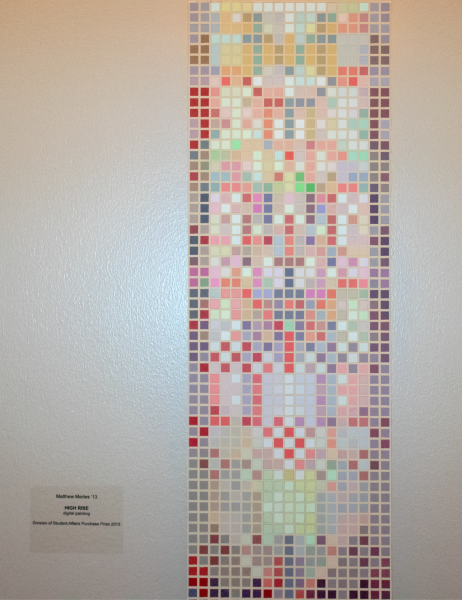
The Bachelor of Arts Exhibition (BAX) Student Government Purchase Prize has been canceled after 17 years.
The award, organized by Student Affairs in partnership with the Student Government Association (SGA), was created in 2008. In its most recent iteration, the winner received $400. The prize was last awarded in the spring of 2024.
The cancellation, students and administrators said, stemmed from a combination of storage constraints, shifting priorities and unclear procedures for selecting winners. With no list of candidates compiled last spring, the award was halted and has not been reinstated, leaving the longstanding program effectively discontinued.

Students said they learned this while organizing the upcoming exhibition.
As the Studio Art Student Educational Policy Committee (SEPC) planned this year’s Bachelor of Arts Exhibition, Alina Ihnatesku `26 said they realized there had been no SGA Purchase Prize since last semester. The SEPC then emailed SGA about it.
The response, said Ihnatesku, was that the prize was permanently canceled.
“I know $400 is not that much money, and I feel like SGA could totally afford it, but for art students, it’s a source of financial and professional support,” said Ihnatesku. “There are a lot of negative consequences that come with this cancellation.”
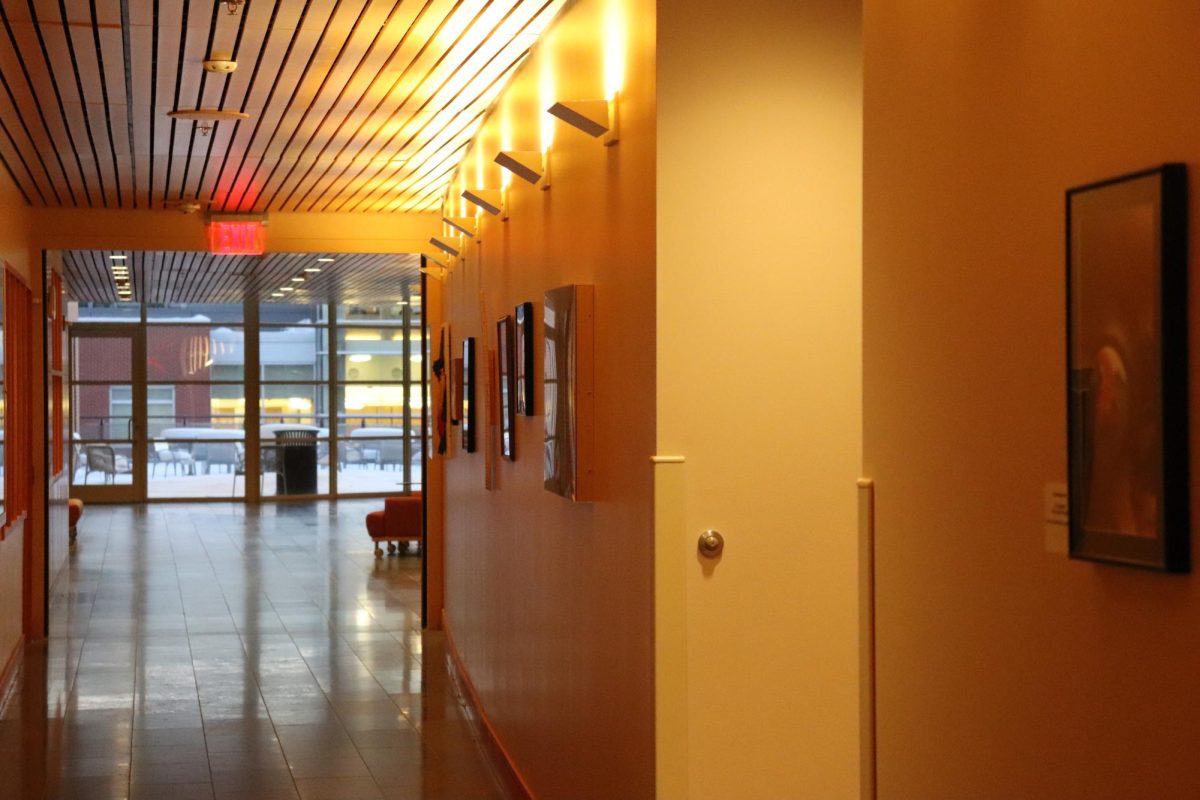
According to the email sent by SGA to the SEPC, the prize was originally established to help fill the Joe Rosenfield `25 Center (JRC) with student art, and SGA now considers that goal fulfilled.
“I just believe that student artists need to have as much support as possible,” said Ihnatesku. “I feel like that’s something that our college, our faculty and even the community should invest in, like those younger people who are trying to get into the art field and make something of themselves. This just feels like a complete dismissal of all of that.”
In an email to The S&B, SGA communications coordinator Brisha Jain `28 wrote, “Unfortunately, we don’t have enough accurate information or documentation about how and why this decision was made, since it predates the 2025-26 SGA Cabinet and Senate.”
SGA President Keanu Yamanaka `26 declined to comment.
SGA’s role in the decision
Former SGA President Kyla Miller `25 said last spring’s cancellation came as a surprise to her as well. She wrote to The S&B that she had been scheduled to select the winner alongside a Student Affairs staff member, only to be told the process was being halted.
According to Miller, the decision to cancel the prize came from Student Affairs, not from the Student Government Association’s cabinet.
“They said that they had to get permission to purchase the art by the student they wanted to award it to, because many students liked to keep their art,” Miller said. “In years prior, they claimed that they had to go through multiple students because of that. Another issue they posed was that it defeated the purpose of the award being a surprise, so they cancelled it completely.”
The Studio Art SEPC expressed their frustration over the decision.
“We have a lot of talk about self-gov here on campus, but at the same time, I do realize that it’s mostly the admin that decides, and I wouldn’t blame other students,” said Ihnatesku.
Maure Smith-Benanti, assistant vice president of Student Affairs and Dean of Inclusive Initiatives, said the purchase prize has always been funded by Student Affairs. It has never come from the student activity fee, which is SGA’s budget.
What was behind the cancellation?
Smith-Benanti said multiple factors went into the decision, one being the lack of space.
First, Smith-Benanti said art could only be hung in areas that were not personalized spaces. For example, she said, although there are empty walls inside and outside student offices on the second floor of the JRC, these spaces cannot have art hung on them because of College policies.
Secondly, she said, the original idea of the prize was to have space in storage for the art to rotate.
“The problem is, even the Museum does not have enough storage for their own pieces, and it has to be archival or art-safe storage,” Smith-Benanti said, referring to the Grinnell College Museum of Art. “And so since they don’t have enough, it’s unlikely that we would also get any space in their storage facility area.”
Andrew Kaufman, chair and professor of the studio art department, said the department was not involved in the planning of the prize. He said he was unaware of the cancellation until he was informed by The S&B.
“I do think it’s great to support the arts, and I also understand that missions have ending times as well,” Kaufman said. “If your mission is to populate the JRC with art, and you’ve done that, I understand.”
Another issue, Smith-Benanti said, was that after the COVID-19 pandemic, students began putting prices on their pieces, many of which went above $400.
“We really don’t want this to feel offensive because the award is what it is, it’s $400, and when a painting is priced at $1,000 that doesn’t necessarily feel like it’s honoring their work,” she said.
Kaufman echoed this, saying that one hardship that came with the prize’s design is that $400 is not a lot of money. He said students can spend more than 30 hours on a piece for the exhibition and many times, the students spend their own money to craft the art.
Kaufman added that the budget for 300-level courses, where most BAX works are produced, remains small, because the art department has not seen an increase in funding for supplies in the past decade.
Smith-Benanti said that after the pricing concerns arose, an agreement was formed and stipulated that either the Studio Art Department or SEPC would curate a list of artists interested in being considered for the award.
Ihnatesku, however, said the SEPC was not aware of the responsibility to curate the list.
“I don’t know what happened on their end, but what I do know is that there were no eligible candidates, as in, nobody put their names on the list to receive the prize,” Smith-Benanti said. “Or whoever was tasked with getting that list didn’t check in, and so there was no list of people to give the award to.”
Because the list was never compiled last spring, Smith-Benanti said, the prize was called off last-minute. Kaufman said he would encourage SGA to come up with other ways to support student artists.
“Being a student artist is hard. We don’t have the pots of money, or even the ability to get that type of money inside the U.S.,” he said.
Maure Smith-Benanti is the supervisor of The S&B. Smith-Benanti is not involved in the writing or editing of any articles of The S&B.
This article has been updated to clarify that the BAX Student Government Purchase Prize was organized by Student Affairs in partnership with the Student Government Association. Updated on 12/8/2025.