QPOC takes a byte out of the future in fall 2025 drag show


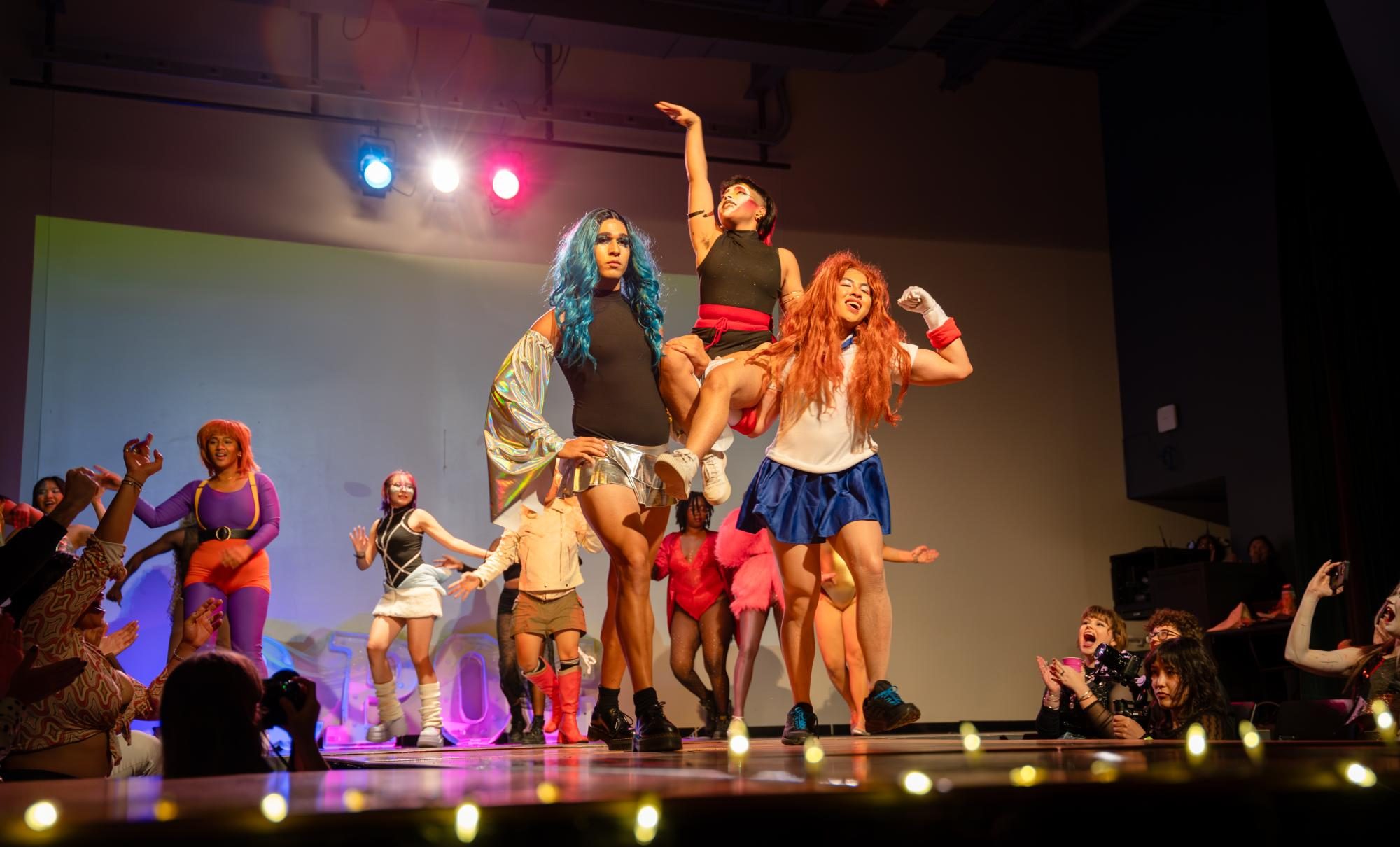
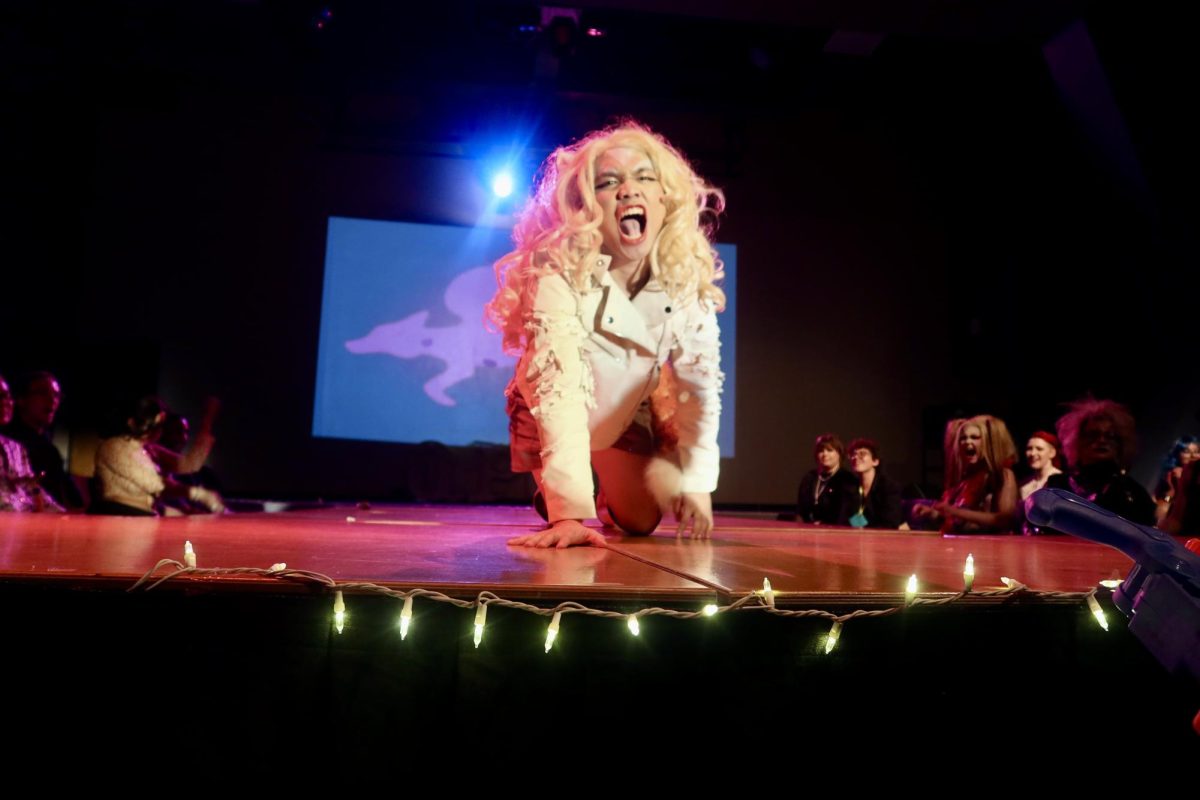
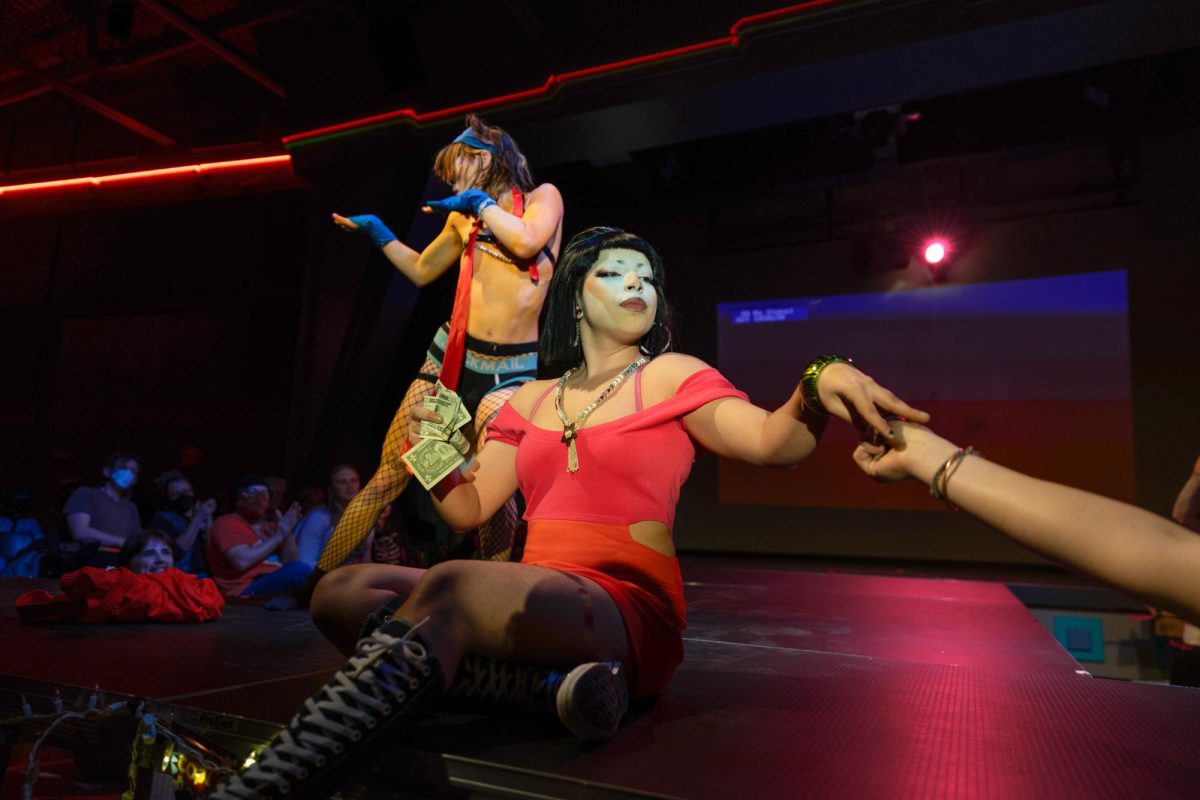
Intergalactic forces collided to transform Grinnell into Metropolips, a simulation of reality, for one night, and one night only. Grinnell College’s Drag Show, organized by the Queer People of Color organization (QPOC), blended Dr. Makeba Lavan’s tutorial class Afrofuturisms, Janelle Monáe’s “Dirty Computer,” and urban dystopian 1927 film “Metropolis” to provide hope amidst current anxieties.
From exploding fans to feathers galore, performers broke free from the boundaries of Earth on Nov. 14 to imagine a humanity beyond capitalism and generative Artificial Intelligence (AI).
Dayana Garcia `26, QPOC president, said that curating the show and deciding on a theme entailed imagining a future with hope, particularly in a dreadful moment with the rise in AI, and rapidly increasing insecurity for incoming adults thinking about the state of the world. “I think that’s the beauty of it, is that we’re all just so miserably stuck in the present. But it’s awesome to be able to think creatively about what’s ahead, particularly when we’re submerged in AI,” Garcia said.
“A lot of people don’t get to see the work that goes into QPOC outside of drag, and I think putting on this amazing show just shows how passionate Grinnellians are about their art outside of being a student,” they said.
From Garcia’s first year performing in the drag show to now serving as QPOC president, she said she has seen so much change in drag, from organizational changes to cultivating a community of care. “It’s like a gateway drug into the queer community in Grinnell,” Garcia said.
Kenya Taylor `28, also known as Ms. Morale, has taken on a new role this semester as QPOC events coordinator. He also choreographed the traditional QPOC intro dance set, featuring multiple members of the organization, to a mashup between Beyoncé’s “Move” and Daft Punk’s “Harder, Better, Faster, Stronger.” Taylor said that he took inspiration from Kendrick Lamar’s alias, Mr. Morale, for his drag name. For him, R&B and house music represent futurism.
As a self-proclaimed R&B drag queen, Taylor chose Toni Braxton’s “He Wasn’t Man Enough” as the soundtrack for his futuristic break up storyline, in which his “cyborg man” cheated on him, ending in not only a divorce of the relationship, but a divorce from the manhood his partner was supposed to embody.
“I love to vogue. I’ve been doing it since my junior year of high school, and I’ve been in the ballroom scene in New York City, where I’m from. I’m trying to bring that attitude onto the stage and bring that ballroom attitude to Iowa,” Taylor said. “There’s not a lot of Black performers here, and doing something that’s really authentically Black is something I really care about.”
Kimmy Vergara `26, also known as Fox McCunt, Jack Ellwein `28, also known as Wolf O’Diva, and Mariposa Condron `27, also known as Fagco, performed a trio act to Ariana Grande’s “Break Free,” inspired by the video game franchise, Star Fox, which follows a combat crew of anthropomorphic animals led by McCloud, traveling through space.
“I’m very bisexual, and we feel like the characters that we’ve chosen have that kind of flair of flamboyant energy that we really wanted to capture for this performance,” said Vergara.
“All of our characters are animals, so that’s kind of a gender neutral baseline already,” Condron said. “I feel like people are more focused on the fact that I have blue wings than whatever the gender presentation is.”
Vergara said their piece imagines new frontiers for humanity beyond Earth. “You don’t have to accept the reality that you are living in now, you can envision a better world, and you can envision getting over your fears, getting over your demons,” they said. “Whatever is alien out there might be very human to you.”
While Ellwein said this show is not explicitly political in nature, Vergara said, “Imagining futures is a very like political thing, especially for a lot of us who are suppressed, who are told that we cannot keep living the way. Getting to have that right to show ourselves on stage as something from another time kind of gives us that power back.”
Ellwein, also known as Glitch Smith, also performed a solo to “Raspy” by Jojo Siwa, following their spring performance to Siwa’s “Karma.” They said that in the song, Siwa becomes self-aware, which made Ellwein think about AI becoming self-aware, and Glitch Smith as an embodiment of breaking down, or becoming raspy.
Ellwein said that their metallic, sparkly costume took direct inspiration from Siwa, who they named the queen of glitter. “I feel like I really shine onstage. It’s a really great opportunity to be able to do this,” they said. Outside of performing and involvement through QPOC, they lead Queer Athletes and Allies and Bi-Focal, Grinnell’s affinity organization for bisexual and pansexual identified students.
“A lot of [the acts], they’re showing the danger behind Gen AI and the delusions that it can put you in, like AI dating, or just relying on AI too heavily,” they said. “Then when it does glitch out or become self aware, as my performance mentions, it can create problems in a way.”
“There are so many uses to AI, and so many ways that AI could make the world better, arguably, but the way it affects artists is so harmful, and it’s important to remember that, and to resist it how we can,” Condron said.
Noelle Buehrer `26, also known as HoneyLavender3000, has adopted a new honorific to their ice-cream flavor inspired drag name each time they have performed, this show being their third time onstage.
They said that their first time experiencing drag was during their first semester at the college, while attending the fall 2022 QPOC drag show. “Seeing non-binary people, trans people, people of color, plus size people, just all of this diversity in what drag is, and the mainstream is just not doing a good enough job of communicating that,” Buehrer said. “To see that represented at the college that chose me is so impactful.”
Buehrer embodied a sex robot frustrated by mistreatment and feeling used. They said their performance was a commentary on people’s reliance on generative AI, drawing inspiration from a presentation they saw from a sociology class taught by Dr. Karla Erickson, which examined in part sex robots and their relationship to selfhood, community and human behavior.
Marie Reyes-Alvarez `26, also known as Minx, said that their duet with Angel Arroyo-Bedolla is an exploration of a reclaimed Latin America.
Reyes-Alvarez said that her Colombian heritage, particularly the roots of the Muisca civilization, informed some of her artistic choices. Alongside Arroyo-Bedolla, who is Mexican, they explored a re-indigenization of their cultures. “A lot of what we have left behind from pre-Columbian Colombia civilization is very fine, detailed gold work. I get very inspired by animals, nature and ritual,” she said.
Their duet was set to Depeche Mode’s “I Feel You,” a longtime favorite of Reyes-Alvarez, to symbolize their dream for Latin America and their personal journey. The pair also devised a short film projected behind their performance, featuring the motif of the sun in contrast to their vampire romance.
“It’s wish fulfillment that I can be a queer person performing in a hostile country to queer people, a hostile town to queer people, almost, and do the song I have been waiting to do my whole life in a queer romance on stage,” Reyes-Alvarez said.
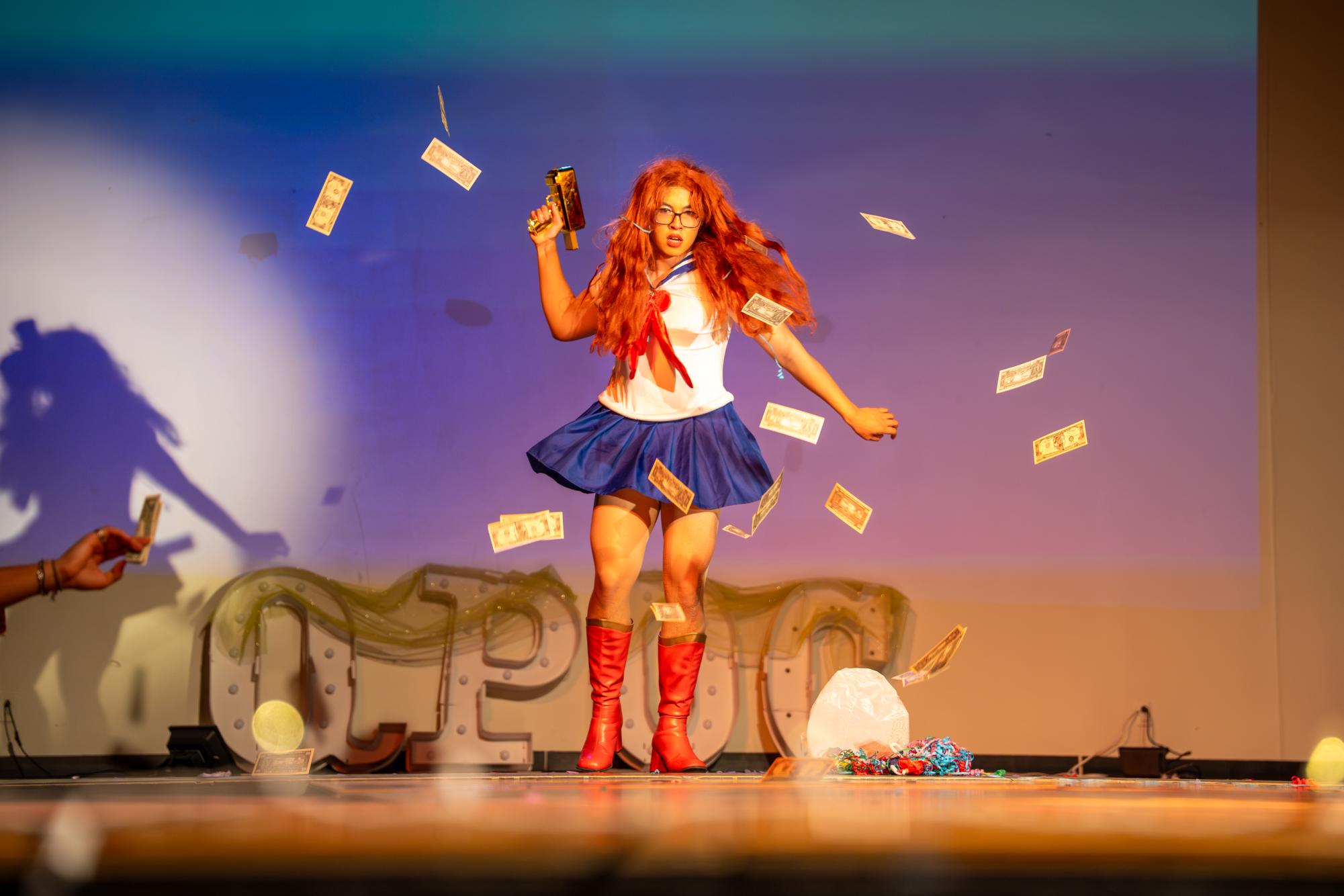
Hridi Ghosh `28, also known as Sir Cummingtonite — a geology pun — brought comedy to drag, performing as a superhero fighting a t-rex to the Just Dance 4 version of Rick Astley’s “Never Gonna Give You Up.” Ghosh said that she and Olivia Brown `28, QPOC cabinet member, took Lavan’s Afrofuturisms tutorial together, where they explored Monáe’s influence, citing her song “Take a Byte” as the direct inspiration for Metropolips.
Ghosh said that Monáe is a pioneer in queer afrofuturism, and that “Dirty Computer” contains themes of weirdness, bisexuality, pansexuality, polyamory and trans-inclusivity in a way that resonated with QPOC and the show.
“In the song, “Pynk,” for example, most of the dancers wear this pair of labia pants, or vagina pants, but not all dancers wear those pants because they want to make this statement that not all women have vaginas,” she said.
Bethany Haas `27, also known as Jane Boston, centered media degradation and disability justice in their gender-defying duet with Vonnie Gutz by exploring the concept of AI cannibalism. “There’s a feedback loop of how [AI] just continues to consume itself in the media that it creates, which is already messed up, and then it creates even worse media, hence AI cannibalism,” Haas said.
Haas said that AI is not only harmful to the environment, but its systems too are in the process of degradation. “My biggest thing is sustainability with my clothing and not just buying something cheap that I’m only gonna wear once. I’ve been trying to source my fabrics and do something that fits my body, and also make sure that I’m comfortable in it,” said Haas. “Accessibility is making my clothes accessible to me.”
In pursuit of making drag accessible, Haas incorporated captions into the act following suggestions from filmmakers versed in disability representation at Grinnell’s second annual Superfest in the Midwest, from Nov. 8 to 9.
All funds raised by the performance will be donated to the Iowa Trans Mutual Aid Fund (TMAF).
Natalie Ng `27, Arts & Culture Editor of The S&B, performed in the drag show. Ng was not involved in the writing and editing of this article or any drag coverage.